Jonathan Anderson’s first Dior haute couture outing for Spring–Summer 2026 landed in Paris like a very serious fashion thesis disguised as an ultra-lush garden party. Under a ceiling thick with moss and cyclamens at the Musée Rodin, he essentially said: “Yes, this is couture, but it’s also my cabinet of curiosities—come snoop.”
The collection was built like a wunderkammer, a personal museum of oddities and treasures, where nothing is random and everything has a story. Critics immediately picked up on that. AnOther Magazine called it proof of both “the span of Anderson’s imagination and the scope of his ambition for the house,” noting how he used couture as “more than a show”—almost like an education in how fantasy and reality can quietly collide on a dress form.
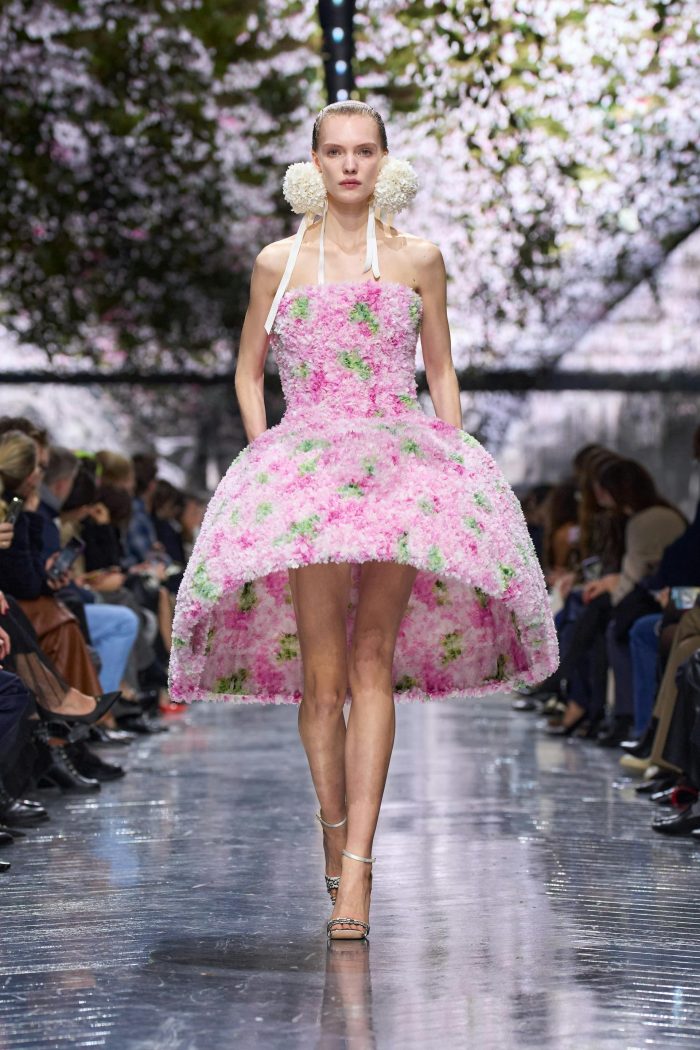
The garden metaphor wasn’t just decorative; it was emotional architecture. Cyclamens gifted to Anderson by John Galliano became the collection’s secret handshake, reappearing as embroidery, ear adornments and floral accents—a kind of floral group chat between Dior creative directors, past and present. Raf Simons’ flower walls got a knowing wink, while Christian Dior’s “flower women” haunted the silhouettes in a very intentional way. Coveteur described it as “pure fantasy” where whimsy and surreality dissolved into moments of “pure beauty and craftsmanship,” and didn’t hesitate to call the debut “a triumph” outright .
On the runway, nothing was straightforward, which is exactly the point. Dresses bellied out like distilled New Look experiments, but with Anderson’s sculptural twist: skirts looked like bulbs about to bloom, tops inflated like couture bubble wrap, and knitwear suddenly thought it was sculpture. Feathers pretended to be reptilian scales or enamel, organza shards mimicked petals, and grass, seaweed or some luxurious hybrid suddenly showed up… as a bag. One model even carried a giant leaf as an umbrella, because of course she did. ELLE summed it up neatly as Anderson “touching grass”—a couture hothouse of organic forms that doubled down on old-school, analog craft in an era addicted to digital shortcuts.
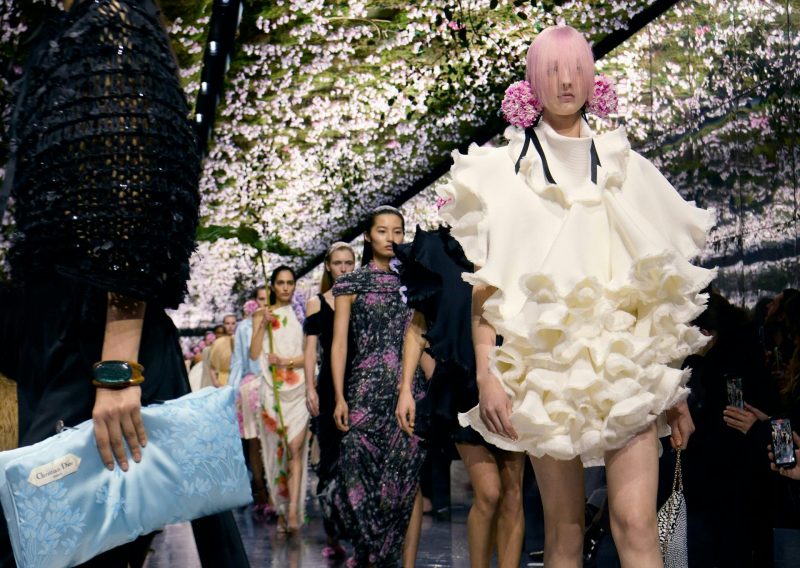
Accessories were their own nerdy flex. Bags and shoes crafted from upcycled 18th‑century French silks and jewelry set with fossil fragments, meteorites and antique miniatures turned each look into a small archaeological dig. This is couture as couture really is: one-offs, built on patience, rare materials and the sort of handwork that justifies the multi–six-figure price tag. AnOther underlined how these real fragments of history were “reconstituted for tomorrow,” while DSCENE praised the collection’s “control, intelligence, and intimate understanding of couture as a discipline built on patience, handwork, and precision”.

New artistically inspired boutique hotels: Grand Bohemian Lodge Greenville
Find more hidden gems in our archiveTHE CURATED CALENDAR
Discover the world’s most prestigious gatherings & exhibitionsThe bride, traditionally the big cinematic mic-drop, was almost serene by comparison: a white gown with a zigzag-cut skirt from a 1948 Dior technique, veiled in white cyclamens and petals. It felt less like a fireworks finale and more like a carefully placed full stop—what DSCENE described as “restraint rather than spectacle,” reinforcing Anderson’s choice to prioritize clarity over drama.
Of course, fashion critics couldn’t resist a little side eye with their praise. While most reviews leaned heavily positive—”fantasy,” “triumph,” “re-energisation of the house”—some raised the obvious question: is the system asking too much of one human? Anderson is now juggling Dior women’s, Dior men’s, haute couture, his own label JW Anderson, plus ongoing collaborations. DSCENE politely wondered if this intensely focused couture might actually highlight an imbalance with Dior’s recent ready-to-wear, suggesting the debut sharpened the question of “whether the current fashion system asks too much of a single creative director”. And at least one commenter in the fashion-obsessed corners of the internet grumbled that some silhouettes felt a bit like they’d wandered in from a Comme des Garçons show, wondering aloud if “the Dior woman is really happy with this.”
Still, walking out of the Musée Rodin, the general mood was clear: this was not a timid first date. Anderson has planted his strange, romantic, hyper-crafted garden firmly in Dior’s backyard. Whether you see it as a dream greenhouse or a slightly overstuffed cabinet of curiosities, it’s a debut that has everyone talking—and that, in couture, is half the job done.