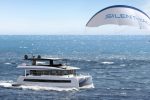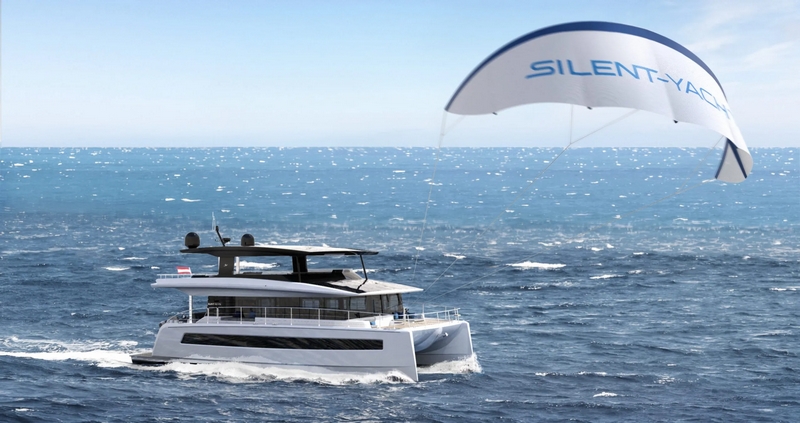
This innovative kite wing is easy to use and adds up to 5 knots to the Silent-Yacht solar electric catamaran speed.
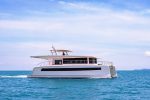
Silent-Yachts has increased its fleet of innovative oceangoing solar electric catamarans introducing the new Silent 60 that has been launched recently at Silent Yachts production facility in Thailand, which is led by the Swiss entrepreneur Philippe Guénat. This is the first unit of the model while eight more hulls are currently under construction and 17 are ordered in total.
What makes it even greener is that it was built with a kite wing, a special system that in contrast to conventional sailing yachts, does not require a big mast and the kite sail generates much more power per square meter than a conventional sail. Silent Yachts offers the optional available kite-sail system for all their models.
“The kite system sounds like the perfect match for windy days together with the electric propulsion system of Silent Yachts,” said the German owner of the first SILENT 60. “I am an enthusiast of new technologies which help, little by little, to overcome the ecological challenges we are facing today.”
Greener than before
The SILENT 60 carries a light compact kite wing from Wingit, that does not require a big mast to hoist the kite and it´s also easy to use. A kite wing that operates in such heights, generates up to 10 times more power per square meter than a conventional sail.
So, how the kite wing system works? There is a dedicated box in the bow area of the SILENT 60, which contains the kite (the sail is 13 sq. m) including all its components (winches, mast, ropes, etc). Here the entire system is also stored, when not in use.
To launch the kite, it’s only required to set up a small mast, which is only two feet high, with four stays (6 mm Kevlar “ropes”) that need to be fixed to four foldable pad-eyes (this takes a few seconds). After taking out the kite, it gets pumped up with an electric pump that is in the box as well (this takes only a few seconds), you switch on the winch, throw the kite overboard where it will drift away with the wind and then the kite can start from the water by pulling the ropes. When in the air, the automatic steering can take over – the pulling rope is released until the kite is more than 120 meters above the boat and it starts to paint a huge “8” in the sky.
Bringing it down is the reverse process. The automatic control moves the kite to a position right above the boat where it has the least pull on the rope, then the owner or a crew member winches the kite down electrically, pulls the right rope so that the kite collapses above the front deck. Now, the kite gets put back into the bag and stored in the box.
The advantages of the kite wing
There are three major advantages of the kite wing for the yacht. First, extra propulsion. The kite can pull the 30-ton SILENT 60 with about 4-5 knots and it reduces the consumption of the e-motors, thus extending the range. The already green solar electric catamaran gets greener and more eco-conscious this way. Second, emergency. If a floating fishing line gets entangled in the propellers, a kite can serve as a reserve propulsion that enables the boat to get to a protected place where the rope can be cut and the prop set free. Last but not least, fun and joy. It is great to see the kite high up in the air, pulling the boat with the power of the wind.
A new high performance hull form
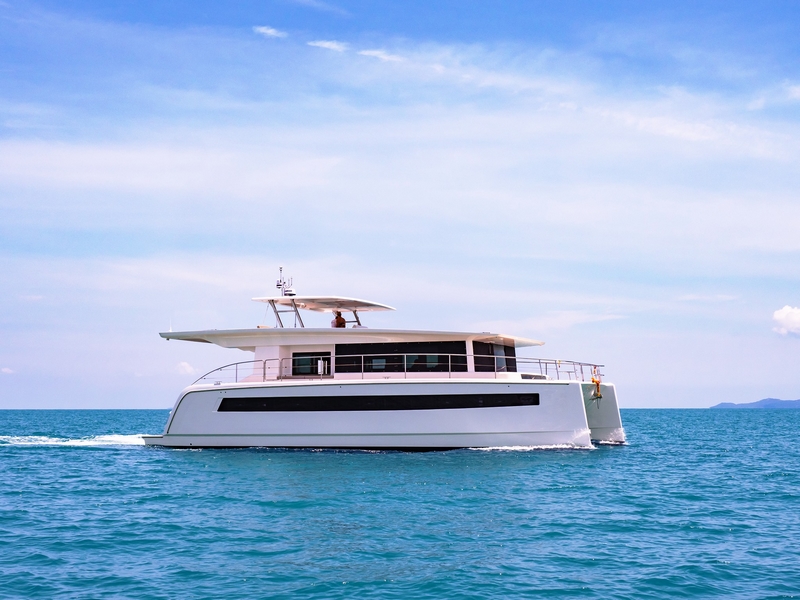
The SILENT 60 also has a new high-performance hull form that is optimized with CFD study, with longer waterline and reverse bow. Its exterior design’s signature details are long window stripes at the sidewall of the hull and more window surface overall.
“I want to congratulate our entire team with this successful project”, said Michael Köhler. “The SILENT 60 is the first example of a new generation of solar electric catamarans that we produce and many more will follow. We are happy to provide sustainable, emission-free solutions for yachting enthusiasts that want to make the world a better place.”
The owner plans to use his SILENT 60 for a few weeks per year and will make it available for charter.
“I thought it would be a pity to leave the boat unused for the rest of the time, and I have decided to rent the boat on a daily or weekly basis to anybody who is interested in trying out this wonderful yacht for a day trip or for a longer holiday with flexible routings,” he said.
The boat can be handled by two people with ease and offers plenty of space for families and crew.
For adventurers, additional water toys, SUP´s, kayaks and e-bikes can be stored in the bridge deck.
The SILENT 60 offers a flexible layout. The first has four guest cabins on the lower deck, including a spacious master suite. There are many social areas on board, an airy main saloon, an aft cockpit, a cosy bow seating and a flybridge. The yacht has higher headroom everywhere (up to 230 cm in the saloon) and more powerful solar panels (42 pieces for 17 kWp against 30 for 10.8 kWp on the SILENT 55).
The new model has a draft of less than 1 meter, which allows it to reach shallower bays, that may be crucial for areas like the Caribbean and South East Asia. The SILENT 60 has two swimming platforms in the aft which can optionally be extended by 90 cm upon owner’s request. In this case, the boat may carry a pair of electric jet skis. A liftable hydraulic platform, which is located between the two swimming platforms, can also be enlarged from the standard 3.7 x 1.7 m to 4 x 2.4 m to carry a larger tender – up to 350 kg and 4-meter long.
The SILENT 60 is equipped with the company’s aeration system, which provides cool and fresh air to all accommodations, heads, and in the saloon. The airflow in each space is individually adjustable and can be used when the weather conditions require the windows to be closed. In addition, a reverse-cycle heat-pump system heats the interior when necessary, ensuring all-season comfort. The insulated hull ensures efficient achievement of desired on-board temperatures.
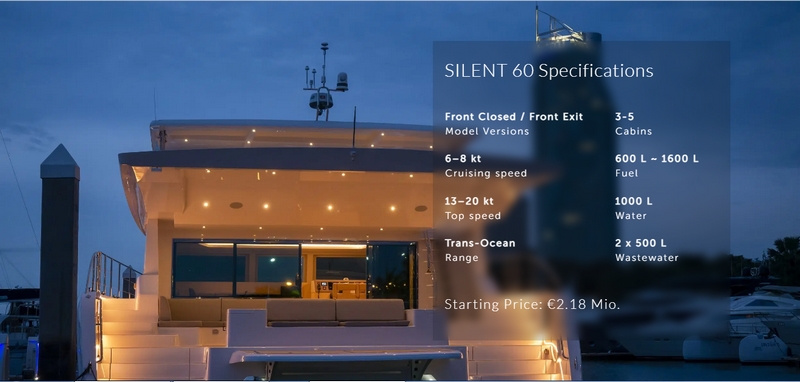
The catamaran is designed to go everywhere as a true ocean-going cruising yacht. It can cruise efficiently for up to 100 miles a day for weeks. At the same time, the arrangement of the components enables the system to power all on board systems without.