From dinosaur bones to private jets, vintage couture to curated high streets — Knight Frank’s landmark 20th Wealth Report takes a long, unflinching look at what truly wealthy people want right now. Spoiler: it’s not what you think.
There’s a question that luxury brands, property developers, auction houses, and yacht builders have all been quietly asking themselves for the past few years: what does a person do when they already have everything?
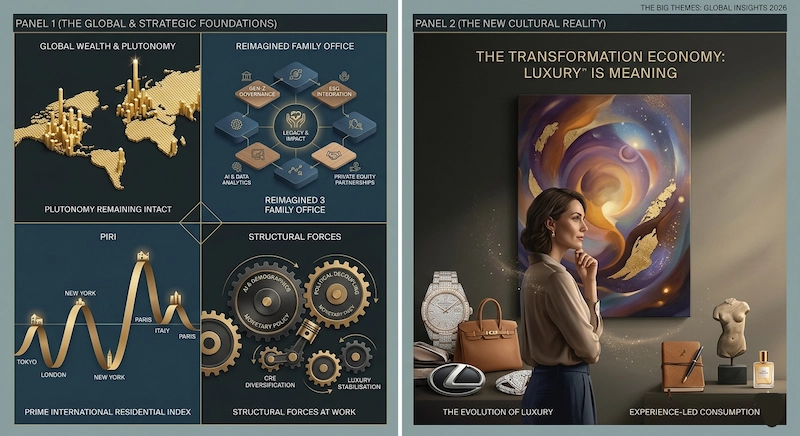
It’s not a flippant question. The world now counts over 713,000 individuals worth more than $30 million, and that number is growing by roughly 89 people every single day. Many of these men and women have accumulated the traditional markers of extreme wealth — the penthouse, the supercar, the watch collection, the art on the wall — and they’re finding that accumulation, by itself, doesn’t hit quite the way it used to.
Knight Frank’s 2026 Wealth Report, the landmark 20th edition of what has become the global bible for understanding private capital and luxury markets, dedicates an entire chapter to unpacking what comes next. The answer that emerges is genuinely fascinating, a little surprising, and — if you’re in any business that touches the affluent — rather urgently important.
The Great Pivot: From Having to Becoming
The headline observation in the report’s luxury section is simple but profound. Luxury is in the middle of a values shift, moving away from what you own and toward who you are. The report frames this through the lens of what it calls the “transformation economy” — a phrase worth spending a moment with, because it captures something real.
Think of it this way. For most of the 20th century, luxury worked like a scoreboard. You accumulated points — the right address, the right car, the right wardrobe — and those points communicated your status to the world. It was transactional. Visible. Relatively legible. Keeping up with certain peers was itself a form of social currency.
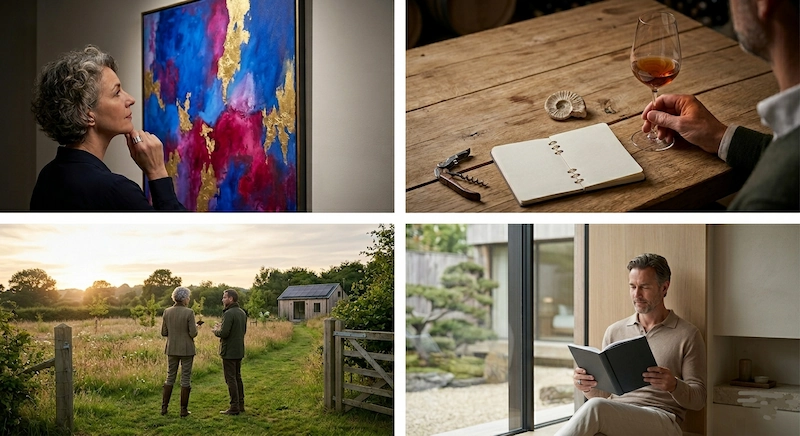
That model isn’t dead. But for a growing segment of the seriously wealthy — particularly those under 50, and particularly the new generation of tech and entrepreneurial wealth — it no longer feels sufficient. What they’re increasingly seeking instead are experiences and investments that change them in some meaningful way: better health, deeper knowledge, a genuine sense of community with people they actually respect.
The report puts it elegantly: luxury is no longer just about what you own — it’s about who you’re becoming.
The commercial implications of this are significant. Brands and developers who understand the shift are repositioning themselves not as purveyors of status symbols but as facilitators of personal growth. We’re seeing luxury hotels retooling their offering around longevity medicine and cognitive performance. Private members’ clubs rethinking their value proposition away from exclusivity (“you’re in, they’re out”) and toward purposeful community (“these are your people, here’s what you can build together”). Residential developers layering their projects with wellness infrastructure, curated cultural programming, and spaces designed not just to impress but to genuinely enrich daily life.
It’s worth noting that the transformation economy isn’t a charitable impulse — it’s a smart commercial one. The reason is simple: experiences that genuinely change you are far harder to commoditise than objects. You can always find a less expensive version of a luxury good. You cannot easily replicate a wellness retreat that genuinely extended someone’s health span, or a private community that connected them with the most interesting people in their field. That’s where the real pricing power sits now.
Chelsea: The High Street as Curated Experience
For a vivid illustration of what the transformation economy looks like in practice, the report points to London’s Chelsea — specifically through the eyes of Hugh Seaborn, the CEO of the Cadogan Estate, the family trust that has owned much of the neighbourhood for generations.
Seaborn’s perspective is distinctive because he thinks in timescales that most developers and retailers can’t or won’t. When you’re planning for generational ownership rather than a five-year exit, you make very different decisions about who you let through the door, what mix of tenants you curate, and what kind of atmosphere you’re trying to sustain.
What Cadogan has built in Chelsea is essentially a proof of concept for the curated urban experience: a neighbourhood that feels genuinely different from the homogenised global luxury retail strips that dominate so many cities. Rather than chasing the highest rents and filling every unit with the same roster of international luxury brands, the estate has deliberately cultivated a mix — independent names alongside established ones, restaurants and cultural venues alongside retail — that gives the area a sense of character and life that you can’t manufacture quickly.
The insight that matters here is that wealthy consumers, when they have the option, are gravitating toward places with an authentic sense of identity rather than places that simply project status. Chelsea works not because it’s expensive but because it’s interesting. The lesson for anyone building or curating luxury environments — whether a hotel, a residential development, or a retail district — is that real character is becoming one of the most valuable things you can offer.
The Luxury Investment Index: Finding Its Floor
Every year, Knight Frank publishes the Luxury Investment Index — a tracking tool for the performance of ten major collectible asset classes: art, watches, jewellery, classic cars, handbags, wine, whisky, coloured diamonds, coins, and furniture. Think of it as the stock market index for things that wealthy people love to own.
The 2025 data tells a story of stabilisation after a rough patch. The index closed the year down just 0.4% — barely a blip — after two consecutive years of meaningful correction across several categories. This is roughly what it looks like when a market catches its breath: not a crash, not a boom, but a careful collective pause while buyers and sellers figure out what things are actually worth.
The Map to Modern Luxury
THE CURATED CALENDAR
Discover the world’s most prestigious gatherings & exhibitionsSome categories are doing better than others. Impressionist art posted solid gains, as did watches — particularly at the ultra-rare end, where brands like Rolex and Vacheron Constantin have been actively building certified pre-owned programmes that add trust and price stability to secondary market transactions. The report notes that brand-backed resale is genuinely reshaping how the watch sector works, in much the same way that official certified pre-owned changed the luxury car market a generation ago.
The long view remains compelling. If you had put $1 million into the KFLII back in 2005 and simply tracked the index, you’d have around $5.4 million today. The same $1 million in the S&P 500 over the same period would have yielded roughly $5 million. So across two decades, passion investments have essentially kept pace with equities — with the significant added benefit that they’re also lovely to live with.
The New Frontier: Fossils, Fractional Shares, and Fashion Archives
The most surprising and genuinely fresh part of the luxury collectibles story in 2026 is what’s happening at the edges: the categories that would have seemed eccentric or speculative just a few years ago but are now generating real serious attention.
Rare fossils are one of the year’s standout stories. The report highlights the sale of a 66-million-year-old Edmontosaurus skull — yes, a dinosaur skull — which delivered a return of 22.4% in just eight and a half months of holding time on the fractional investment platform Timeless. That number would be remarkable in almost any asset class. What’s driving it is a combination of extreme rarity (there is, by definition, a finite supply of scientifically significant natural history specimens), emotional resonance, and the growing confidence of a new generation of collectors who haven’t been socialised into the idea that “proper” collecting means art and wine.
As one market participant quoted in the report puts it, the appeal is both the tangibility and the emotional factor — it’s about diversification of assets with a genuinely fun story to tell. That’s a revealing formulation. The best luxury investments increasingly need to do double duty: function as an asset and as a narrative.
Vintage haute couture is another rising category. The logic here is elegant: exceptional archive fashion from the great houses — a Balenciaga from the 1950s, a McQueen from his early Givenchy period — is genuinely irreplaceable, often carries significant cultural and historical weight, and is now finding a generation of collectors who are prepared to treat it with the same seriousness as Old Master drawings or rare wines. The supply is permanently constrained; the appreciation for craftsmanship and historical context is growing.
And then there’s fractional ownership — perhaps the most structurally significant shift in the collectibles market. Platforms like Timeless and others are enabling buyers to hold shares in museum-quality pieces that would otherwise be completely out of reach for anyone except the very top tier of collectors. This democratisation of access is changing the shape of the collector market: bringing in younger, more digitally native buyers, creating more liquid secondary markets, and — crucially — building a broader culture of serious collecting that ultimately supports the entire ecosystem.
On the Water and in the Air: The Mobility of the Very Wealthy
The report’s section on what it calls “wealth without borders” covers two assets that function as more than mere toys for the ultra-rich — superyachts and private jets — and frames them as genuine windows into how the seriously wealthy think about mobility, privacy, and the organisation of their lives.
On yachts, the news is positive after a difficult period. The superyacht market is staging a comeback, driven partly by a cohort of new buyers for whom the vessel isn’t primarily a status statement but a genuinely functional mobile headquarters. A modern superyacht — equipped with satellite connectivity, sophisticated security systems, and the capacity to operate as a fully functional office environment — allows its owner to maintain a global business from international waters with a degree of privacy that is increasingly hard to find on land. Given that the report identifies privacy as one of the most coveted luxuries among the ultra-wealthy today, this framing makes complete commercial sense.
The private jet landscape is undergoing a more fundamental redrawing. The report notes that the geography of private aviation is shifting in ways that reflect the broader mobility of wealthy individuals. Point-to-point routes are increasingly less about connecting traditional financial capitals and more about accessing the new hubs — Dubai, Miami, Singapore, Riyadh — that are attracting wealth migration. The growth in the market for ultra-long-range aircraft reflects owners who are genuinely living across multiple continents rather than simply visiting them.
Art Gets Real Again
The art market — one of the most emotionally complex and intellectually rich corners of the collectibles world — went through a gold rush period and then a hangover, and the 2026 report suggests it’s now entering something more honest and more interesting.
The gold rush era, roughly from 2010 to 2023, was characterised by spectacular auction results, aggressive speculation, and a wave of new money that sometimes overwhelmed the market’s capacity for genuine connoisseurship. Prices at the very top became divorced from any rational relationship to artistic merit, and the secondary market for contemporary work in particular became more about financial positioning than about love of art.
The correction that followed was, in retrospect, necessary and perhaps even healthy. What’s emerging now is a market with more discipline, more genuine curiosity, and more openness to areas that were previously considered peripheral. South Asian contemporary art is one of the categories gaining the most momentum — stronger infrastructure, rising global recognition, and pricing that still sits meaningfully below comparable Western equivalents, suggesting genuine room for appreciation. Works in editions — limited prints and multiples rather than unique canvases — are finding renewed interest because they create more accessible price points and a more liquid secondary market, particularly where the artist’s visual identity and cultural relevance are strong.
The report also paints a picture of what serious collecting looks like now, through the lens of Lee Bofkin, founder of Global Street Art and a passionate collector in his own right. His view — that the true value of collecting lies not in money but in taste, knowledge, and time — is a thread that runs through the entire luxury chapter. The collectors who are thriving in this market are those who bring genuine intellectual engagement to what they buy, who have done the work to understand their area deeply, and who collect with something closer to passion than to portfolio management in mind.
What It All Means” Step back from the individual categories, and the luxury chapter of Knight Frank’s 2026 Wealth Report tells a coherent story.
Wealthy consumers are getting more sophisticated. They’ve had enough time with the traditional markers of luxury to know what actually brings lasting satisfaction and what doesn’t. The answer — increasingly, consistently — is that experiences that change you, communities that genuinely include you, and objects that you truly understand and love outperform the trophy acquisition that looked impressive in the moment but grew ordinary over time.
This is good news for the luxury industry, if it’s willing to listen. The market isn’t shrinking — with nearly three-quarters of a million UHNWIs and more being created every day, the demand base is larger than it has ever been. But the nature of the demand is evolving, and the brands, developers, auction houses, and advisers that thrive over the next decade will be those who meet their clients where they actually are rather than where the industry has traditionally assumed them to be.
The transformation economy isn’t a trend. It’s a direction of travel. And according to Knight Frank’s best read of the data, it’s just getting started. Full report at knightfrank.com/research.

1 thought on “How the World’s Wealthiest Are Rewriting the Meaning of Luxury in 2026”
Comments are closed.