Pop Art, Pocket Watches & Pure Chaos: The AP x Swatch Drop the Watch World Didn’t See Coming
@Audemars Piguet × Swatch ‘Royal Pop
The much-debated Audemars Piguet × Swatch ‘Royal Pop’ — A new take on the pocket watch, and why this collaboration makes more sense than anyone wants to admit.
There’s a moment in every great collaboration when you stop and think: how did no one think of this before? The Audemars Piguet × Swatch Royal Pop is one of those moments — wrapped in bioceramic, dangling from a calfskin lanyard, and selling out in Swatch stores before most people had finished their morning coffee.
The internet, predictably, exploded. Purists cried. Hypebeasts queued. And somewhere in Le Brassus, Switzerland, a 150-year-old Manufacture quietly smiled.
Two Worlds, One Octagon
To understand why this collaboration is genuinely significant — and not just a clever marketing stunt — you need to understand the two houses that made it possible.
Audemars Piguet: The Holy Trinity’s Quiet Rebel
Founded in 1875 by Jules-Louis Audemars and Edward-Auguste Piguet in the remote Vallée de Joux, Audemars Piguet (AP) is one of watchmaking’s great paradoxes: a family-owned independent manufacture that has somehow become a global cultural icon without ever chasing trends.
If Rolex is the watch you inherit, and Patek Philippe is the one you leave to your children, then AP is the one you wear to tell the world you know the difference. Its place alongside Patek Philippe and Vacheron Constantin in the so-called “Holy Trinity” of Swiss watchmaking is not accidental — it is earned, movement by movement, decade by decade.
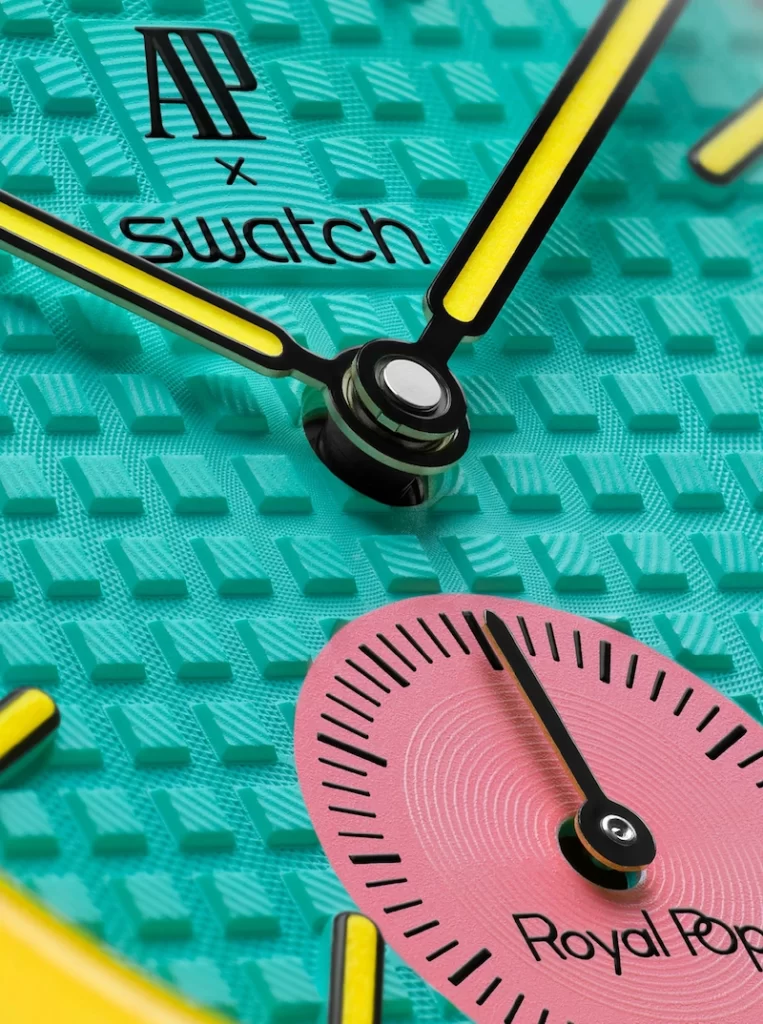
The crown jewel? The Royal Oak — designed in 1972 by the legendary Gerald Genta in a single night, born from the audacious idea that a luxury sports watch could be made entirely of steel, wear an octagonal bezel secured by eight exposed hexagonal screws, and carry a “Petite Tapisserie” guilloché dial that has since become one of the most recognisable patterns in all of design. It was radical then. It remains radical now.
Today, the Royal Oak accounts for approximately 88% of AP’s total sales — a concentration that speaks not of limitation, but of the immense power that a single iconic design can hold across generations.
The Numbers Don’t Lie
In a Swiss watch market facing headwinds — exports fell by 2.8% to CHF 26 billion in 2024 — Audemars Piguet has been rowing against the current with remarkable strength. The brand achieved revenues of approximately CHF 2.38 billion in 2024, then grew a further 9% to CHF 2.6 billion in 2025, surpassing Omega to claim the third spot in the global watch ranking for the first time in its history. That growth was achieved on the back of just 53,000 watches annually — roughly one-tenth the volume of competitors generating similar revenues.
At an average selling price exceeding CHF 51,000 per piece, AP has essentially redefined what it means to do more with less. Revenue has roughly quadrupled since 2012, a trajectory that makes the brand arguably the single most efficient commercial operation in luxury watchmaking today.
Yet AP’s CEO, Ilaria Resta, the first woman to lead the brand, is not resting on those numbers. “We can’t stand still,” she has said. “While we have not been impacted by the crisis and we are actually doing well, I think we should be excited about the future ahead and keep building new things.”
@Audemars Piguet × Swatch ‘Royal Pop
2025: The Year AP Turned 150 — and Went Full Innovation
AP’s milestone anniversary year produced a constellation of new releases that showcased both its heritage mastery and its appetite for the future.
The headline act was the introduction of the all-new Calibre 7138/7139 — a redesigned perpetual calendar movement now available across both the 38mm and 41mm Royal Oak and Code 11.59 collections. This is significant: perpetual calendar complications had previously been reserved for the larger 41mm case, making this a genuine democratisation of haute complication for slimmer wrists.
The Code 11.59 Grande Sonnerie Carillon Supersonnerie pushed the boundaries of acoustic watchmaking — blending traditional chiming complications with contemporary aesthetics. The Royal Oak Concept Tourbillon “Companion”, created in collaboration with artist KAWS, brought the subversive energy of street art into a limited-edition mechanical statement piece.
Then there was something that no one expected from a watchmaker: an AI-powered setting box. Born from a two-year partnership with the Dubai Future Foundation, AP unveiled an intelligent device that uses computer vision, robotics, and machine learning to automatically set and wind the Royal Oak Perpetual Calendar in approximately five minutes. Drop the watch in, close the lid, and an AI reads the dial, identifies what’s out of sync, and corrects everything — replicating the dexterity of a master watchmaker without human intervention.
It is a fascinating signal: AP is not afraid of technology. It is afraid of mediocrity.
The Mechanical Watch in the Age of the Smartwatch
Here is the uncomfortable truth that the Swiss watch industry must confront every morning: the Apple Watch outsells every Swiss brand combined. The smartwatch wave is not a wave anymore — it is the ocean. Fitness tracking, notifications, heart rate monitoring, NFC payments — the wrist has become a computing platform, and a mechanical watch, by comparison, just tells the time.
And yet.
The Swiss watch industry’s top four brands — Rolex, Cartier, Audemars Piguet, and Patek Philippe — now control 55% of the entire market’s value, a share that continues to grow. The segment of watches priced above CHF 50,000 represented 37% of total watch export value in 2025, despite being only 1.4% of total units shipped. The story of mechanical watchmaking in 2025 is not one of decline — it is one of beautiful, defiant polarisation.
The mechanical watch has become what it always secretly was: not a tool, but a cultural object. A philosophical statement. An heirloom in embryo. A rebellion against the disposable. In a world where your phone tracks your every heartbeat and your watch face changes with an app update, the quiet, singular obsession of a hand-finished movement — with its hundreds of components, its Nivachron balance spring, its decades of accumulated craft — carries a meaning that no firmware upgrade will ever replicate.
The Map to Modern Luxury
THE CURATED CALENDAR
Discover the world’s most prestigious gatherings & exhibitionsAP understands this better than almost anyone. And that understanding is precisely why the Royal Pop exists.
Swatch: The Democratiser
No brand has done more to make the idea of Swiss watchmaking accessible than Swatch. Born in 1983 as a counterattack against Japanese quartz dominance, Swatch turned the watch into a fashion accessory, a collector’s item, and a cultural artifact — all at prices that invited everyone to the party.
Its track record of strategic collaborations is second to none. The Omega × Swatch MoonSwatch of 2022 caused queues around the block in cities worldwide, triggered a secondary market frenzy, and proved that a CHF 250 watch inspired by a CHF 6,000 icon could generate cultural shockwaves far beyond its price point.
Now, Swatch brings its SISTEM51 movement — a mechanical marvel in its own right, assembled entirely by robots, boasting 15 active patents — to bear on the most audacious collaboration in its history. The SISTEM51, presented here in a new hand-wound version with over 90 hours of power reserve, an anti-magnetic Nivachron™ balance spring, and laser-based precision adjustment, is the unsung hero of the Royal Pop story: genuine mechanical watchmaking, at a Swatch price point, wearing Royal Oak clothes.
@Audemars Piguet × Swatch ‘Royal Pop
The Royal Pop: What It Actually Is
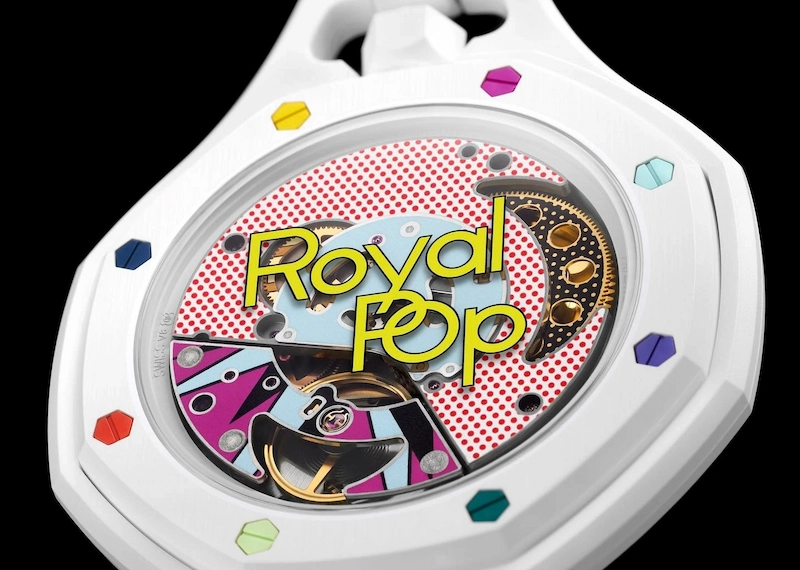
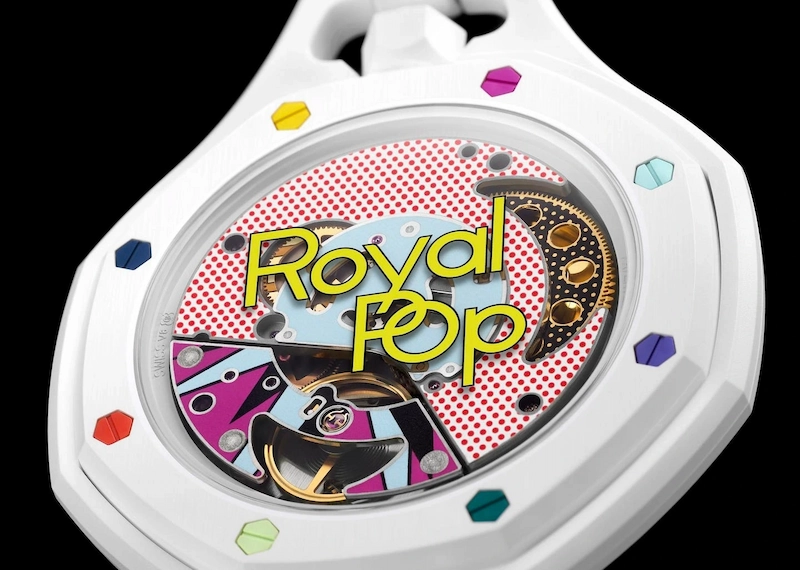
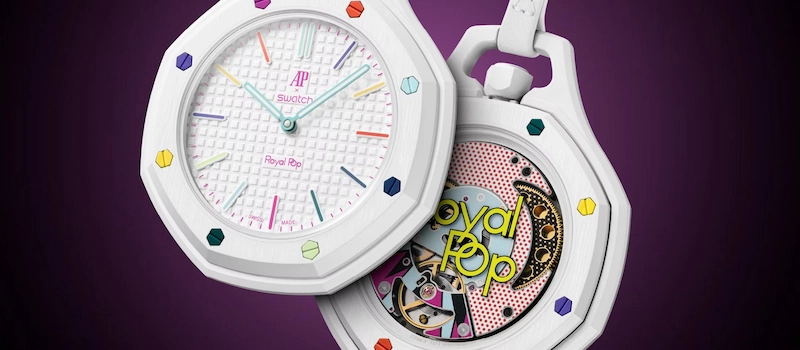
The Royal Pop is a pocket watch — and it is not a pocket watch. It is a wearable object, a collectible, a piece of wearable pop art, a bag charm, a lanyard statement, a necklace. It is eight things at once, which is fitting, given the eight hexagonal screws on its bezel.
Available in eight models, each rendered in AP’s signature bioceramic — the same material that gives the MoonSwatch its distinctive feel — the Royal Pop carries every essential Royal Oak DNA marker with near-religious fidelity:
- The “Petite Tapisserie” pattern dial, that iconic hobnail grid that has adorned the Royal Oak since 1972
- The octagonal bezel with eight hexagonal screws
- The vertical satin finish on the bezel and case back
- Super-LumiNova® Grade A on hands and hour markers for night legibility
- Two sapphire crystals, front and back, revealing the SISTEM51 movement beneath
Each piece arrives on a high-quality calfskin lanyard with contrast stitching — worn around the neck, tucked into a pocket, clipped to a bag, or displayed as pure sculptural object. It is simultaneously the most democratic and the most philosophical object AP has ever put its name to.
The reference number is telling: 5697 — a nod to AP’s very first Royal Oak pocket watch, and a thread that ties this kaleidoscopic, bioceramic Pop Art object back to the brand’s 19th-century heritage of polygonal, hexagonal, and octagonal pocket watches crafted in very small series.
Why This Collaboration? The CEO Answers
Ilaria Resta does not mince words.
“For the joy and boldness it represents. Because audacity is often the starting point of innovation and new ideas. And because it invites a broader audience including the younger generations to experience mechanical watchmaking differently.”
But the reasoning goes deeper than marketing copy. Resta has been explicit about who this collaboration is truly for: Gen Alpha. The children who are now 10, 12, 15 years old. The ones who have never worn a mechanical watch, never felt the gentle resistance of a hand-wound crown, never pressed their ear to a case to hear the heartbeat of a movement.
The financial logic is equally striking: AP will use 100% of its Royal Pop proceeds not for profit, but to fund a dedicated initiative supporting the preservation and transmission of watchmaking savoir-faire — focusing on rare skills and the next generation of horological talent. “This isn’t a financial return for us,”
In an era where brands talk endlessly about purpose and legacy, AP has actually put its money where its movement is.
The Backlash, the Queues, and the Big Picture
No cultural event of this magnitude arrives without controversy, and the Royal Pop is no exception. Reports emerged within days of launch of chaotic scenes outside Swatch stores — long queues, frustrated buyers, and incidents that prompted Swatch Group to publicly call for calm. Flippers prepared their listings. Purists prepared their op-eds.
The Royal Pop is only available through a selection of Swatch stores — not AP boutiques, not grey market dealers, not online resellers. This deliberate distribution choice keeps the experience accessible, physical, and rooted in Swatch’s democratic retail DNA.
The real question — the one that will be debated in watch forums for years — is whether this collaboration dilutes the AP brand or amplifies its mission. History suggests the latter. The MoonSwatch did not damage Omega’s Speedmaster; it created a new generation of Omega admirers. The Blancpain × Swatch collaboration did not cheapen the Fifty Fathoms; it gave the dive watch a new cultural relevance.
The Royal Pop will not replace a Royal Oak. It will make people want one.