@The Ginori Terrace by Ritz-Carlton Yacht Collection × Ginori 1735
When a 290-Year-Old Porcelain House Sets Sail: The Ritz-Carlton Yacht Collection x Ginori 1735 and the New Language of Luxury at Sea
Design collaborations are reshaping what it means to travel in style — and the ocean is now the ultimate canvas.
There is a quiet revolution happening at sea, and it has nothing to do with ship size, engine power, or the number of swimming pools on Deck 12.
It is happening at the dinner table, on the sun lounger, in the scent of the air and the colour of a cushion. It is happening because the most forward-thinking names in luxury cruising have understood something the hotel world figured out a decade ago: the experience is the product. And the fastest way to elevate an experience is to surround it with objects, stories, and aesthetics that carry meaning far beyond their function.
The Ritz-Carlton Yacht Collection’s new collaboration with Ginori 1735 — one of Europe’s most storied porcelain houses — is the latest, and perhaps most beautifully conceived, expression of this shift. It is also a signal of where the entire industry is heading.
Italy, the Sea, and Neptune’s Dinner Service
Ginori 1735 was born, appropriately enough, in the hills of Tuscany in — as the name declares — 1735. Nearly three centuries of porcelain mastery, passed through the hands of aristocrats, collected by European courts, and eventually acquired by Kering (the luxury group behind Gucci and Bottega Veneta), which has spent recent years restoring the Maison to its rightful place at the pinnacle of Italian decorative arts.
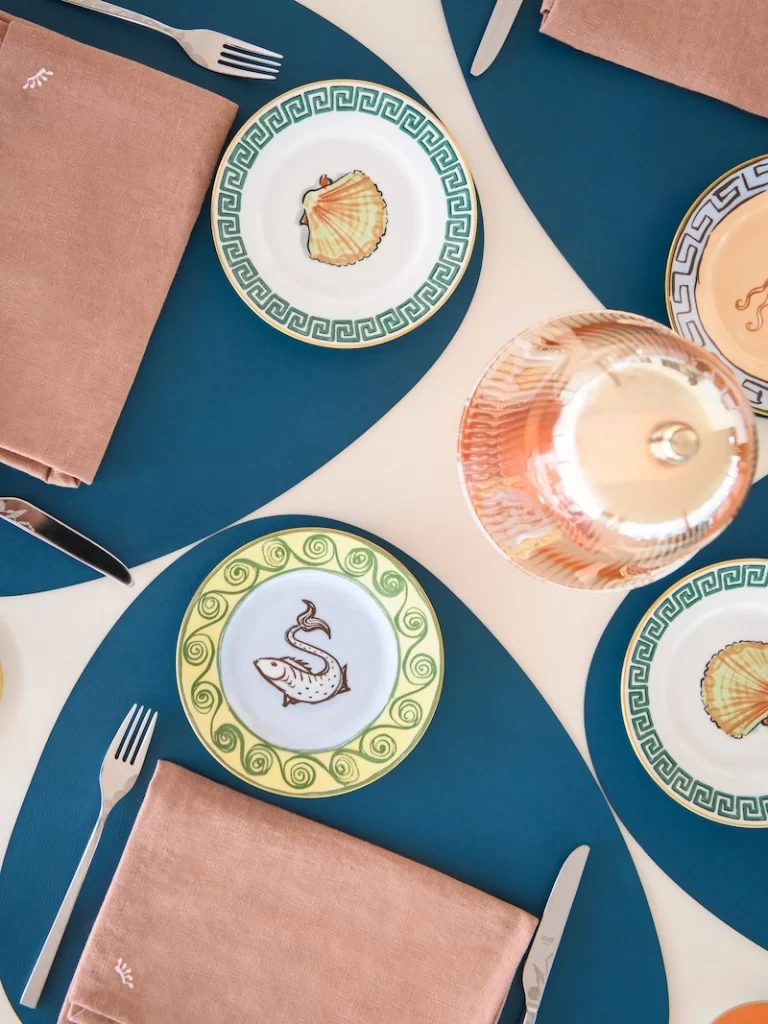
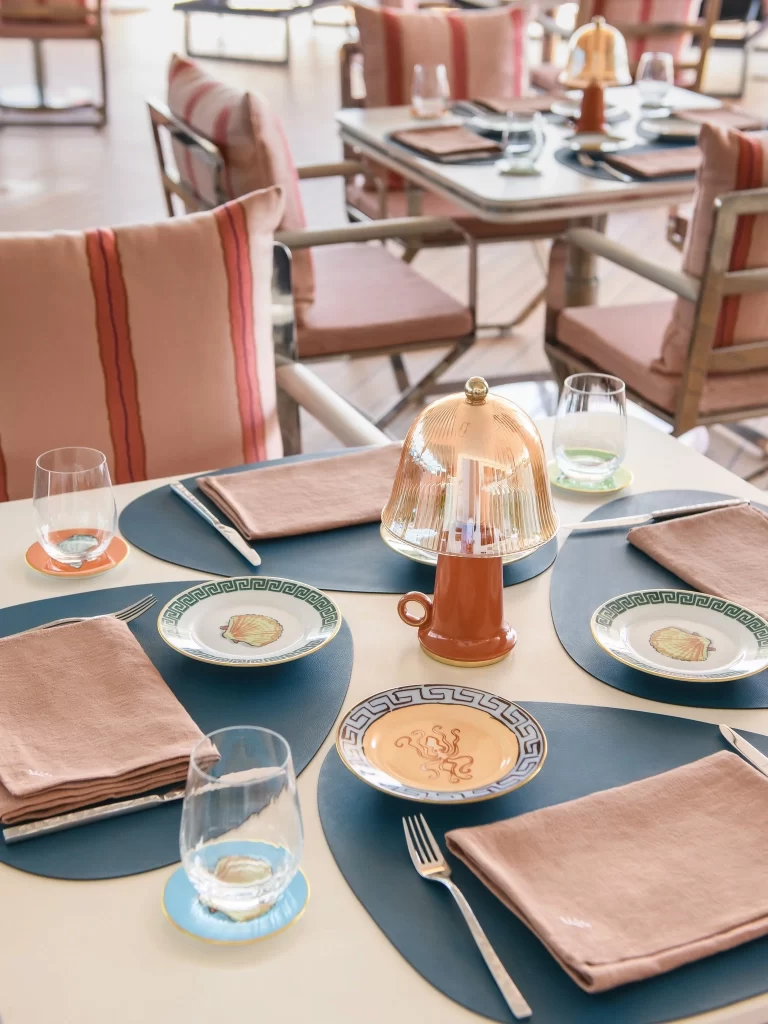
The collection at the heart of this collaboration, Il Viaggio di Nettuno, was designed by English artist Luke Edward Hall — a painter known for his joyful, myth-soaked visual world. Hall’s Neptune is not austere. His sea creatures are fantastical. His mythological figures burst with colour and a sense of play. It is porcelain as storytelling, tableware as theatre.
Aboard Evrima — The Ritz-Carlton Yacht Collection’s inaugural 298-guest yacht, launched in 2022 and currently sailing the Mediterranean — the concept unfolds across three outdoor spaces, each dressed in a distinct colour story drawn from Ginori’s own palette:
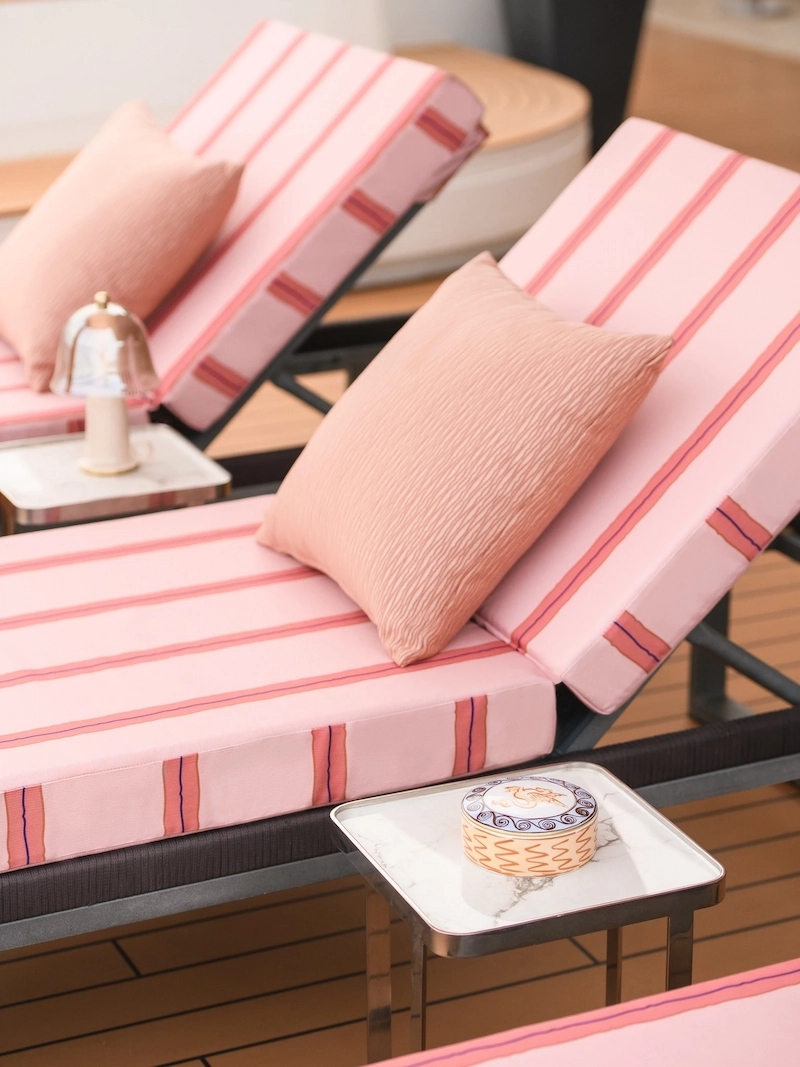
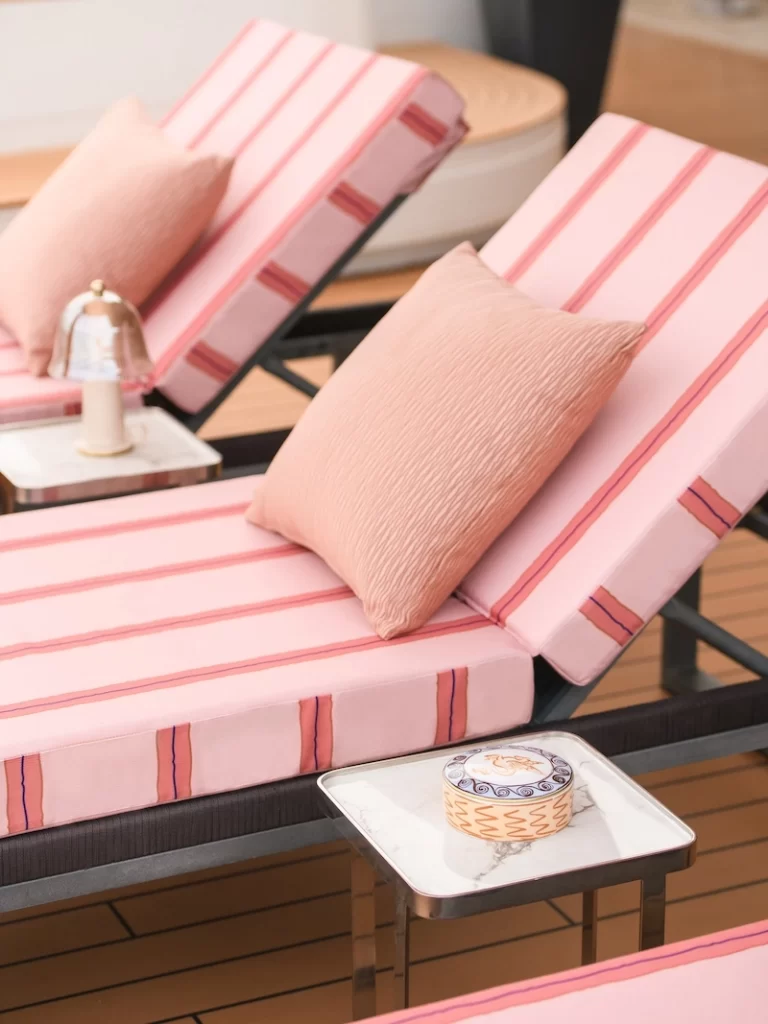
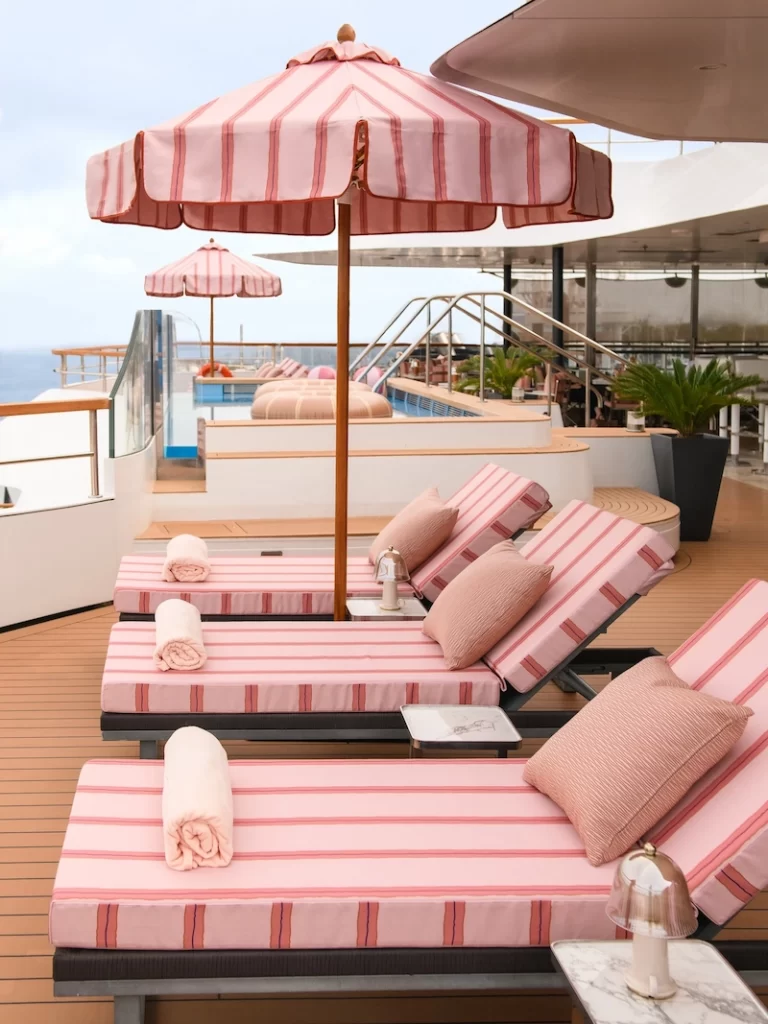
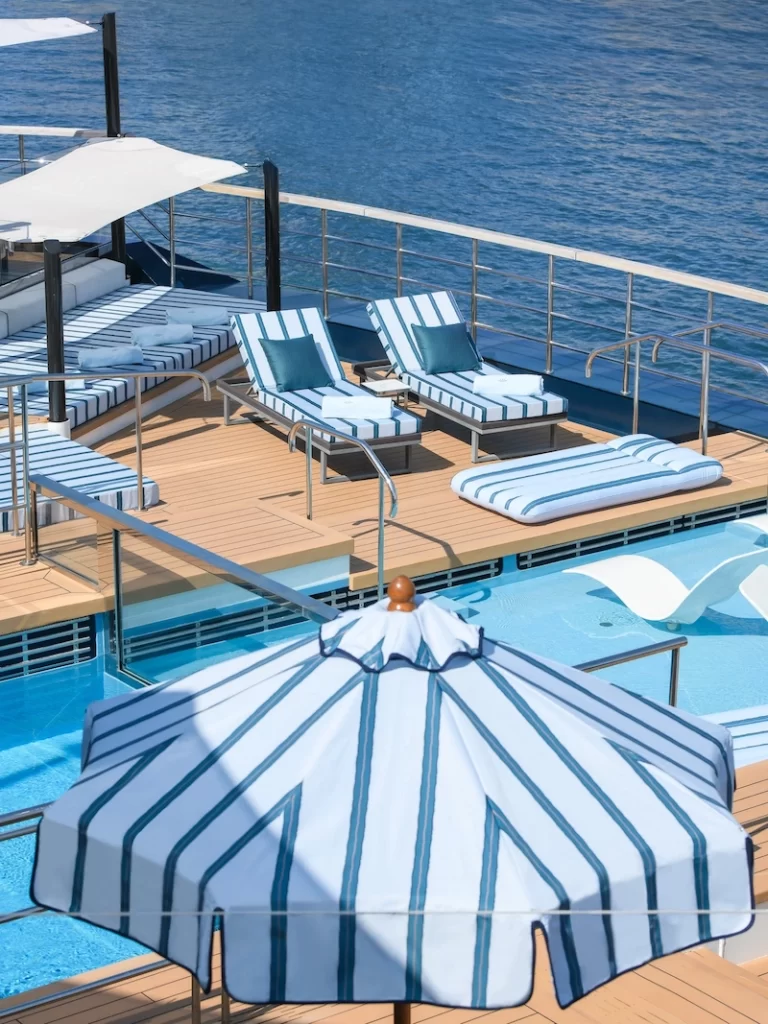
The Pool House on Deck 5 is bathed in Azzurro — striped sky blues and deep teals that blur the line between deck and horizon. The Mistral restaurant on Deck 8 adopts the warmth of Mandarino — orange, coral, and blush tones — where Il Viaggio di Nettuno tableware, glassware, and lighting accents transform al fresco dining into something closer to a collector’s private garden party. And at the Marina, the water’s edge glows in Zafferano, a burst of golden amber evoking the precise colour of a Mediterranean sunset seen from a low deck chair with a glass of something cold in hand.
Custom outdoor textiles, upholstered sun loungers, signature cocktails, and a limited retail selection — select pieces available to purchase and ship home from The Boutique — complete a concept that is as commercially clever as it is aesthetically cohesive.
This is not decoration. It is world-building.
Why This Matters Beyond the Beautiful Objects
The Ginori Terrace is significant for reasons that extend well past its considerable visual charm. It marks the first time the Ginori Terrace concept — previously a land-based expression — has been translated to the sea. It brings a 290-year-old craft tradition into direct conversation with the most dynamic growth segment in luxury travel. And it frames the collaboration explicitly around narrative: the art of viaggio, the Italian word for travel, as a lens through which design, food, and human connection are understood.
“Ginori 1735’s heritage and approach to elevating everyday rituals make it a natural partner,” said Gaby Aiguesvives, Chief Marketing Officer of The Ritz-Carlton Yacht Collection. That phrase — elevating everyday rituals — is the key to understanding the new luxury cruise philosophy. The morning coffee. The sunset aperitivo. The moment you catch the light on the glaze of a soup bowl. These are not incidentals. They are, increasingly, the point.
The Broader Wave: How Luxury Cruising Learned to Collaborate
The Ritz-Carlton × Ginori partnership sits within a much wider movement. Across the luxury cruise sector, the most ambitious lines have spent the last several years building ecosystems of cultural and creative partnerships that would not look out of place in the strategy decks of the world’s great hotel groups.
The Map to Modern Luxury
THE CURATED CALENDAR
Discover the world’s most prestigious gatherings & exhibitionsSilversea arguably set the benchmark with its S.A.L.T. (Sea and Land Taste) programme — a holistic culinary concept that ties together a destination-inspired restaurant, a hands-on cooking laboratory, a craft cocktail bar, curated food-focused shore excursions, and talks by chefs, food historians, and winemakers. S.A.L.T. does not simply serve local food; it interrogates the culture behind it. “Food is probably the strongest expression of any culture,” Silversea’s chief commercial officer Barbara Muckermann has said. The programme, now expanded across multiple ships including Silver Spirit following a recent revitalisation, represents a genuine intellectual partnership between a cruise line and the places it visits.
Viking, whose fleet carries one of the largest privately owned collections of contemporary Scandinavian art at sea, has taken the cultural partnership model into entertainment, recently announcing a collaboration with Downton Abbey: The Grand Finale — bringing the franchise’s world of aristocratic elegance into conversation with Viking’s own understated Nordic luxury.
Cunard has consistently translated its transatlantic heritage into cultural programming, most recently through its Transatlantic Fashion Week aboard the Queen Mary 2 — a seven-night voyage featuring designer runway shows and Q&As, with fashion icon Christian Siriano as 2025’s headliner. An ocean liner as fashion week venue: the line between cruise and cultural event has been permanently blurred.
Seabourn has built UNESCO partnerships into its expedition programming, while its “Shopping with the Chef” concept — market visits in Sicily, Istanbul, and Provence guided by the ship’s own culinary team — transforms a port stop into an intimate, expert-led experience that no land-based hotel could replicate.
Regent Seven Seas, aboard the forthcoming Seven Seas Prestige, is partnering with Italian sleep specialists Flou to install handcrafted Leonardo Sleep Systems in its most distinguished suites — a detail so specific, so considered, that it signals a new kind of luxury thinking: not the grand gesture, but the perfected detail.
Norwegian Cruise Line has turned the ship’s hull itself into a canvas, commissioning Filipino-American multidisciplinary artist Allison Hueman — who has previously collaborated with Nike, Google, and Sony Music — to create the artwork wrapping the Norwegian Aqua. When the collaboration starts on the outside of the ship, you know the industry has fully committed.
The New Luxury Cruise Guest: Who Is All of This For?
The answer is more interesting than it might appear. The luxury cruise guest of 2026 is not simply a wealthy retiree seeking comfort on calm seas. They are, increasingly, a design-literate, culturally curious traveller who books a cruise the way they might book a stay at a Mubi-adjacent art hotel — drawn by the programme as much as the destination.
The Ritz-Carlton Yacht Collection, Explora Journeys (launched by MSC Group in 2023 with a fashion-forward, boutique hotel aesthetic), and newer entrants like Scenic are all competing for this guest — one who notices the glaze on the porcelain, asks which artist painted the stairwell mural, and wants the chef to explain not just the dish but the village it came from.
For this traveller, a collaboration with Ginori 1735 is not a marketing exercise. It is a reason to choose one ship over another. It is a story to bring home. It is a photograph that means something.
A New Vocabulary for Luxury at Sea
What the Ritz-Carlton × Ginori collaboration ultimately represents is the maturation of a new creative language — one in which a cruise line is understood not as a vehicle, but as a platform for design, culture, and craft.
The ocean, that most timeless of settings, turns out to be the perfect stage. Colour looks different against open water. A mythological sea creature on a porcelain plate carries more resonance when you are actually at sea. The golden tones of a Zafferano textile at the Marina gain depth when the Mediterranean light is actually hitting them in the late afternoon.
This is what the best of these collaborations understand: context is content. The environment does half the creative work. The brands merely need to be brave enough to let it.