


Using Xbox One Controller On Windows 10 Laptop

      If you have just gotten a new gaming laptop and you are looking forward to starting then you are in the right place. Staying at home can be boring therefore you can play your favourite Xbox games or casino games (visit www.paripop.com/fr) on your laptop to make the day interesting. If you … Read more

How Discerning Travellers Can Use Technology To Make Every Journey Luxurious

  Travelling is an exhilarating chance to see more of the world, but it can also be incredibly arduous and tiring. From long layovers to difficult transfers, there are a variety of reasons why you might find travelling around the world far from relaxing. However, this doesn’t mean that you can’t make then most of … Read more

Xbox Live and Nintendo Online collapse under increased demand

Online gaming services reported short-term outages, while home fitness apps boom

Twenty tech trends for 2020

From new gaming consoles to activism at Apple, we predict the things you will – or won’t – see in tech this year

From Cyberpunk 2077 to The Outer Worlds: are role-playing games getting too predictable?


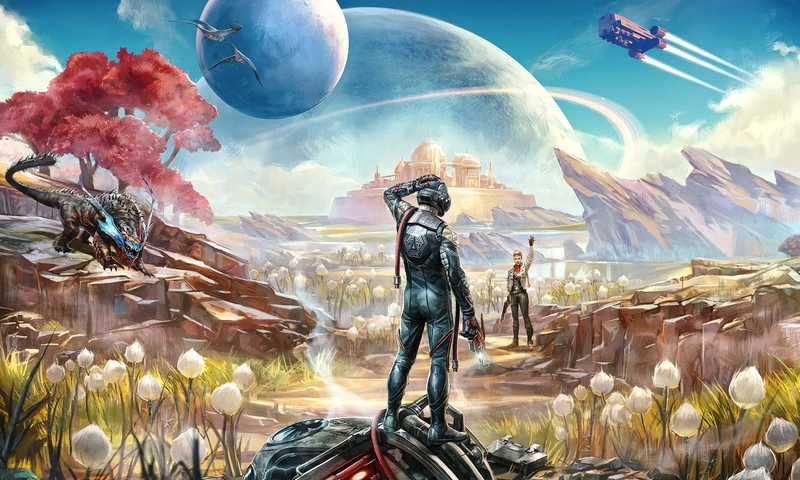
The Outer Worlds by Obsidian
The Outer Worlds by Obsidian; @Obsidian Entertainment

Powered by Guardian.co.ukThis article titled “From Cyberpunk 2077 to The Outer Worlds: are role-playing games getting too predictable?” was written by Alex Hern, for theguardian.com on Tuesday 20th August 2019 08.30 UTC

It might be set in space rather than on an Earth ravaged by nuclear war, but there is a strong argument that The Outer Worlds, a forthcoming first-person role-playing game (RPG) by storied developers Obsidian, is spiritually a Fallout game. Not only is it directed by Fallout creators Tim Cain and Leonard Boyarsky, it shares a lot of DNA with Obsidian’s Fallout: New Vegas – a spin-off with a reputation as the best in the series. New Vegas earned particular praise for its dialogue, and a world-building background that makes it feel like more than a thin justification for firing mini-nukes at super-mutants.

New Vegas was Obsidian’s first and last game set in the Fallout universe, but The Outer Worlds places similar importance on freedom of choice in dialogue and gameplay. In this world, where mega corporations are starting to take over alien planets, you can act like a hero, an opportunistic mercenary, or a total idiot. The writing is sharp, snappy and funny, the world exciting and vibrant, and there’s a classic New Vegas interplay between factions of characters, any of whom the player can help or hinder.

The genre of choice-based, do-what-you-like narrative game that The Outer Worlds inhabits – sometimes called “immersive sims” – is one I love. But it has ossified so much that a 2019 game can build on the legacy of one from 2010 without needing to change much.

Freedom of choice: will you chat to people or terrorise them? ... The Outer Worlds
Freedom of choice: will you chat to people or terrorise them? … The Outer Worlds. Photograph: Obsidian

This year’s E3 games expo was a stark reminder of how formulaic games in this mould have become. Showing off The Outer Worlds for the first time, Obsidian had the player arriving on a new planet and heading off obediently to infiltrate a facility on the ask of a quest-giver. Depending on whether the player’s character is created for intelligence, stealth, strength or whatever else, they can go in guns blazing; sneak around without being noticed; or use a combination of charm, intimidation, persuasion and hacking to waltz in as if they own the place. But on meeting the head of the facility, there’s a twist: they offer to double your fee if you go back and kill the person who sent you.

When I went to see the near-future action-RPG Cyberpunk 2077, Polish developer CD Projekt showed the player arriving in a new part of the game world, heading off to meet a quest-giver and being told to infiltrate a facility. You can take three broad approaches, we’re told: go in guns blazing; sneak around; or chat your way inside. But once again, on meeting the head of the facility, they offer to double the fee if you go back and kill the person who sent you there in the first place.

In tone and style, Cyberpunk 2077 and The Outer Worlds are different: one is a gritty, violent, urban affair, the other colourful sci-fi. But the fundamental skeleton the games are built on is so constricting that, given an hour to show off everything they could be, both developers independently converged on a near-identical script.

Genre conventions like this have their advantages. Film has embraced the three-act structure for years; pop songs have settled on a rhythm of verse-chorus-verse-chorus-bridge-chorus. They provide creators with structure and familiarity on top of which innovation can occur without fear of alienating audiences.

Gritty and violent … Cyberpunk 2077.
Gritty and violent … Cyberpunk 2077. Photograph: CD Projekt Red

But every now and again, a game comes along which shows that innovation can happen without putting people off and revives a genre in the process. The Ubisoft model was once to open-world games what the Fallout model is to first-person RPGs. The blueprint: climb towers to unlock new areas, sprinkle a map with icons representing mini goals to reach, make progress at your leisure. It underpinned Ubisoft’s Assassins Creed, Far Cry and Watch Dogs series, Warner Bros’ Batman and Middle Earth franchises, and many others.

Then came The Legend of Zelda: Breath of the Wild, in 2017. It’s got the towers, the open-world, and the plethora of smaller activities to distract you from the main noble quest. But it quietly revolutionised that stale old structure. Nothing in Breath of the Wild is gated. If you wanted (and you were extremely skilled) you could simply walk to the final boss and finish the game, though you would be far more likely to be lasered to death by guardian robots on the way up to the castle. The icon-filled map is almost entirely gone: only fast-travel points and the occasional quest-line show up. The rest is there for you to discover with your eyes and ears, rather than following objective markers like an orienteering enthusiast.

I’m looking forward to The Outer Worlds and Cyberpunk 2077. But their genre needs its Breath of the Wild moment: an outsider to toss out the conventions, and build something beautiful from what is left. Surely choosing between shooting, stealthing or sweet talking can’t be the only options that the next generation of virtual worlds have to offer.

guardian.co.uk © Guardian News & Media Limited 2010

Published via the Guardian News Feed plugin for WordPress.
Head in the cloud(s): the return of Microsoft Flight Simulator


microsoft flight simulator
microsoft flight simulator; screenshot @.flightsimulator.com/

Powered by Guardian.co.ukThis article titled “Head in the cloud(s): the return of Microsoft Flight Simulator” was written by Matt Kamen, for theguardian.com on Wednesday 24th July 2019 09.00 UTC

Flight Simulator was once one of the jewels in Microsoft’s crown, as close to synonymous with PC gaming as it’s possible to get. The series debuted a staggering 37 years ago, pre-dating even Windows as an operating system, and demanded exacting attention from players as they guided increasingly detailed planes safely through the skies. Over the course of a dozen iterations spanning nearly four decades, the flying experience evolved from blocky cockpit views to full aerial tours with a hangar’s worth of realistically modelled aircraft to get to grips with. It’s been running so long that even Microsoft does not know its sales figures, but Flight Simulator has certainly been played by millions.

Yet as PC gaming blossomed, becoming home to everything from competitive shooters to arthouse narrative games, Flight Simulator’s star began to wane. The last major release was 2006’s Microsoft Flight Simulator X (eventually revamped and repackaged for Steam in 2014), while 2012’s simplified spin-off, Microsoft Flight, had an aborted take off, cancelled a mere five months after launch. The golden age of flight (simulators) has long been over.

Until, that is, this year’s E3 in Los Angeles, where a brand new Microsoft Flight Simulator made a surprise appearance. It was announced during the Xbox conference, for Xbox consoles as well as its more familiar PC home. The franchise’s shock reappearance was very well-received, but even Microsoft’s head of Xbox Phil Spencer wasn’t confident about debuting a flight sim alongside the likes of Gears of War and Forza.

“I remember we were going through the planning, and I was like, ‘could we really get Flight Sim on our stage?’,” Spencer says. “I thought for sure, there’s just no way. But then we saw the visuals.”

As the trailer above demonstrates, the new Flight Simulator looks absolutely astounding. Real-world locations including Dubai, San Francisco, and Egypt are recreated in photorealistic 4K resolution, with geography and textures captured from satellite imagery. Players will be able to control numerous authentic planes from light aircrafts to passenger vehicles, set their own flight paths, and navigate through unpredictable scenarios thrown up by Microsoft’s Azure cloud computing platform, which leverages artificial intelligence and machine learning to dynamically shift flight conditions. This will keep players on their toes – get too comfortable running a commuter flight, and Azure might throw up sudden shifts in the weather, turning a sunny flight into a battle to keep aloft as storm conditions roll in.

Spencer first saw footage of Flight Simulator in “probably February or March”, and was so taken aback that he had to confirm with Microsoft’s studios head Shannon Loftis that it was actually real. “There were scenes that look better than photorealistic,” he recalls.

If Flight Simulator looks ahead of its time, that’s because, in many ways, it is. Not only do the underlying AI and graphical technologies behind its creation push current gaming technology to its limits, but they begin to surpass them. The geographic data alone, needed to render the world players will be flying around, comes in at two petabytes – equivalent to 20,000 Blu-ray discs.

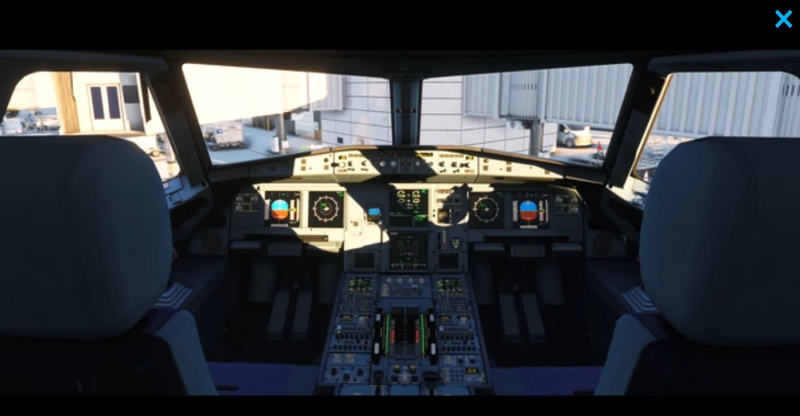
Microsoft Flight Simulator screenshot: a view from the cockpit.
Microsoft Flight Simulator screenshot: a view from the cockpit. Photograph: Microsoft

It will be far in excess of what can fit on a disc or be reasonably downloaded, and so Flight Simulator is at the vanguard of a new breed of game that can only live, perhaps fittingly, in the cloud. Microsoft servers will do a lot of the visual processing remotely and beam the results to a player’s screen, doing away with the need for a super-powerful PC at home (though you will need a fast internet connection). This is part of a wider shift that is already under way in video games: as technology improves and developers strive to create ever more realistic virtual worlds, games balloon in size, and the hardware needed to run them becomes more and more expensive. Offloading some of that data and processing to cloud servers is the solution that Microsoft – among other companies, such as Google – is betting on.

For games like Flight Simulator, the cloud provides “a system that kind of understands how much capability I need at any point,” Spencer explains. “It’s no different than what we’ve done in years past, streaming into available RAM that’s available on our consoles.” Flight Simulator will have an offline mode when it launches in 2020, but given how heavily it relies on data streamed from Microsoft servers, it’s likely to be severely truncated.

Always-online games are sometimes controversial – not everyone likes logging into a server every time they want to play (and indeed, some players aren’t able to). But in this case, the advantages are surely worth it. “We’re getting to the point with games where there’s the [question of] how much data can you actually download and store?” says Spencer. “[But] there’s also the matter of how much data do I need to have locally at any time? I’m not playing the beginning, middle and end of every game at every time … Not only do we have two petabytes of data behind [Flight Simulator], but we’ve got Azure AI running [so] you have different levels of fidelity in different parts of the planet. As you’re flying around, you’re seeing the highest buildings and the weather’s changing in real time. It is just unreal.”

Ahead of Flight Simulator’s release in 2020, Microsoft has launched an Insider program, to share development updates with players and provide early access to the game in return for feedback from early adopters. Flight Simulator’s approaching return will be watched closely by its many passionate fans – but if Microsoft can stick the landing, this will be a game beyond the wildest dreams of anyone who played in the 80s and 90s.

guardian.co.uk © Guardian News & Media Limited 2010

Published via the Guardian News Feed plugin for WordPress.