After three years of a “temporary” shop that behaved suspiciously like a long engagement, the French house has made it official.
When a brand famous for waiting lists decides to stay somewhere, the neighborhood should take notice. Williamsburg, the Brooklyn enclave once known for warehouses, vinyl and artisanal everything, now has a permanent address of the world’s most patient luxury house.
The News, Decoded
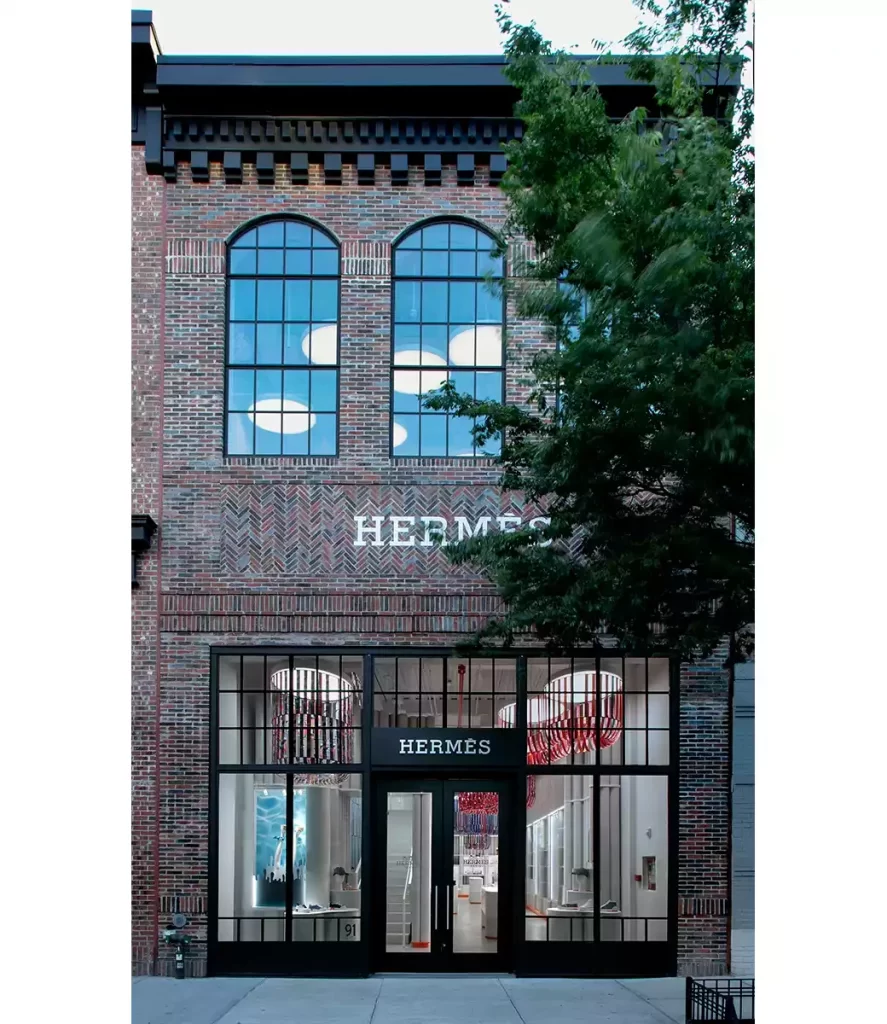
Hermès, the Parisian house founded in 1837 as a harness workshop and now best known for the Birkin and Kelly bags, silk scarves and its orange packaging, opened its first permanent Brooklyn store on September 19, 2026. It stands at 130 Berry Street, on the corner of North 6th Street, in the same warehouse-style building that hosted an Hermès pop-up for about three years. It is the house’s 44th store in the United States.
The boutique was designed by RDAI, the Paris architecture studio that shapes Hermès stores worldwide. Over two floors, five brick façades echo the neighborhood’s architecture, while the interior borrows from Brooklyn lofts and workshops: high ceilings, raw brick, gray terrazzo, metalwork and oak. Local artists contributed to the walls and floor details, a staircase is wrapped in leather and modeled on city fire escapes, and the opening windows were created by Antoine Platteau, who designs the windows at Hermès’s Paris flagship, together with Brooklyn artist Christina Zimpel. The store presents all of the house’s 16 métiers, the term Hermès uses for its craft categories, from leather goods and silk to home, jewelry and beauty. Gucci and Bottega Veneta have staged pop-ups in the area, but reports describe Hermès as the first couture-caliber brand to commit to a long-term home there.
The Perspective
Why Williamsburg? Start with the pop-up. Hermès did not arrive with a flagship and a marketing blitz; it tested the neighborhood first. Three years of temporary trading is, in luxury terms, a long courtship. By the time the permanent store opens, the brand knows who walks in, what they buy and how far they travel. Local population growth (reports cite about 41% in the decade to 2020) and an affluent, creative customer base made the bet safer than it looks.
How to decode the architecture. Hermès’ design is the real message. A glossy Manhattan-style box would have said “we have arrived.” Brick façades, local artists and fire-escape stairs say “we belong here.” That matters because Williamsburg’s audience is allergic to obvious luxury. Hermès solves this the way it always does: with craft that feels specific rather than loud. In other words, the house understood the assignment and then politely overdelivered it.
The slow-luxury logic. Hermès grows by adding stores carefully rather than flooding markets, and it keeps supply tight. A neighborhood store can deepen loyalty without diluting scarcity. Brooklyn clients who once crossed the river now have a boutique at home, and Manhattan loses nothing, since the brand has little interest in discounting either.
The Map to Modern Luxury
THE CURATED CALENDAR
Discover the world’s most prestigious gatherings & exhibitionsWhat to expect. Expect the full Hermès repertoire, including a leather goods department. As anywhere else, availability of the most coveted bags is at the house’s discretion, so do not plan a vacation around a particular color. Expect rotating windows, with local artists and community-flavored displays, and a store that doubles as a neighborhood attraction. Whether it becomes a sales engine or a brand statement, it works as both.
Humor break: a Birkin in Brooklyn is no longer a rumor of Fifth Avenue; it is a possibility two subway stops from your favorite oat-milk café. The oat milk, regrettably, is still not available in orange.
The takeaway: luxury retail is moving from grand avenues to well-researched neighborhoods. Hermès’s move shows that the most powerful strategy is patience: test, listen, then plant roots.


