The most famous car brand on earth has figured out how to sell you the idea of a Ferrari, even if you never turn the key.
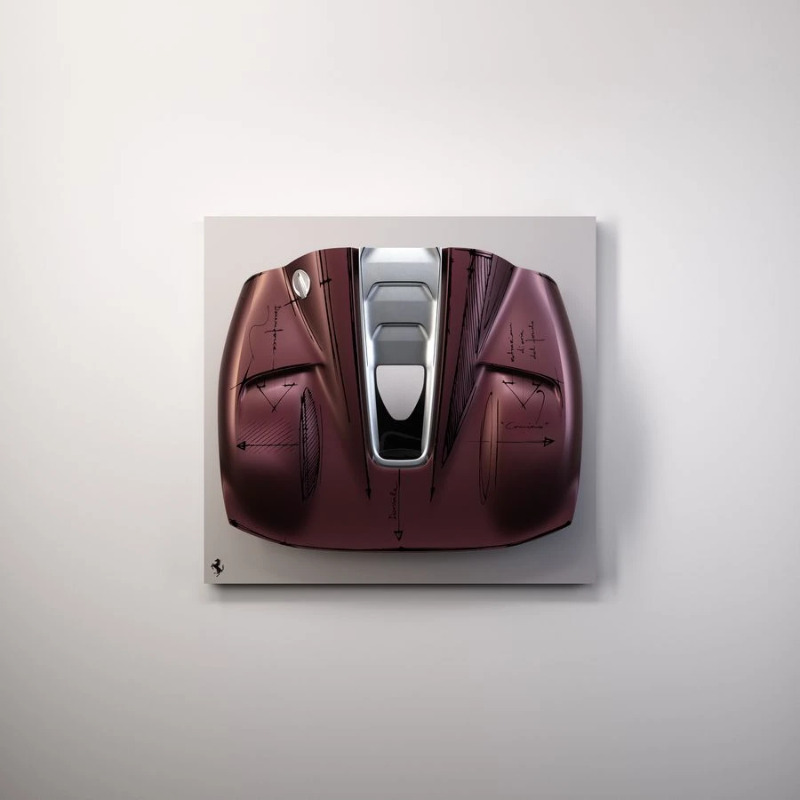
There is a point in every luxury empire’s life when the core product, however magnificent, is no longer the only way to monetize devotion. Hermès has scarves, Ferrari has… bonnets. Framed ones.
The News, Decoded
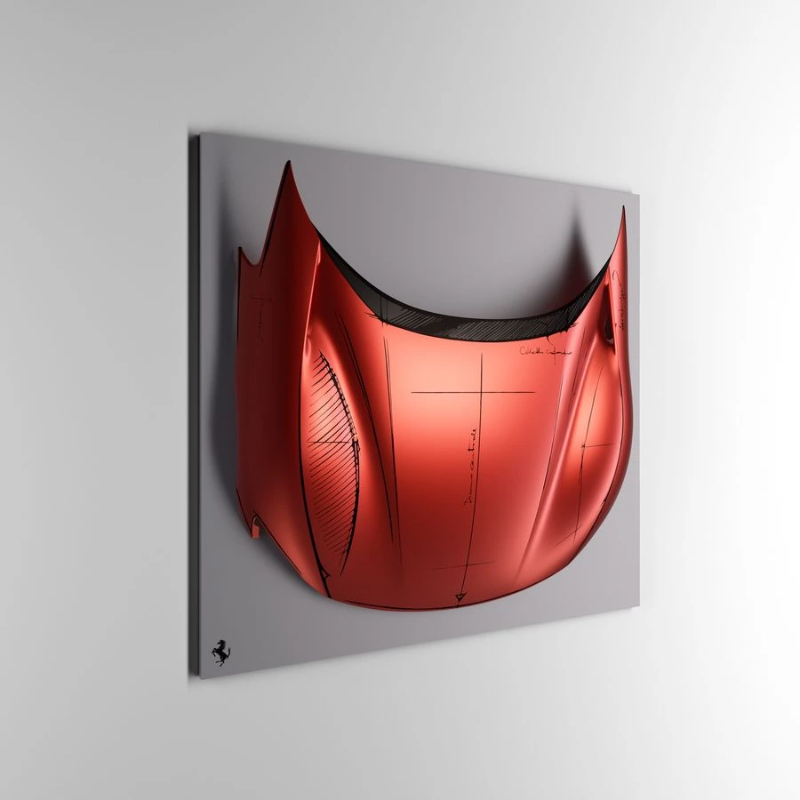
Ferrari, the Maranello-based Italian marque famous for its red, V12-powered supercars and its Formula 1 team, has launched Sketch Body, the newest chapter of its Collectibles project. Earlier chapters (Components, Red Pieces and Drivers’ Pieces) offered racing-related parts and memorabilia. Sketch Body goes in a more openly artistic direction: hoods and rear spines from road cars become three-dimensional canvases carrying the hand-drawn lines of Flavio Manzoni, Ferrari’s chief design officer.
The concept grows out of the one-off 812 Competizione Tailor Made, a car on which sketch lines were painted directly onto the bodywork. The gallery shows panels based on the 12Cilindri, Purosangue, Daytona SP3 and the F80 hypercar. Ferrari says the idea explores the relationship between the first design gesture and the engineering needed to realize it, bringing the two back together on one surface. Pricing, production numbers and the sales method have not been disclosed.
Meanwhile, at the Museo Enzo Ferrari in Modena, The Greatest Hits – Music Legends and their Ferraris has run since February 2026 and stays open until 16 February 2027. The exhibition mixes cars, photography and original audio, including podcasts narrated with journalist Federico Buffa. On display: conductor Herbert von Karajan’s 250 GT Lusso, the one-off SP12 commissioned by Eric Clapton, J Balvin’s 512 TR and the SF90 XX owned by Swizz Beatz. The coda is a Ferrari Jukebox.
The Perspective
Put the two projects side by side and the strategy is unmistakable: Ferrari is turning from a manufacturer into a cultural institution. One project moves the car into the gallery (art); the other moves musicians into the museum (culture). Both say the same thing: a Ferrari is not transport, it is a medium.
This matters commercially. Ferrari deliberately builds fewer cars than it could sell; scarcity is the business model. But the waiting list of people who want the brand is far larger than the group who can be allocated a car. Luxury collectibles are the pressure valve. A body panel with a designer’s pencil lines is a way to belong to the story without joining the order book. It is the supercar equivalent of the fashion house’s fragrance, only with considerably more aluminum and, one suspects, a considerably higher price tag.
The Map to Modern Luxury
THE CURATED CALENDAR
Discover the world’s most prestigious gatherings & exhibitionsThere is also a clever honesty in the Sketch Body idea. Luxury usually hides the process and sells the finished object. Here, the process is the object: the napkin sketch, the first gesture, the lines before the lawyers and the wind tunnel. Collectors increasingly pay for provenance and authenticity, and “the drawing that became the car” is as authentic as marketing gets.
As for the music exhibition, it is the softer side of the same logic. Musicians are the original influencers of the car world, and their choices (a Lennon 330 GT 2+2, Clapton’s commissioned one-off) turn Ferrari into a lifestyle with a soundtrack. Ownership stories sell cars better than horsepower figures.
The gentle humor writes itself: Ferrari has found a way to sell you the car you could not afford, in the part you can hang above the sofa. Whether the wall is ready for 2.5 meters of carbon-and-aluminum ego is a question for your interior designer.
The takeaway: the next frontier of ultra-luxury automotive branding is not the next engine. It is the next way to own a piece of the myth.