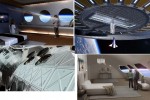
IFA 2019: Monolith – a towering achievement in cooling technology

      IFA 2019: Monolith – More space for pure luxury; Monolith, Liebherr Appliances’ refrigeration division, is taken to the next level. Stainless steel will still be a luxury status symbol, but formulated differently by moving to the interior: stainless steel drawer boxes, interiors of fridges like the ones presented by Liebherr Appliances’ Monolith luxury … Read more

From Cyberpunk 2077 to The Outer Worlds: are role-playing games getting too predictable?


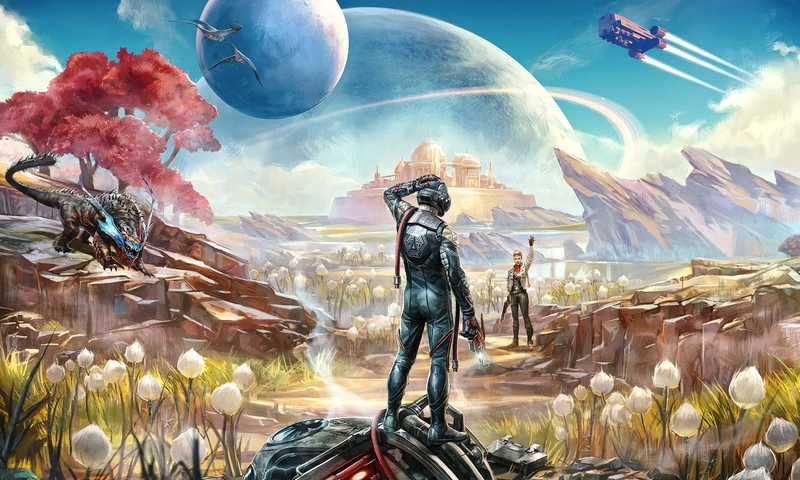
The Outer Worlds by Obsidian
The Outer Worlds by Obsidian; @Obsidian Entertainment

Powered by Guardian.co.ukThis article titled “From Cyberpunk 2077 to The Outer Worlds: are role-playing games getting too predictable?” was written by Alex Hern, for theguardian.com on Tuesday 20th August 2019 08.30 UTC

It might be set in space rather than on an Earth ravaged by nuclear war, but there is a strong argument that The Outer Worlds, a forthcoming first-person role-playing game (RPG) by storied developers Obsidian, is spiritually a Fallout game. Not only is it directed by Fallout creators Tim Cain and Leonard Boyarsky, it shares a lot of DNA with Obsidian’s Fallout: New Vegas – a spin-off with a reputation as the best in the series. New Vegas earned particular praise for its dialogue, and a world-building background that makes it feel like more than a thin justification for firing mini-nukes at super-mutants.

New Vegas was Obsidian’s first and last game set in the Fallout universe, but The Outer Worlds places similar importance on freedom of choice in dialogue and gameplay. In this world, where mega corporations are starting to take over alien planets, you can act like a hero, an opportunistic mercenary, or a total idiot. The writing is sharp, snappy and funny, the world exciting and vibrant, and there’s a classic New Vegas interplay between factions of characters, any of whom the player can help or hinder.

The genre of choice-based, do-what-you-like narrative game that The Outer Worlds inhabits – sometimes called “immersive sims” – is one I love. But it has ossified so much that a 2019 game can build on the legacy of one from 2010 without needing to change much.

Freedom of choice: will you chat to people or terrorise them? ... The Outer Worlds
Freedom of choice: will you chat to people or terrorise them? … The Outer Worlds. Photograph: Obsidian

This year’s E3 games expo was a stark reminder of how formulaic games in this mould have become. Showing off The Outer Worlds for the first time, Obsidian had the player arriving on a new planet and heading off obediently to infiltrate a facility on the ask of a quest-giver. Depending on whether the player’s character is created for intelligence, stealth, strength or whatever else, they can go in guns blazing; sneak around without being noticed; or use a combination of charm, intimidation, persuasion and hacking to waltz in as if they own the place. But on meeting the head of the facility, there’s a twist: they offer to double your fee if you go back and kill the person who sent you.

When I went to see the near-future action-RPG Cyberpunk 2077, Polish developer CD Projekt showed the player arriving in a new part of the game world, heading off to meet a quest-giver and being told to infiltrate a facility. You can take three broad approaches, we’re told: go in guns blazing; sneak around; or chat your way inside. But once again, on meeting the head of the facility, they offer to double the fee if you go back and kill the person who sent you there in the first place.

In tone and style, Cyberpunk 2077 and The Outer Worlds are different: one is a gritty, violent, urban affair, the other colourful sci-fi. But the fundamental skeleton the games are built on is so constricting that, given an hour to show off everything they could be, both developers independently converged on a near-identical script.

Genre conventions like this have their advantages. Film has embraced the three-act structure for years; pop songs have settled on a rhythm of verse-chorus-verse-chorus-bridge-chorus. They provide creators with structure and familiarity on top of which innovation can occur without fear of alienating audiences.

Gritty and violent … Cyberpunk 2077.
Gritty and violent … Cyberpunk 2077. Photograph: CD Projekt Red

But every now and again, a game comes along which shows that innovation can happen without putting people off and revives a genre in the process. The Ubisoft model was once to open-world games what the Fallout model is to first-person RPGs. The blueprint: climb towers to unlock new areas, sprinkle a map with icons representing mini goals to reach, make progress at your leisure. It underpinned Ubisoft’s Assassins Creed, Far Cry and Watch Dogs series, Warner Bros’ Batman and Middle Earth franchises, and many others.

Then came The Legend of Zelda: Breath of the Wild, in 2017. It’s got the towers, the open-world, and the plethora of smaller activities to distract you from the main noble quest. But it quietly revolutionised that stale old structure. Nothing in Breath of the Wild is gated. If you wanted (and you were extremely skilled) you could simply walk to the final boss and finish the game, though you would be far more likely to be lasered to death by guardian robots on the way up to the castle. The icon-filled map is almost entirely gone: only fast-travel points and the occasional quest-line show up. The rest is there for you to discover with your eyes and ears, rather than following objective markers like an orienteering enthusiast.

I’m looking forward to The Outer Worlds and Cyberpunk 2077. But their genre needs its Breath of the Wild moment: an outsider to toss out the conventions, and build something beautiful from what is left. Surely choosing between shooting, stealthing or sweet talking can’t be the only options that the next generation of virtual worlds have to offer.

guardian.co.uk © Guardian News & Media Limited 2010

Published via the Guardian News Feed plugin for WordPress.
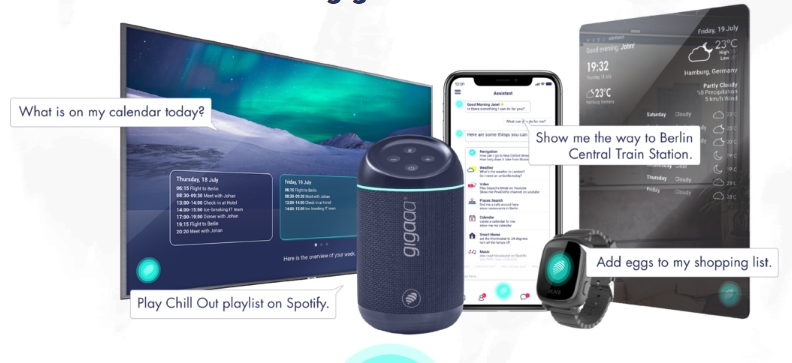
Focus topics of IFA NEXT 2019 – global know-how for the future of technology, business and lifestyle

        Focus topics of IFA NEXT, the innovation platform of IFA Berlin 2019. Smart cities, the future of mobility, artificial intelligence, robotics and virtual reality – these and many other topics are the focus of IFA NEXT, the innovation platform of IFA, an exciting mix of start-ups, tech companies and research institutions. … Read more

Lancôme x Zendaya to combat illiteracy among women and give voice to this universal cause

    Of the 43 million low literate adults in the U.S., two-thirds of them (28 million) are women. Because of this number, ProLiteracy and Lancôme partnered together to develop the Write Her Future Institute to empower women through literacy. Women who lack basic reading and writing skills have a hidden handicap that can seriously … Read more

Holidays in the stars: Von Braun Space Station – world’s first space hotel with artificial gravity


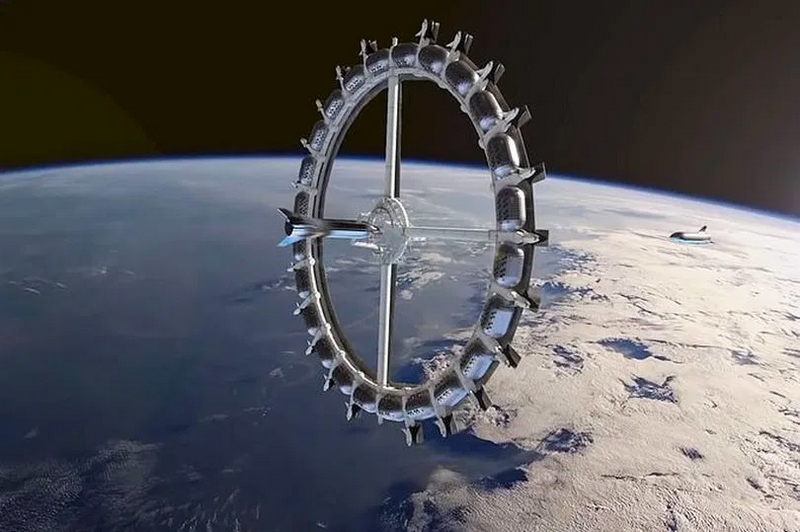
Von Braun Space Station - world's first space hotel with artificial gravity
Von Braun Space Station – world’s first space hotel with artificial gravity; @gatewayspaceport.com

Humankind has long held a fascination with building a large spaceport like The Gateway. Designs for Von Braun Space Station, world’s first space hotel with artificial gravity, have been unveiled.

Both scientists and science fiction writers have thought about the concept of a rotating wheel space station since the beginning of the 20th century. Konstantin Tsiolkovsky wrote about using rotation to create an artificial gravity in space in 1903. Herman Potočnik introduced a spinning wheel station with a 30-meter diameter in his Problem der Befahrung des Weltraums (The Problem of Space Travel). He even suggested it be placed in a geostationary orbit.

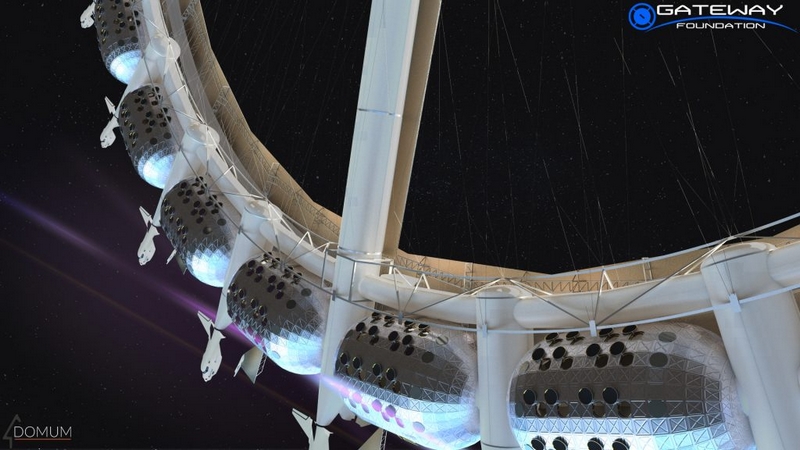
Von Braun Space Station - world's first space hotel with artificial gravity-
Von Braun Space Station – world’s first space hotel with artificial gravity; @gatewayspaceport.com

A rotating wheel space station, or von Braun wheel, is a hypothetical wheel-shaped space station that rotates about its axis, thus creating an environment of artificial gravity.

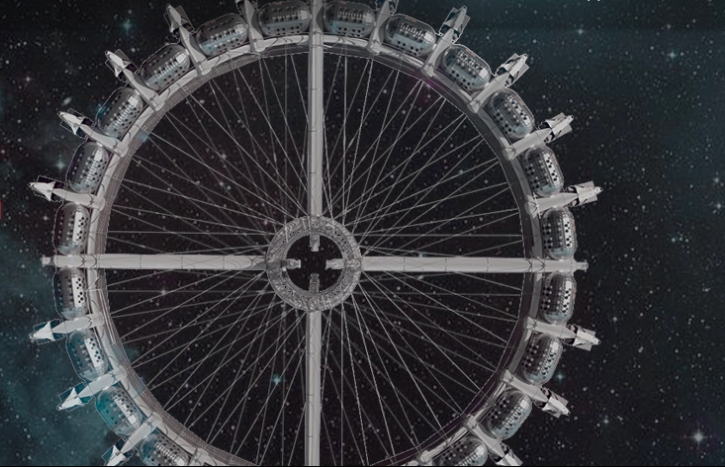
Von Braun Space Station is just a design now but has the potential to become the first commercial space hotel with artificial gravity “operational by 2025 with 100 tourists visiting the station per week”. Designed by the Gateway Foundation, the Von Braun Space Station is resembling a space ship. The structure will consist of two concentric structural rings fixed together with a set of spokes supporting a Habitation Ring made-up of large modules.

According to The Gateway Foundation, the rotating space station will be designed to produce varying levels of artificial gravity by increasing or decreasing the rate of rotation.

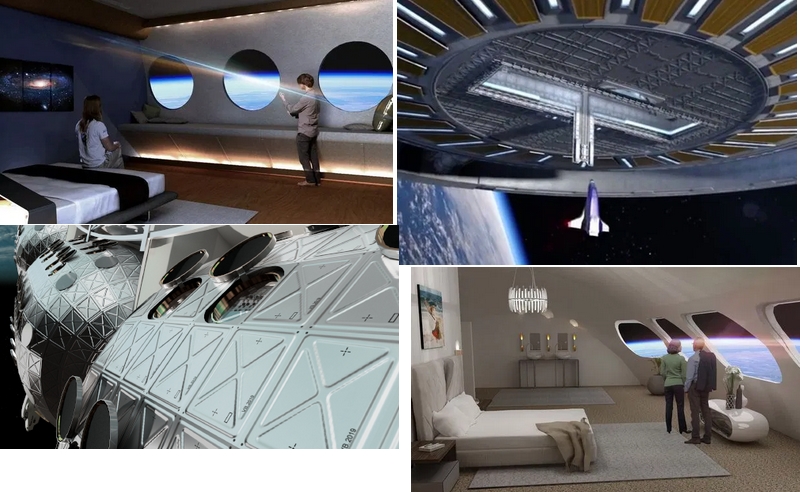
The space hotel will have gravity so guests can walk around.

The station will be designed from the start to accommodate both national space agencies conducting low gravity research and space tourists who want to experience life on a large space station with the comfort of low gravity and the feel of a nice hotel. The space hotel will offer 24 space suites with “Earth view” fully operational restaurants, bars and cinemas.

“Some of the space station’s modules will be sold as private residences, wrote businesstelegraph.co.uk, while government and science agencies such as NASA will rent the others.”

An un-pressurized ring structure with docking arms and stabilizers designed to capture and lock in place a visiting spacecraft to unload passengers and cargo. At first there will be one docking port, but later we will add another so that two craft can be docked to the station at the same time. All passenger and cargo access to the station will be through a set of pressurized access tubes connecting the Docking Hub to the Outer Ring Truss.

NASA has never attempted to build a rotating wheel space station, for several reasons. First, such a station would be very difficult to construct, given the limited lifting capability available to the United States and other spacefaring nations. Assembling such a station and pressurizing it would present formidable obstacles, which, although not beyond NASA’s technical capability, would be beyond available budgets. Second, NASA considers the present space station, the ISS, to be valuable as a zero gravity laboratory, and its current microgravity environment was a conscious choice.[3]

More recently, NASA has explored plans for a Nautilus X centrifuge demonstration project. If flown, this would add a centrifuge sleep quarters module to the ISS. This makes it possible to experiment with artificial gravity without destroying the usefulness of the ISS for zero g experiments. It could lead to deep space missions under full g in centrifuge sleeping quarters following the same approach.

Von Braun Space Station - world's first space hotel with artificial gravity-01
Von Braun Space Station – world’s first space hotel with artificial gravity; @gatewayspaceport.com

Von Braun Space Station - world's first space hotel with artificial gravity-02
Von Braun Space Station – world’s first space hotel with artificial gravity; @gatewayspaceport.com

London Design Festival 2019: Sony looks at the future relationship humans can develop with robots capable of emotion

    Affinity in Autonomy – an exploration into how technology can enrich our lives and society Since the creation of the world first Entertainment Robot, ‘AIBO’ in 1999, Sony has continued to grow its knowledge and understanding of AI and Robotics. At this year’s London Design Festival, Sony envisions a futuristic installation of AI … Read more