Theoretically, at a luxury hotel no request is too big. Ritz-Carlton Partners with Vogue and GQ for First Immersive Theatre Experience
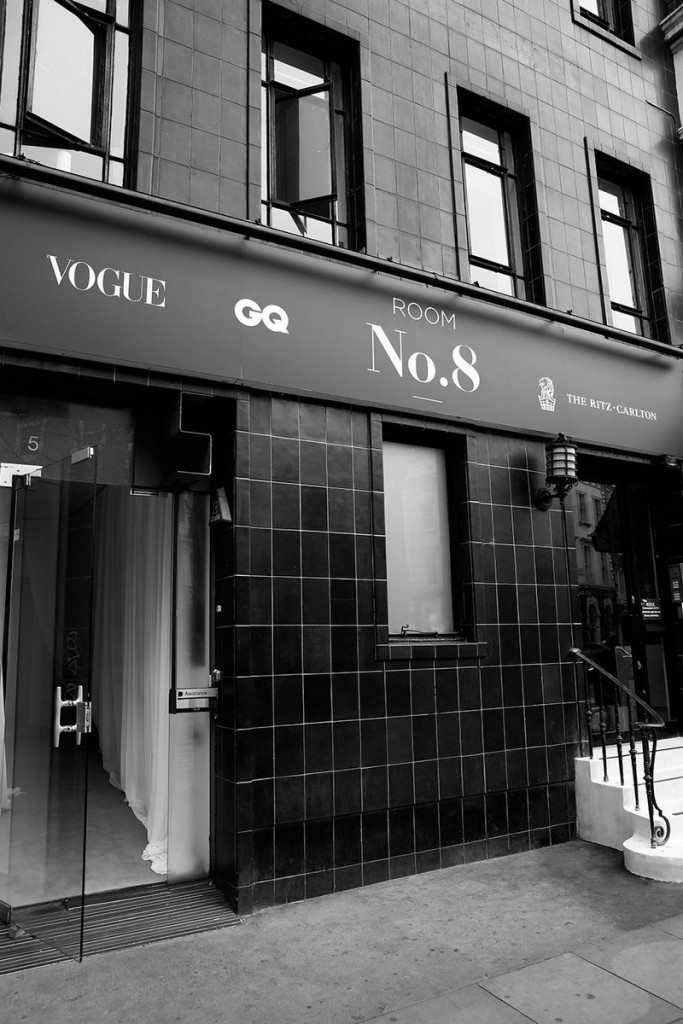
Room No.8 is a special hotel room inspired by “the infinite possibilities of the Ritz-Carlton.” In collaboration with British Vogue and British GQ to create this unique room concept, The Ritz-Carlton presented a multi-sensory performance-art experience created by some of the best names in visual effects, sound art and immersive theatre. The first of its kind, this event showcased The Ritz-Carlton to patrons in London, was created for enlivening senses in a whole new way. Room No. 8 was held at the White Space Gallery, London WC2.
“One of our opportunities in marketing is to bring to life the magical experiences created by the ladies and gentlemen at our hotels through media channels. With Room No.8, Condé Nast, UK has worked with our brand to create a beautiful, highly sensory journey, which is designed to further levels of engagement and interest in our hotels worldwide,” explained Nick Teare, Senior Director, Brand & Field Marketing The Ritz-Carlton.
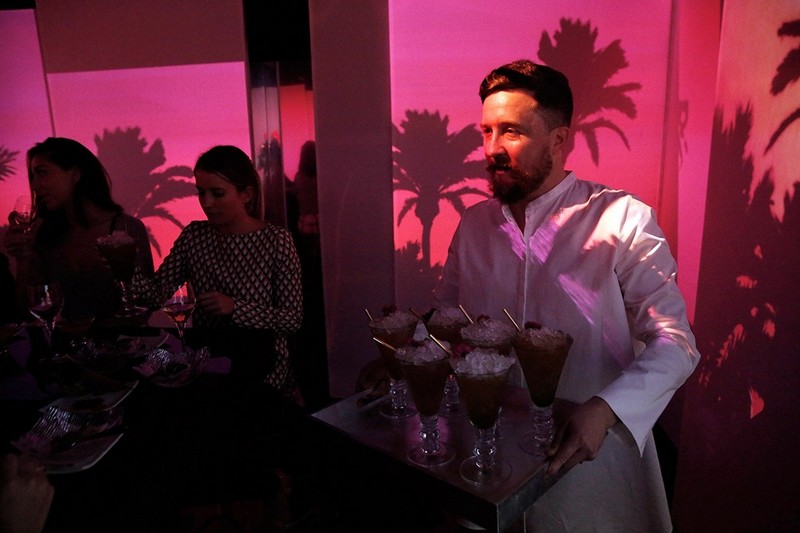
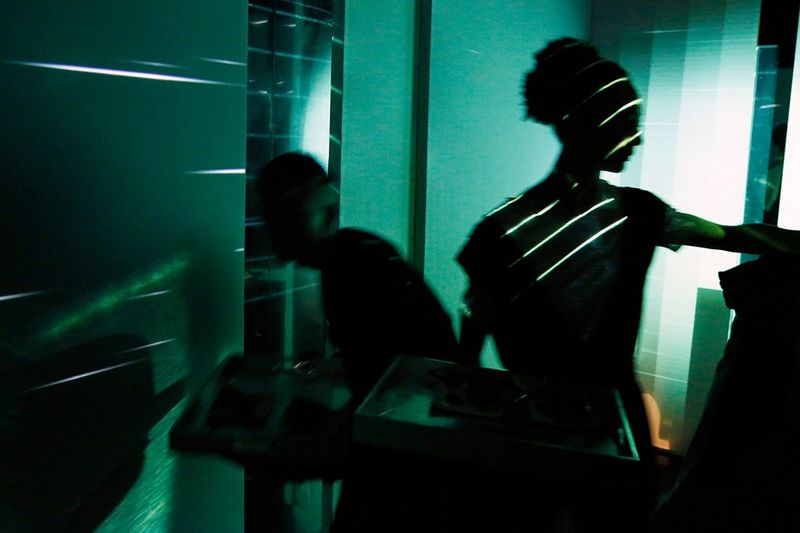
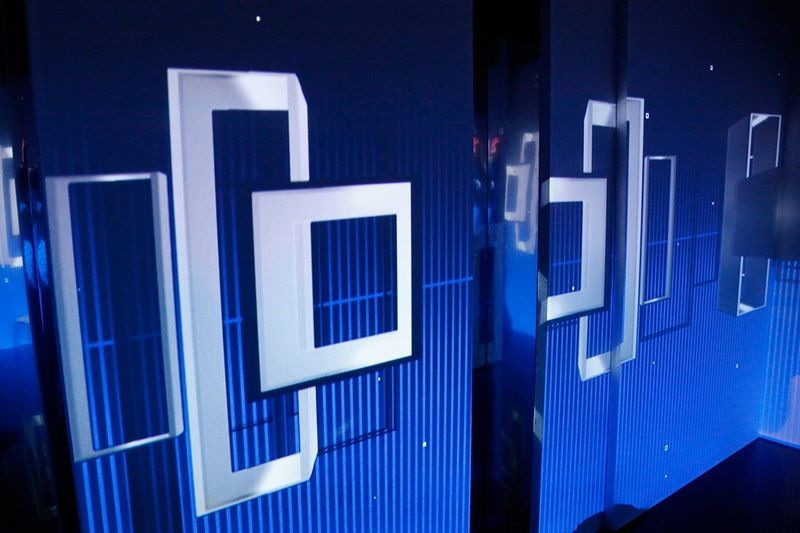
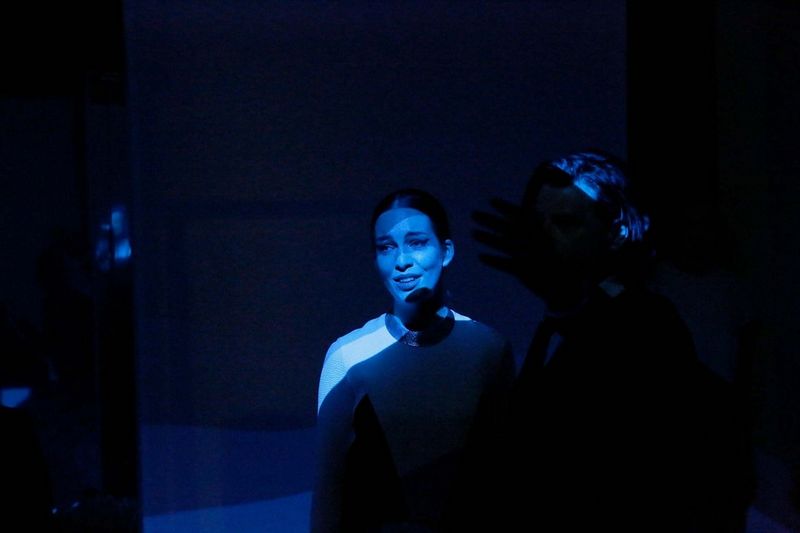
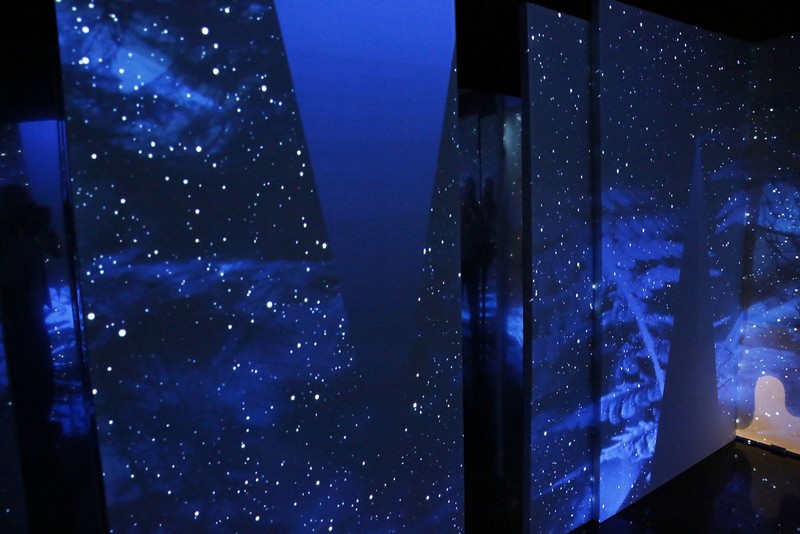
Upon arrival, guests breezed through flowing white curtains into a dark room with a table and seating for seven. Four courses of themed small plates and drinks were delivered as performers acted out real guest stories with the help of projection mapping, 360 degree panels, and custom audio recordings.
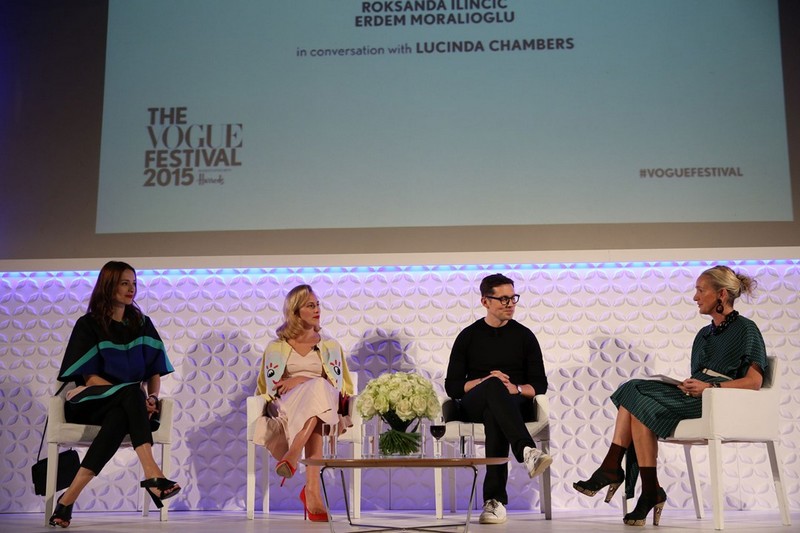
The Vogue Festival 2016 returns with an even more stellar line-up of activities and speakers – and Harrods will be sponsoring the fashion-packed event for the third year in a row. Taking place over the weekend of the 21st and 22nd of May on the East Albert Lawn in Kensington Gardens and the Royal Geographic … Read more
London Fashion Week starts on Thursday so mark it by getting acquainted with fashion designer extraordinaire Coco Chanel, from her humble beginnings to her last words on her deathbed
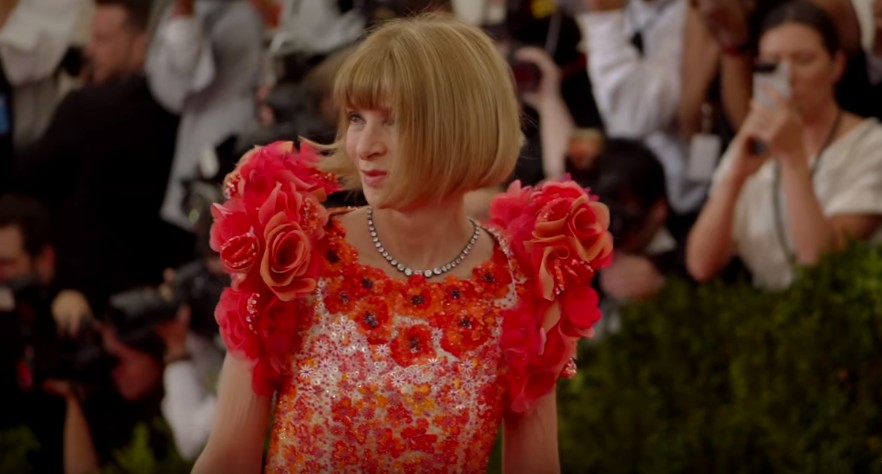
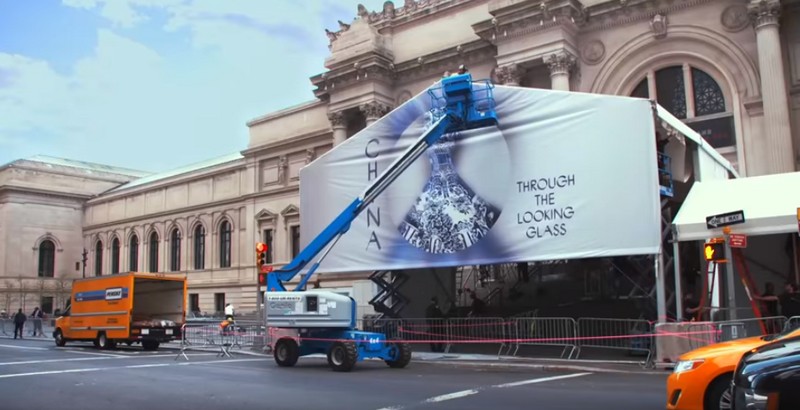
‘Fashion … it’s a kind of theatre.” You betcha, Anna Wintour. Which is why the trailer for the new behind-the-scenes Vogue film The First Monday in May is tantalisingly good. The documentary follows the team at Vogue and the Metropolitan Museum of Art as they prepare for the launch party of last year’s exhibition, China: Through the Looking Glass. The Met Ball – as it is affectionately known – is fashion’s most glamorous party, although insiders have sometimes whispered that, once inside, it’s well, um, boring. But it is, as Vogue alumnus André Leon Talley says, the “Super Bowl of social fashion events”, and the cash, the gossip and the general over-the-topness makes for compelling viewing.
Naturally, the trailer raises more questions than it answers. Here are our five:
The first trailer for The First Monday in May, a new documentary about Vogue magazine.
Who is always on his mobile phone ?
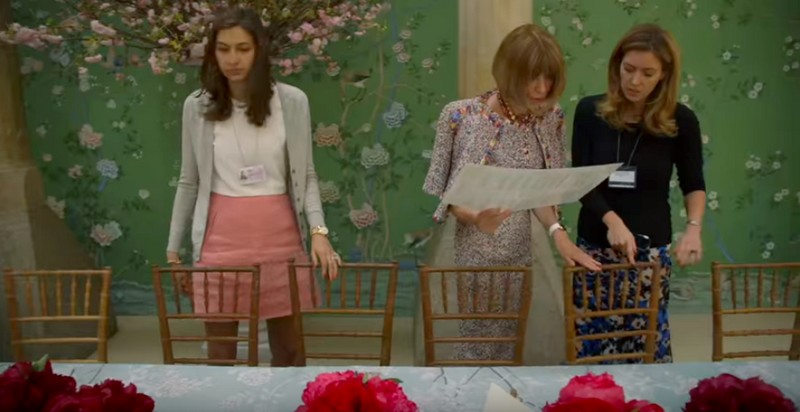
While Anna looks at the seating plan for the dinner with a glossy-haired courtier (sorry assistant), she dryly says: “Oh, he’s coming now, is he? Well, he’d better not be on his cellphone all night.” But who is being chided rather publicly? Is it Kanye? Is it Derek Blasberg? Or someone else?
Have we been pronouncing ‘Rihanna’ in a really unfashionable way for ages?
Because everyone at US Vogue says “Ree-Yanna”. It’s a little disconcerting. Alas, in the trailer no one discusses how to describe the singer’s omelette dress.
What sort of Chinese restaurants does Anna Wintour frequent?
In one scene, the editor-in-chief says: “It’s going to look like a Chinese restaurant.” Her tone suggests that’s a criticism. We’d be sceptical that Wintour knows anything about any eatery that doesn’t sell blooded steak if it weren’t for the fact that: a) cult label Vetements showed their catwalk collection in a Chinese restaurant recently; b) she was spotted eating fish and chips in the Refinery (a cocktail bar-cum-restaurant under an office block in SE1) during London fashion week; and c) she’s seen shifting the tables herself, which could hint at a pre-fashion life as a waitress?
Anna Wintour on the front row for the Topshop Unique AW16 show.Photograph: Richard Young/Rex/Shutterstock
Was curator Andrew Bolton the only one who considered that the exhibition theme could be interpreted as racist?
If so, why didn’t he mention it to Sarah Jessica Parker before she wore that questionable (was it appropriation or appreciation?) headpiece? Either way, the British curator is clearly one of fashion’s biggest brains. He is filmed striding the Met’s famous staircase in a tux and mankles, as the voiceover says: “I’m not afraid of controversy” and “this isn’t Disneyland”. Presumably, it was Bolton who put the kibosh on the exhibition’s original title, Chinese Whispers: Tales of the East in Art, Film and Fashion.
What exactly is the size of Rihanna’s budget?
The camera lingers on the subject bar of an email to Anna Wintour, which says: “Do you have a second to talk about Rihanna’s budget?” Oh yes, we have literally hours. Tickets famously cost $25,000 a pop, a couture dress costs up to $70,000, hair and makeup isn’t cheap; you would need a really, really big limo to get that dress in. Assistants are on pretty much minimum wage, but Rihanna would need at least seven. Thank goodness she seems content to swig a beer from a plastic cup.
Few publications, however august or important, have had quite the same continuous cultural impact on British life as British Vogue. You feel it shouldn’t be so – it is a magazine devoted to chronicling the clothes women wear, after all. Yet it has always been more than simply a fashion bible: at key moments in its history, Vogue becomes something different – a record of where and who we are. Or at least, would like to be.
On Tuesday, I went to the National Portrait Gallery for a sneak preview of Vogue 100: A Century of Style with my hair piled damp on my head and a red blister below one eye thanks to a splash of fat while cooking the previous night. Overwhelmed by home, children and work, I had failed to liberate any sophisticated clothes from the dry cleaner’s, so pitched up in a jumper that I realised afterwards was beginning to unravel at the hem.
This is my life and the life of many women. Yet I can look at the temple of style that Vogue represents and somehow feel I belong. Like Cecil Beaton’s famous wartime image of a woman gazing at the bomb-damaged ruins of Middle Temple, London, I may be in the midst of chaos, but somewhere deep inside me, I should know how to wear a well-tailored well-tailored suit by Digby Morton.
Fashion Is Indestructible by Cecil Beaton (1941). The Conde Nast Publications Ltd
This mystery of inclusion and exclusion, of the highest fashion being at the centre of life, yet somehow apart from it, lies at the heart of Vogue’s appeal. And all of this is up for debate, prompted by the photographs that line the gallery’s walls. At one level, it is the quality of the images that guarantees Vogue’s continuing eminence.
It was founded in 1916, in the middle of the first world war, when the American publisher Condé Montrose Nast shrewdly calculated that if American Vogue sales had quadrupled since 1914, then a British edition might also thrive. But he also believed that the best paper stock and the most modern typography and design were key to the magazine’s success. So too was the photography. As Robin Muir, curator of the National Portrait Gallery show and a former Vogue picture editor, points out: “The magazine used the great names of modern photography.”
And there they are, the images glossy with beauty, dripping with class. Edward Steichen’s four cloche-hatted models (including Lee Miller) on a yacht, gazing out to sea like well-dressed nymphs; his portrait of a smiling Chaplin, leaning on a cane, dwarfed by his own shadow; Beaton’s Vivien Leigh, impossibly slim, surrounded by the detritus of photography itself, like “a Persian gazelle in the dark studio forest of chains and planks”.
Those early years also saw another quality of British Vogue established. Its first editor, Dorothy Todd, only lasted a few months before she was sent to New York, to learn magazine publishing the Condé Nast way. On her return to the editorship in 1922, it wasn’t entirely clear she had learned the lesson. “She attempted,” says Muir in his catalogue essay “to turn Vogue from a fashion magazine with light coverage of the arts into a magazine of the arts that hesitantly included fashion.”
The Bloomsbury set flocked to “sweep guineas off the Vogue counter”, as Virginia Woolf put it in her diary in 1925. The novelist herself wrote no fewer than five essays for the magazine, and although Todd’s defiant literary pursuits were a commercial disaster (and led to her sacking), they set the template for something Vogue has continued to be – a magazine for smart women in every sense, for thinkers as well as fashion lovers. Down the years it has happily accommodated writers from Rebecca West to Jeanette Winterson, from Nancy Mitford to Antonia Fraser and Marina Warner. It has straddled the broad cultural landscape with considerable ease, perhaps because so few of the editors have been fashion specialists.
Beatrix Miller, the editor who had a decisive impact on the magazine in her tenure from 1964 to 1984, once defined the topography she called Vogueland. It was, she believed, “relatively superficial, but in the broadest sense, it is the mood of the moment translated visually – the words people use, the books they read, the sounds they hear, the houses they live in, the pictures they look at”.
David Hockney, Maudie James and Peter Schlesinger in 1968.Photograph: Cecil Beaton/The Conde Nast Publications Ltd
The current editor, Alexandra Shulman, appointed in 1992 and now the longest serving in British Vogue history, expresses a similar sentiment. “Vogue has always been very true to its initial aim to report on the world of contemporary style using the best talent available to do it,” she says. “Although styles and fashions change, Vogue has remained constant as a chronicler and to some extent creator of a certain type of world that fascinates. And a large amount of the content has been about culture in general, which is a great complement to fashion and which gives it a broader base than some other fashion magazines.”
The breadth of that base is reflected in the photographs. Fred Astaire dances, Alfred Hitchcock squats like a toad, John Osborne smokes, Francis Bacon broods, Kate Winslet shimmers, David Hockney paints in vivid technicolour – the cultural life of Britain has shimmied across the pages, presented through the eyes of photographers such as Beaton and David Bailey, who became famous themselves as they redefined what a portrait could do. Even Margaret Thatcher, who took a stern view of fashion magazines – “When we look at fashions, ordinary people like me, we would love photographs that show you what the clothes are actually like” – takes her place in the Vogue pantheon, stern but glamorous in black velvet and pearls, photographed by Bailey.
It is a very British affair. As Shulman points out “All the Vogues are very home-culture specific. And British Vogue has certainly been helped by the culture of this country. There is such a rich mix of talent, creativity, society and influences for us to reflect.”
Historically, it was the second world war that established this national character. “It was the making of the magazine,” Muir argues. “It was given extra paper, even under rationing, because it was considered very important for morale on the home front. And it had to stand alone and find its own identity; it couldn’t rely on imported pictures from the US, and there is not much happening culturally so it looks very inward.”
Beaton came into his own, swapping society beauties for wartime reporting. Norman Parkinson entered the lists, with bucolic images of farm girls in government-approved austerity wear, somehow turning digging for victory into an elegant art. Lee Miller, transformed from model into photographer, sent back astonishing images from the frontline, of the flames leaping from Hitler’s redoubt at Berchtesgaden set alight by allied troops, or of the young woman who has killed herself rather than face the repercussions of defeat. As Shulman points out: “Vogue has never pretended that it is warts-and-all reportage. Even Miller’s pictures were highly edited, but we have a point of view, and that is one of our strengths.”
That point of view encompassed a profound sense of place. It is there when the 1960s finally arrive – they swing late in Vogue’s pages, with the brave new world of youth breaking into its rarefied atmosphere in 67. But their entrance is spectacular: Terence Donovan shoots an advertorial for Hoover in Crawley new town, with the rain reflected on the streets making it strangely unreal and instantly recognisable. The same sensation of being rooted in the society from which famous people spring is there decades later in 1999 when Posh Spice, as she then was, and a young David Beckham are pictured by Juergen Teller sprawled in the corridor of the Midland Hotel, a symphony in beige with the cleaning staff lurking anxiously around the corner.
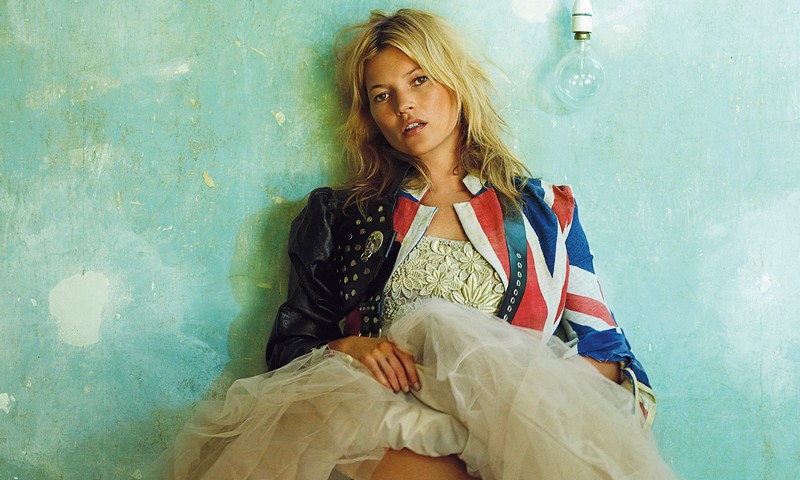
It’s there too in the pivotal photograph from 1993 when Corinne Day shot “a cocky kid from Croydon” almost without makeup, in a translucent top, and simultaneously made Kate Moss a star and opened up a new direction for fashion photography.
Linda Evangelista. Photograph: Patrick Demarchelier for The Conde Nast Publications Ltd
Where other magazines relaunch and alter, British Vogue has simply evolved, finding continuity within change. There is a direct lineage between the magazine that launched in 1916 and the one we buy today – it stays fresh by constantly reflecting the times without sacrificing its values.
In this context, the arrival of what Parkinson mockingly dubbed “the Black Trinity” – Bailey, Donovan and Brian Duffy – had the same energising effect on its photographs as the Beatles had on music. In photographing Jean Shrimpton in frank closeup, Bailey treats her as a friend and lover, breaking with the remoteness of much that had gone before. Lord Snowdon, now the magazine’s longest serving photographer, also made an impact; his arrival in 1956 brought humour to fashion shoots and a different kind of formality to portraits of the new stars: Martin Amis intensely gazing at the camera, David Bowie posing on a park plinth.
Twenty years later, the supermodels swept through, in all their big-shouldered, confident swagger, taking the breath away with their pizzazz, as in Patrick Demarchelier’s first cover of Naomi Campbell, dressed like a golden idol, or his vision of Linda Evangelista in sweeping Versace, chin raised, best foot forward. In latter days, Mario Testino, Nick Knight and Tim Walker all conjure startling images that are as redolent of their own times as Beaton was of his.
One of my favourite photographs in the show is by Frank Horvat, taken in 1960, and designed to promote Bradford as a centre of the British woollen industry. It shows a smiling model surrounded by neatly dressed children on a cobbled street, and it’s full of life. It also reveals the tightrope that British Vogue has walked for 100 years – that precarious balance between the real and the unreachable, the dream and the grim reality.
It is a tension with which even its own editors have struggled; in 1927 Alison Settle, who had a background on women’s pages in newspapers, took up her new post and grumbled that it was “unbelievable how snobbish it was”. Yet the Fabian socialist Audrey Withers, who regarded fashion as “slight and ephemeral” according to Parkinson had no difficulty in fitting herself to the editor’s chair.
As far as Shulman is concerned, those who query the magazine’s purpose are asking the wrong question. “I see no reason why it is in any way negative to portray a world that allows people to dream and indulge. The Vogue filter is optimistic and inclined towards beauty, elegance and high style but that is the point of us,” she says. “We allow people to indulge to some extent in a world that is not necessarily their own but something they enjoy looking at.”
I’d go further. What puts Vogue’s photographs on the walls of an art gallery is its clarity of vision. You might dismiss that view as superficial, but it is impossible to deny the magazine’s power. Beaton wanted to call his autobiography When I Die I Want to Go to Vogue. It may not be heaven for everyone, but sometimes it comes pretty close.