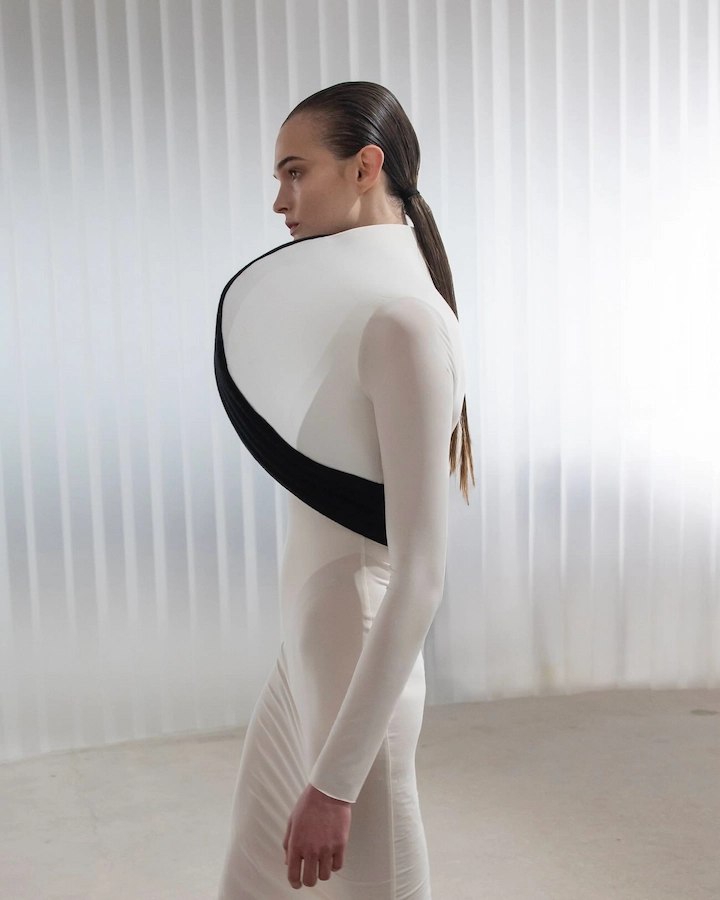
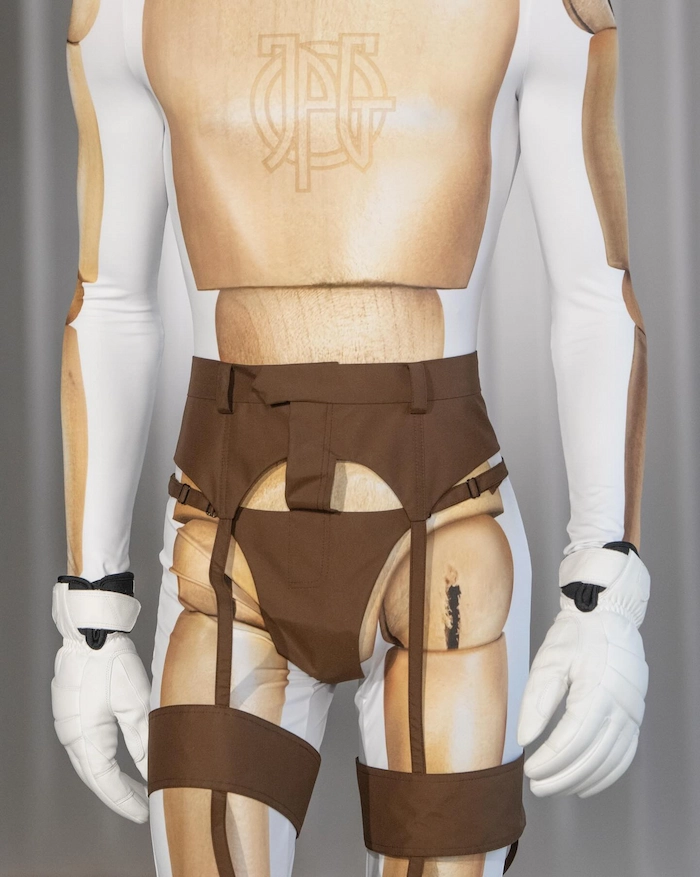
Dutch provocateur Duran Lantink has made his debut as creative director of Jean Paul Gaultier with a Spring/Summer 2026 collection titled “JUNIOR” — and fashion just exhaled, slowly, through a structured bustier. Staged in the basement of the Musée du Quai Branly in Paris, the show channelled the late 1980s Amsterdam club scene, linebacker shoulders, trompe-l’œil bodysuits, and the house’s iconic marinière stripes — not as nostalgia, but as raw material for something genuinely new. The verdict from the front row and beyond? The enfant terrible of French fashion has found, perhaps for the first time in years, a worthy heir to its particular brand of beautiful chaos.
The Rebel Gets a New Heartbeat: Gaultier’s Wildest Chapter Yet Has Just Begun
Softly Chaotic, Loudly Brilliant:THE HOUSE THAT JEAN PAUL BUILT
Before we talk about what’s next, we owe a moment to what was. Jean Paul Gaultier — the man, the myth, the man who put Madonna in a cone bra and sent men down the runway in skirts before most designers had even considered it — is one of the few figures in fashion history who genuinely changed the culture, not just the silhouette.
From his first collection in 1976, Gaultier operated with a kind of joyful defiance that the industry had never quite seen. He plundered the wardrobes of sailors and punks, drag queens and body-builders, corset-wearers and street-market regulars, and made them all impossibly glamorous. The marinière stripe — that humble Breton sailor shirt — became a Gaultier signature, a symbol of his ability to elevate the ordinary into the iconic. His fragrances, including the legendary Le Mâle, became global phenomena. His couture, which he continued after closing his ready-to-wear line in 2014, remained some of the most technically extraordinary work in Paris.
When Gaultier announced his retirement in 2020, the fashion world genuinely held its breath. He had spent decades as fashion’s greatest original — the designer least likely to be replicated and most dangerous to try. What followed was an intriguing experiment: a revolving series of guest designers, each invited to interpret the house’s codes for a single couture season. Sacai, Simone Rocha, Haider Ackermann, Glenn Martens — the names were stellar, the results consistently surprising. But they were, by definition, passing visits. The house needed a permanent voice.
How Duran Lantink Is Reinventing the House of Gaultier
The appointment of Duran Lantink as permanent creative director was, in retrospect, the most Gaultier-esque decision the house could have made. The Dutch designer — known for his upcycling practice, his disregard for conventional construction, and his deep roots in Amsterdam’s club and queer scenes — is not a safe pair of hands. He is a disruptor by instinct and a craftsman by training, which is precisely the combination a house built on beautiful rule-breaking requires.
His debut, titled “JUNIOR,” arrived with the energy of something that has been waiting to escape. The name itself is telling: not “heir,” not “legacy,” not “tribute” — junior. Younger. Louder. Still figuring it out and absolutely thrilling for it.
THE COLLECTION: SOFTLY CHAOTIC, LOUDLY BRILLIANT
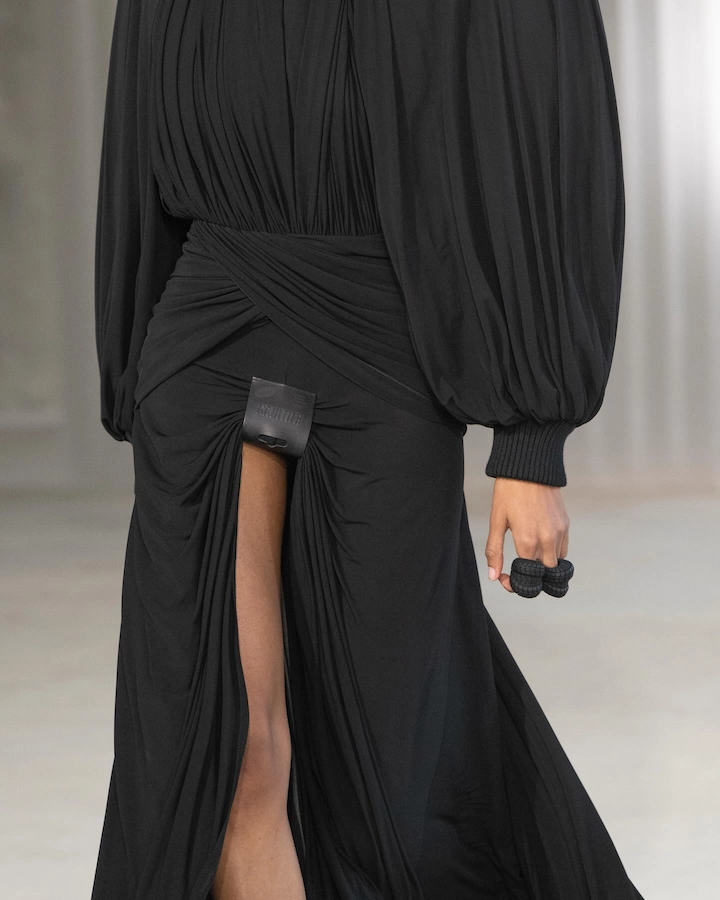
The Musée du Quai Branly basement is not a room that whispers. And neither did “JUNIOR.” Lantink opened with the house’s marinière stripes — but reworked, exaggerated, pulled into new geometries that felt simultaneously archival and alien. The shoulders were linebacker-wide, architectural in their ambition. The busts were structured into bustiers that owed a debt to Gaultier’s 1980s corsetry while feeling utterly contemporary. Trompe-l’œil bodysuits played with perception, with the eye, with the very idea of what is dressed and what is bare.
The late 1980s Amsterdam club scene — Lantink’s spiritual home as much as his biographical one — ran through the collection like an electrical current. There was something of the underground about it: clothes that knew they were going somewhere dark and loud and wonderful, clothes that had something to prove and every intention of proving it. The silhouettes were not pretty in any conventional sense. They were compelling, which is considerably more interesting.
What Lantink avoided — wisely, brilliantly — was direct homage. This is not a collection that bows to Gaultier’s archive. It raids it, remixes it, and occasionally argues with it. The result is what Vogue and W Magazine both described as a “rebel” era for the house, and it is hard to disagree. This feels like the beginning of a genuine conversation between two creative intelligences across time, rather than a student faithfully copying a master’s notes.
The campaign, shot by the legendary duo Inez van Lamsweerde and Vinoodh Matadin and starring model Leon Dame, underlines the point. It is cool without being cold, strange without being alienating — a visual manifesto for a house that has rediscovered its appetite for mischief.
HOW IT WAS GREETED
The Map to Modern Luxury
THE CURATED CALENDAR
Discover the world’s most prestigious gatherings & exhibitionsThe reception has been, by any measure, warm — and in fashion’s frequently overcrowded landscape of debuts, genuine warmth is rare currency. Another Magazine called the aesthetic “softly chaotic,” which may be the best two-word review of a runway collection in recent memory. The consensus across the industry press is that Lantink has done something genuinely difficult: he has honoured a monumental heritage without being crushed by it.
There is relief in the reviews, too, which tells its own story. The house of Gaultier has spent the years since its founder’s retirement navigating a genuinely unusual identity question — how do you continue to be the enfant terrible once the original enfant has retired? The guest designer model was creative and commercially interesting, but it was also inherently provisional. “JUNIOR” feels, for the first time, like an answer rather than a question.
THE BRAND’S HEALTH: WHERE DOES GAULTIER STAND?
Commercially and culturally, Jean Paul Gaultier occupies an intriguing position in 2026. The couture business — maintained and growing — gives the house an institutional legitimacy and a craft-focused identity that resonates strongly in the current market, where heritage and artisanship are once again genuinely valued rather than merely invoked. The fragrance empire, anchored by Le Mâle and Classique, continues to generate substantial revenue and keeps the name in global circulation far beyond the fashion press.
The guest designer years, whatever their creative merits, also served a quiet commercial and cultural function: they kept the house in the conversation, season after season, associated with some of the most exciting creative minds in contemporary fashion. That association has done no harm to the brand’s positioning.
What Lantink brings is something the house has lacked since 2020: continuity of vision. A permanent creative director means a collection that builds on itself, references become recurring signatures rather than one-night cameos, and a genuine point of view can develop over time. For a brand whose entire identity is built on a distinctive, irreplaceable aesthetic intelligence, that continuity matters enormously.
The risk, as always with a house this singular, is imitation versus interpretation. Lantink has cleared the first hurdle with style. The seasons ahead will tell us whether “JUNIOR” is a beginning or a peak.
WHAT TO EXPECT NEXT
If “JUNIOR” is the opening statement, it is one that raises rather more questions than it answers — in the best possible sense. Lantink’s practice has always been process-driven and conceptually rigorous; he is not a designer who repeats himself when he can push further instead. Expect the silhouettes to evolve, the archival dialogue to deepen, and the Amsterdam underground spirit to resurface in unexpected forms.
The couture calendar will be the other space to watch. How Lantink’s ready-to-wear sensibility — raw, clubbed, body-aware — translates into the extreme craft requirements of haute couture will be one of fashion’s more fascinating ongoing experiments. If his debut is any indication, he will not take the obvious route. He never has.
Jean Paul Gaultier, the house, is not being preserved in amber. Under Duran Lantink, it is being handed a shot of something strong, strange, and deeply alive. Fashion’s original rebel has a new heartbeat.
And it is beating faster than ever.