By Philippe Mihailovich & Caroline Taylor
Paris 2 June 2023
This year’s 1.618 Paris Sustainable Luxury fair served to be a perfect platform for France’s oldest biodynamic champagne house to introduce itself to those who seek out ethical and eco-sustainable products and creations. For the discreet, under-the-radar and privately-owned, biodynamic champagne pioneer, Leclerc Briant, it was a strong statement that they were making, that being, “We are back with a vengeance!”
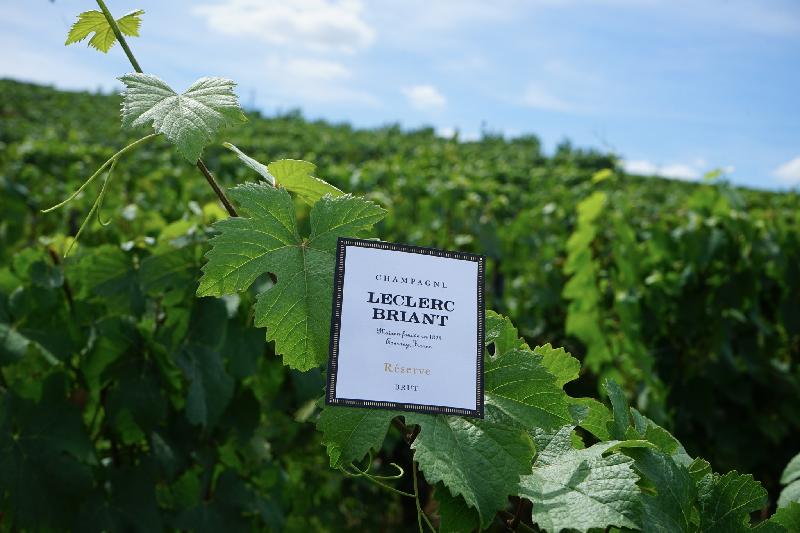
Founded by the novice winegrower, Lucien Leclerc in 1872, the vineyard took the lead in developing a more natural way of growing grapes and making champagne, and it has been raising the bar for the industry ever since. After many years of organic farming and experimenting with biodynamic viticulture on it’s Cumières estate, the practice was extended to their entire 30-hectare vineyard spread between Cumières, Damery, Epernay, Hautvillers and Verneuil. Each generation added a few steps forward, and sometimes backward. For instance, Pascal Leclerc-Briant, the 5th generation head of the house who was very attached to tradition, reintroduced animal ploughing on the estate.
When he passed away at the early age of 60, none of his four daughters had the will to continue the saga and began selling off their land to famous competitors such as Roederer and Bruno Paillard. Ten years ago, before the house could close, a wealthy and dynamic American ‘investment’ couple, Denise Dupré and Mark Nunnely *, who are known to share a passion for the French art of living, bought what was left of the estate on the encouragement of the visionary veteran champagne marketer, Frédéric Zeimett who had as a secret weapon, France’s leading biodynamic viticulture Cellar Master, Hervé Jestin – an established œnologist specialising in biodynamics. Along with many innovative ideas, Zeimett was able to ensure a certain continuity with the previous commitments of the House (1).
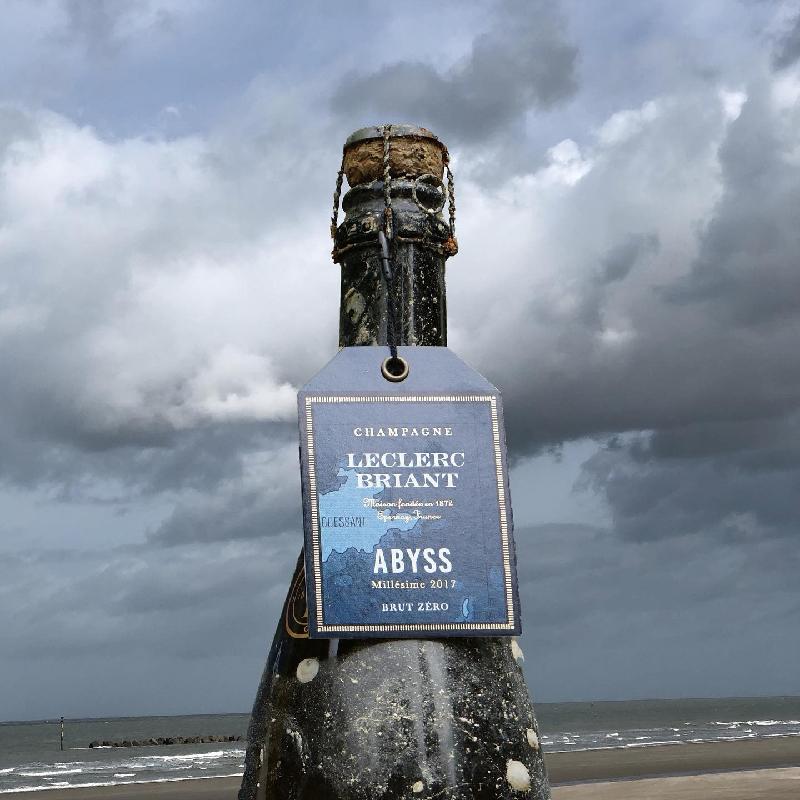
According to the ‘Natural Champagne Enthusiast, Content Marketer and Fizzyvines blogger’, Inge de Jong (2), “The Bretagne-born chef de cave, Hervé Jestin is known for his unconventional ways of making champagne as well as his unique experiments ; Abyss (The Deep Sea Champagne) is probably the most sensational example. Abyss is transported to Bretagne, where the champagne is put to rest at the bottom of the ocean near the island Ouessant. And it’s not even a marketing trick. Jestin believes the ocean waves resonate with the champagne so that it takes on its most natural form. This way of thinking illustrates the philosophy that both Jestin and the Leclerc Briant champagne house swear by: let nature lead the way and see what happens. Those are words to live by! », she states.” What’s also interesting is that all Leclerc Briant champagnes are certified as vegan, meaning there’s no use of egg whites or gelatine in the production process ».
« Many years of observation and experimentation have convinced Hervé Jestin, that humans, as regards their relationship with vines and wine, are capable of understanding and calling upon the intelligence inherent in Nature », the house states on its website. « His work has enabled him to define the principles of biodynamic resonance and to apply them, not only to the cultivation of vines, but also to the making of wine, a crucial field that is often overlooked.
Each stage of vinification at Leclerc Briant, from pressing the grapes to disgorging the champagne, is soft and natural. The wines are listened to and respected, nourished with the energy, the light and the life force of biodynamics so that they can express their full personality, without modification of any kind, in accordance with the unique energy of each vintage », the house explains. “After at least nine months ageing in barrel, the wines enjoy an extended period of ageing deep in the cellars. With little or no dosage they reveal themselves without artifice and with a purity that gives consumers an experience like no other. »
According to Gérard Muteaud (3) of the LVMH-owned business newspaper, Les Echos, Hervé Jestin has paid particular attention to the shape of the containers and respect for the golden ratio in the layout of the cellar to ensure that good vibes circulate: “If we consider that the vine is subject to external influences linked to nature and, in particular, to the lunar calendar, it seems obvious to me that these did not disappear once the grapes were picked. I’ve been working for a long time on the impact of these energies, whether they come from man or nature, on the quality of wines. The influence of the solstices and equinoxes on alcoholic fermentation is well known, as is that of the planet Mars on malolactic fermentation. My job is to provide the material with the information it needs to get through these delicate phases as naturally as possible. The principle is to let the wine follow its own rhythm, without trying to push it in any particular direction. We simply accompany it, leaving it as close as possible to its natural state.
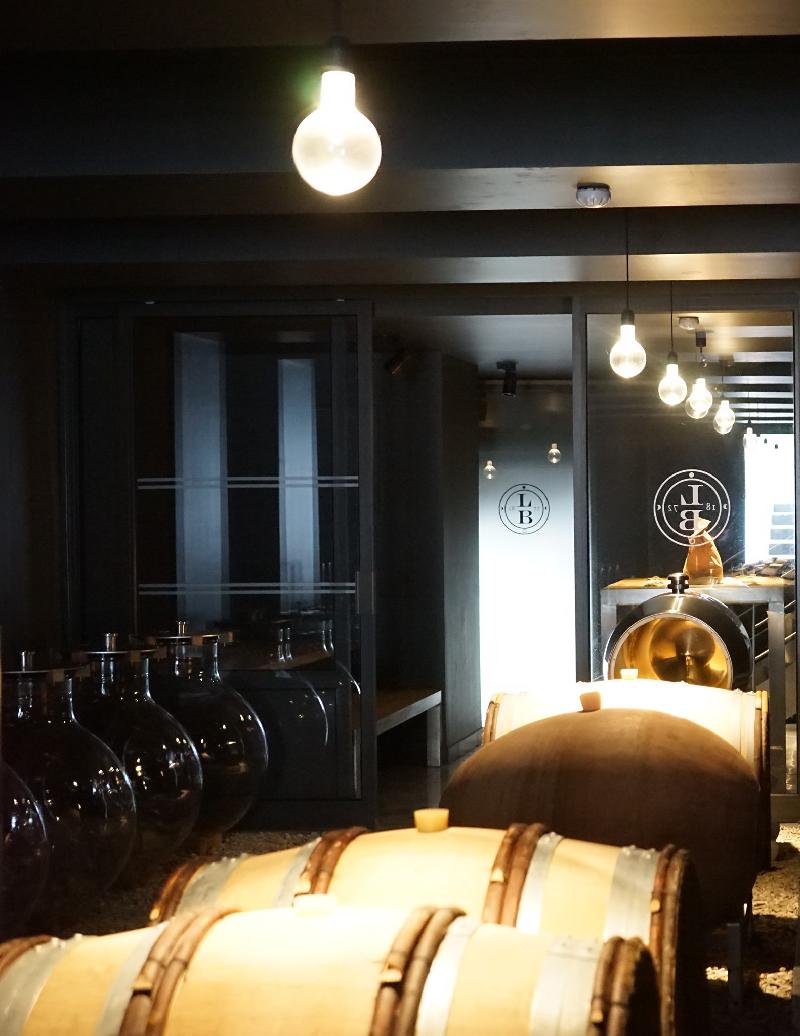
In the centre of the cellar, amidst the oak barrels, horizontally arranged terracotta eggs and glass spheres, sits a strange stainless steel barrel called ‘Goldorak’, the inside of which has been covered in gold (the equivalent of an ingot!). Gold has a powerful, alchemical symbolic dimension,” explains Jestin. It resonates with solar and cosmic activity. Terracotta echoes the earth’s magnetic field. Oak forms the link between the cosmic and the telluric. I thought it would be interesting to blend the wines matured in these three containers. All you have to do is taste them to see that they are different”.
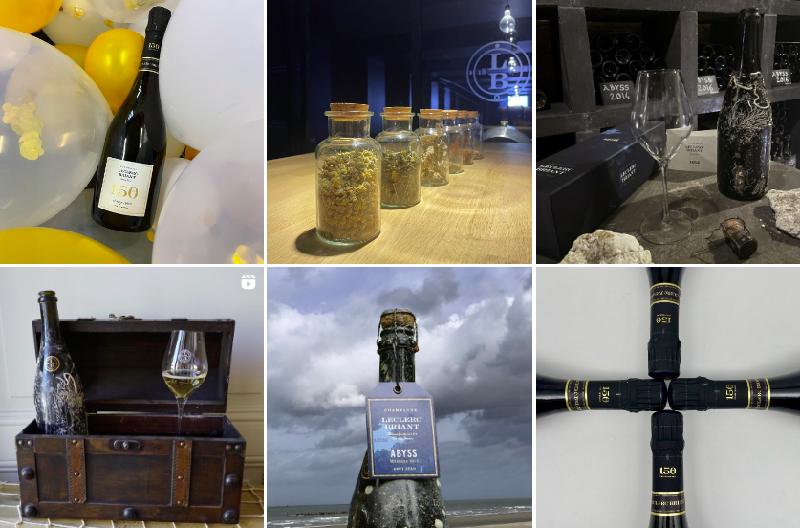
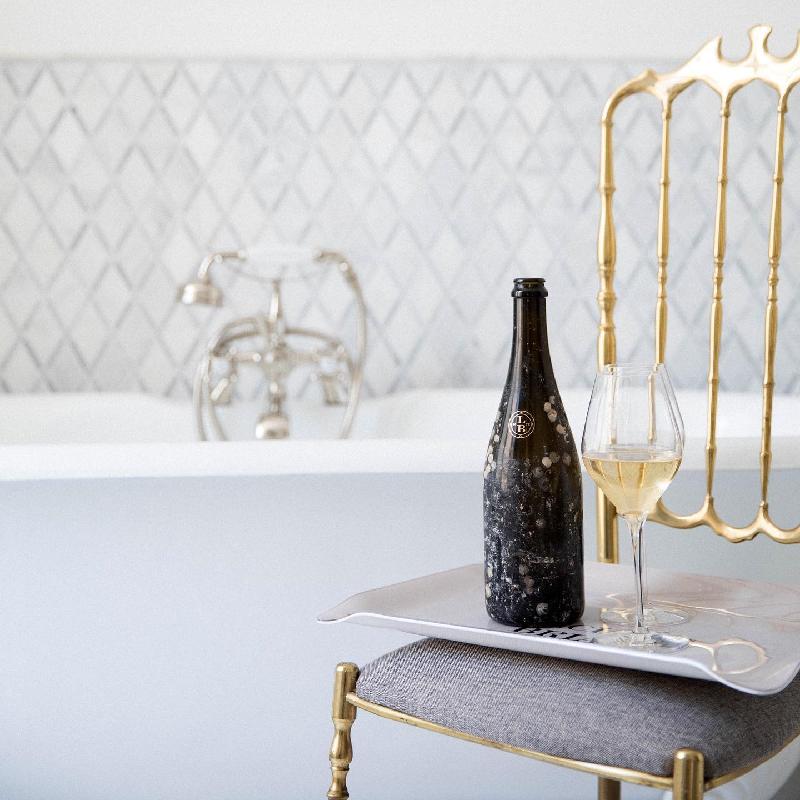
The Abyss cuvée, immersed at a depth of 60 metres in the Iroise Sea off Ouessant, follows the same approach. “The idea is to age the wine in the heart of unspoilt nature, in an environment where the energy is powerful and the temperature constant. We’re seeing a real revitalisation of the wines in this oceanic environment, which contains all the information on the planet since its origins”, he explains. Although Champagne is not expected to taste good after 30 years, bottles recently recovered from shipwrecks have proven the 30 year limit to be a myth. It would seem that the sea preserves champagne better than anything on earth.
Frédéric Zeimett, (CEO) follows these biodynamic experiments on the borderline between metaphysics and shamanism with interest and curiosity. “I read, inform myself and try to explain Hervé’s complex thinking to our teams. It’s essential that they are able to share our philosophy of wine. With its fifteen or so different cuvées, including five parcellaires, Leclerc-Briant is attracting the interest of champagne lovers, whose taste buds are receptive to the message it wishes to convey. “The brand is constantly reinventing itself, resulting in champagnes that are both delicious and very interesting. It’s like they’re short stories caught in a bottle! » Inge adds.
Frédéric Zeimett, who previously worked for Moët & Chandon, Pommery, Chapoutier, Alliance Loire and Ackerman, and is responsible for the running of the estate, also inherited the lunar calendar. Fortunately, however, this is not the first time he has managed a biodynamic estate, as he has returned to the principles of Goethe and Steiner, with whom he had already worked at Chapoutier. And to put them into practice, both in the vineyard and in the cellar, he sought the advice of Hervé Justin, the well reputed oenologist and thinker on geobiology and now the benchmark for biodynamic viticulture in the Champagne region. Hervé Justin, has famously been testing glass and cement vats gilded with gold leaf, as well as experimenting with micro-vinification in terracotta jars (4).
Biodynamic continuity has not been Zeimett’s only challenge. More importantly, he had to bring the house back to life! In the luxury field, we would classify such revivals as ‘Sleeping Beauty’ strategies, but only if the team gets it right. Resurrecting a brand badly, would be better described as a ’zombie’ strategy!
In our book,”HAUTE ‘Luxury’ Branding” (5) we speak of such strategies and claim that the luxury brand strives for immortality – although perhaps all brands do. A brand is not considered to have a ‘life cycle’ as products may do. This is because a brand exists first and foremost in the mind. It may live for as long as it is remembered, after which it may still be successfully resurrected, as was witnesses by the rebirthing of luxury houses such as Moynat and Penhaligans. To some extent we should really be considering Chanel, Dior, Lanvin, Balenciaga, Schiaparelli, Balmain, Carvin, Patou, Moreau, Vever, Rouvenat, Fabergé and Poiret as successfully resurrected sleeping beauty brands. Many have failed as well, examples being Worth, Fath, and more recently, Vionnet and L’Etrange.
Some so-called sleeping beauty brands could be considered as fake or inauthentic marketing revivals in that they did not really exist before or did not exist in the form that they do today. Examples are Officine Universelle Buly (inspired by a Balzac novel and based on a 19th century merchant perfumer, Claude Bully), Faure Le Page (an 18th Century firearms manufacturer and today a handbag house) and Joseph Duclos (a leather goods maison inspired by an 18th Century old royal leather manufacturer). As such, the latter may be considered as inauthentic relative to their true past.
Due to the mostly successful resurrections of so many luxury brands, there has been a massive trend towards such strategies. As with Moreau and Buly, one may simply register the trade mark and have no link to the founder’s families or have access to their ancient archives or original ‘savoire faire’ (know-how).This is certainly not the case with Champagne Leclerc Briant. All the archives, know-how and heritage has been retained and even enhanced with total respect, authenticity and integrity. It also remains a ‘family business’.
The downside or perhaps the upside is that the house is relatively unknown to consumers. Perhaps that really is its great advantage! Firstly, it is very known and respected in the B2B field of the champagne industry for its excellent vineyards and pioneering biodynamic experiments. Professional recognition and respect is fundamental to building a strong luxury house. The fact that consumers may not have heard of it is far better than it being famous for something bad! Bad news always travels faster than good news. Think Ryanair, Spirit Airlines and other such top 10 hated brands. In B2B one can think of Lehman Brothers and Enron.
As such, Frédéric Zeimett has the advantage of introducing this old brand into our open minds in a new way from now onwards. The brand identity and story has been very well thought through as has its’ competitive advantage. “While brands concerned by revival strategies do not need to be authentic, and can be invented to a degree, revival does alter brand properties physically and symbolically”, states Prof. Delphine Dion of ESSEC Business School (6).
”There is therefore a need to make your brand as authentic and as legitimate as possible in order to ensure success. The issue of heritage authenticity is challenging not only for cult brands, but also for brands which retain very little reputation in the market and are largely forgotten after many years out of the public eye. The first step is thus to collect both tangible and intangible features that will authenticate the brand heritage »she adds.
We believe that Champagne Leclerc Briant has implemented the first step beautifully and have cleverly immortalized themselves on the cover and in the last chapter of Casanave and Simmat’s “The Incredible History of Wine” animation book (4th ed 2022).
As you would no doubt agree, it is hard to create a great brand without a great product and a strong sense of purpose. Having said that, we feel obliged to confess to having never had the chance to taste Abysse or any of LB house creations for that matter. Their online reviews are good, so we can only assume that they’ve cracked it and will fast become a serious challenger to be reckoned with!
We hope you will enjoy watching our video interview of Frédéric Zeimett.
*The American Owners
Denise Dupré is the founder and managing partner of Champagne Hospitality, a hotel design and development company. Her teams at two properties, The Royal Champagne and Le Barthélemy recently won Conde Nast #1 ranking in their regions: in Europe and the Caribbean respectively. She currently serves on the Harvard Business School Board of Dean’s Advisors and the Board of the Isabella Stewart Gardner Museum. She and her husband Mark Nunnelly and their four children love to travel and experience hospitality throughout the world.
Mark Nunnelly is a billionaire private-equity mogul who managed Domino’s for six years beginning in 1998, became a Partner of Bain & Company was Managing Director of Bain Capital and runs a multi-faceted engineering firm. He even served as commissioner of the Massachusetts Department of Revenue and special advisor to Massachusetts Governor Charlie Baker for technology and innovation competitiveness. He has an MBA from Harvard and started out as an Assistant Brand Manager at Procter & Gamble.
Along with Denise, they acquired in 2017 the Domaine Belleville in Rully, the Château and Clos de la Commaraine in Pommard and created the same year the tailor-made Maison de vins Les Parcellaires de Saulx in Meursault. Domaine de la Commaraine and its Château has a rich wine producing history and dating back to the 12th century, with one of the most prestigious Premier Cru of Pommard inside its monopole, Clos de la Commaraine. The couple have also acquired the beautiful Royal Champagne Hotel & Spa, once a coaching where the kings of France would stay. The recently renovated 49 room historical property is said to feature breathtaking views over the vineyards, includes a Michelin-starred restaurant, and 21st Century creature comforts. The couple also offer accommodation at “Le 25bis »at 25bis Avenue de Champagne in Épernay and they still find the time and energy for philanthropy!
1. https://portraitsdebulles.com/2017/03/16/portrait-of-the-estate-leclerc-briant/
2. https://fizzyvines.com/reviews/leclerc-briant-champagne/
3. https://www.lesechos.fr/weekend/gastronomie-vins/le-champagne-leclerc-briant-capte-les-energies-en-mer-sur-terre-et-dans-le-ciel-1213331
4. https://www.terredevins.com/actualites/champagne-leclerc-briant-la-biodynamie-en-heritage
5. Mihailovich, P & Taylor, C, « HAUTE ‘Luxury‘ Branding: Professor’s Notes”( 2021) Librinova
6. https://knowledge.essec.edu/en/strategy/sleeping-beauties-how-transform-your-brand-legend-.html