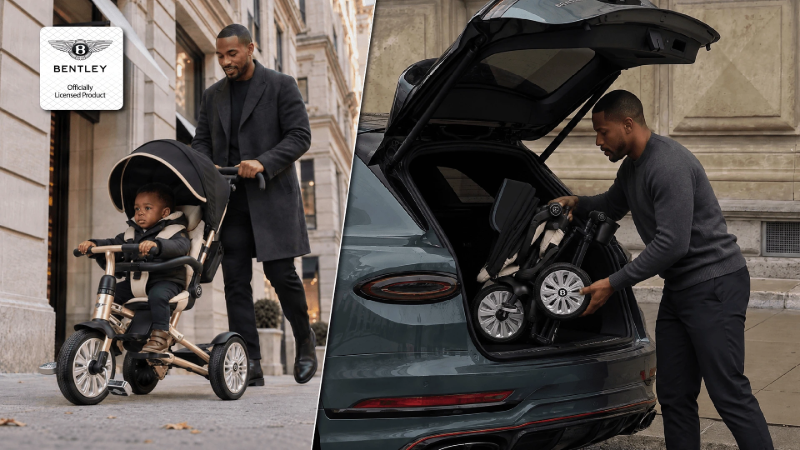
Bentley Trike has launched its Foldable Stroller/Trike across the United States and Canada, bringing the brand’s six-in-one convertible design into a more travel-ready format. It is a premium children’s tricycle that folds with its seat, backrest and canopy still attached, rolls on built-in travel wheels like a piece of cabin luggage, and arrives with a storage bag.
The launch is more interesting than a luxury logo on a toddler vehicle. It captures a broader shift in high-end parenting: parents no longer want beautiful objects that stay at home—they want design-led gear that survives airports, city pavements, grandparents’ houses and the chaotic logistics of modern family life.
Six Stages, One Very Polished Ride
The new model is designed for children from roughly 10 months to six years, evolving from a parent-controlled stroller into an independent pedal trike. Bentley Trike positions it as a six-stage product, with a five-point harness, padded safety guard, adjustable parent handle, protective canopy and the brand’s familiar diamond-quilted seating and contrast stitching.
The fold is the real headline. Unlike the standard Bentley 6-in-1, the new Foldable Stroller/Trike can be collapsed with its seat and canopy attached, then moved on travel wheels and stored in the included bag. Shipping in North America was estimated to begin in late November.
A child’s first vehicle should not merely look expensive. It should make the parent’s life less complicated—preferably without requiring a degree in industrial design.
The Competitors: Luxury Meets Logistics
Bentley is not operating in a vacuum. The folding stroller-trike category already includes strong functional rivals, especially Doona’s Liki Trike, which has built its reputation around compactness and genuine travel practicality. The Liki Trike S3 is a five-in-one, foldable tricycle for toddlers aged 10 to 36 months, listed at $280 on Amazon
Other competitors lean toward versatility and value rather than automotive-inspired prestige. QPlay offers an eight-in-one folding stroller-trike for children aged 10 months to six years at $185.99, while generic folding push-trikes with canopies, parent handles and storage bags can be found from roughly $152.
The competitive tension is clear: Doona competes on engineering and portability; QPlay and Rito compete on flexibility and price; Bentley competes on desire. The new folding Bentley does not necessarily beat every rival on fold size or value. Its advantage is that it makes a practical category feel like part of a luxury lifestyle.
What Bentley Is Really Selling
At $899, the Foldable Stroller/Trike sits well above the mainstream market and even above Bentley’s own standard 6-in-1 range, which starts at $599. That premium is not only for a folding mechanism. It is for the feeling that a child’s first ride can carry the same visual language as the family’s car, watch, luggage or weekend wardrobe.
Bentley Trike’s products are officially licensed by Bentley Motors, and the company describes its collection as combining automotive styling with practical features for growing families. In luxury-brand terms, this is a classic extension strategy: take a recognised symbol of status and translate it into a category where emotional purchase decisions are unusually powerful.
Parents may tell themselves they are buying safety, convenience and longevity. They are also buying a very photogenic answer to the question: What kind of family are we?
The Wider Trend: Luxury Goes Mobile
The launch reflects several converging trends in premium parenting.
- Multi-stage products are replacing single-use purchases. A six-in-one design promises years of use, which makes a high price easier to justify.
- Foldability is becoming a baseline expectation. Urban families, frequent travellers and smaller homes increasingly treat compact storage as a core feature, not an afterthought.
- Luxury brands are entering childhood earlier. From ride-on cars to designer strollers and trikes, brands are cultivating affinity before the customer can even pronounce the logo.
- Travel is reshaping product design. Built-in wheels, storage bags and folding frames turn a child’s trike into something closer to premium luggage.
- Safety remains the non-negotiable luxury feature. A five-point harness, protective canopy and parent-controlled steering matter more than quilted leather once a toddler starts testing the boundaries of physics.
The global kids’ tricycle market is projected to grow from about $5.8 billion in 2025 to $9.6 billion by 2035, at a 5.2 percent annual growth rate. Industry analysis also identifies folding mechanisms, lightweight aluminium frames and brand trust as key drivers of premium demand.
The Toddler Has Better Luggage Than You
There is something deliciously absurd about a toddler arriving at an airport with a quilted, Bentley-inspired trike that folds, rolls and comes with its own travel bag. Meanwhile, the adult in the party is wrestling a suitcase zip, a boarding pass and a coffee that has already become a structural component of the stroller.
But that is precisely the point. This is not merely a tricycle; it is a tiny piece of mobile architecture for families who want their everyday objects to look considered. The child gets a ride. The parent gets a rolling statement of intent.
The Map to Modern Luxury
THE CURATED CALENDAR
Discover the world’s most prestigious gatherings & exhibitions
The Critique: Beauty Should Not Outrun Usability
The risk with luxury children’s products is familiar: design can become more important than daily use. A folding trike must fold easily, remain stable when pushed, survive pavements, fit into car boots and not turn a simple school run into a mechanical performance.
Bentley’s move is smart because it addresses the most common objection to its original model—portability. Yet the brand will need to prove that the folding version is not simply a more expensive version of the same idea. The test is whether parents use it daily, travel with it happily and still consider it beautiful after a year of crumbs, rain, kerbs and toddler-driven steering decisions.
Bentley Trike’s folding launch signals that luxury childhood is entering its practical era. The winning products will not be the ones that look best in a nursery; they will be the ones that move seamlessly between home, travel and city life while retaining enough design presence to justify their price.
For affluent parents, the Bentley Foldable Stroller/Trike is less a trike than a compact declaration: our family travels well, spends thoughtfully, and refuses to compromise on style—even at 10 months old.
Bentley is the outlier. The other luxury automotive brands have largely entered children’s mobility through licensed electric ride-on cars, junior supercars or brand merchandise, but not through a true folding stroller-trike designed to grow with a child from infancy. Bentley’s move is therefore less “another luxury car brand doing kids’ products” and more a deliberate expansion into parent-facing luxury mobility.
Who Has Done What
| Brand | Children’s mobility direction | Folding stroller-trike? | What it signals |
|---|---|---|---|
| Bentley | Officially licensed 6-in-1 stroller-trike; now a folding travel version | Yes | The most developed luxury-brand entry into early childhood mobility. |
| Rolls-Royce | Mainly adult travel accessories and lifestyle products; licensed or “style” children’s ride-ons exist through third parties, but no comparable official stroller-trike | No | The brand protects its ultra-luxury, adult-focused identity rather than entering parenting hardware. |
| Maserati | Licensed 12V children’s ride-ons, such as the GranCabrio model with parental remote, lights and suspension | No | Uses familiar luxury-car licensing, but stays in the toy/ride-on lane. |
| Ferrari | Licensed children’s electric ride-ons and racing-inspired toys | No | Strong brand extension, but oriented to play and performance fantasy rather than daily parenting. |
| Lamborghini | Extensive licensed ride-on range, including Urus and supercar-inspired models with scissor doors | No | The most commercially visible supercar licensing strategy in the category. |
| Aston Martin | Licensed DB11 and F1-inspired children’s ride-ons | No | Performance and motorsport imagery, not family mobility. |
| Lucid | No established luxury stroller-trike or comparable official children’s mobility product found | No | Still primarily focused on adult electric vehicles and brand ecosystem. |
| Genesis | No established official folding stroller-trike or comparable children’s mobility products | No | Luxury positioning remains adult- and hospitality-led. |
| Lotus | No established official folding stroller-trike or comparable children’s mobility products | No | Brand extensions lean toward performance, lifestyle and driving culture rather than early childhood. |
Bentley’s Real Advantage
Bentley has not merely licensed its name to a toy. Its stroller-trike is a functional parenting product: it begins as a parent-controlled stroller, evolves through multiple stages and ends as a child-pedalled trike. The new folding model adds airport-style portability, with the seat and canopy remaining attached during the fold and built-in travel wheels for movement.
That makes Bentley’s product closer to a luxury travel system than to a miniature car. It competes with Doona, QPlay and other stroller-trike makers, while using automotive design language to justify a premium price.
The Other Brands’ Playbook
Most luxury automotive brands have chosen the easier route: licensed ride-on cars. These products reproduce badges, bodywork and styling cues, but they are fundamentally battery-powered toys for children generally aged around three to eight.
A Lamborghini Urus ride-on with scissor doors, a Ferrari 488-inspired model or an Aston Martin F1 racer creates a strong emotional connection with the parent’s automotive taste. But it does not solve the daily problem that Bentley’s stroller-trike addresses: moving a very young child through an airport, a city or a long walk.
A ride-on car says, “My child likes fast cars.”
A Bentley stroller-trike says, “Our family’s everyday logistics have entered the luxury category.”
Why Others Have Not Followed
There are good reasons Rolls-Royce, Ferrari, Lamborghini, Aston Martin, Lucid, Genesis and Lotus have not entered this space.
- Brand risk: A stroller-trike is used daily, in public, by parents under pressure. Any safety, durability or usability issue carries more reputational weight than a toy.
- Different buyer journey: Ride-ons are gifts and play objects; stroller-trikes are essential parenting equipment with intense practical scrutiny.
- Manufacturing complexity: Folding mechanisms, harnesses, canopies, steering systems and multi-stage conversions require child-product engineering, not automotive licensing alone.
- Luxury codes differ: Ferrari and Lamborghini sell speed and spectacle. Bentley’s more domestic, “grand touring” identity translates more naturally into family mobility.
- Market saturation: The folding stroller-trike segment already has credible specialists, so a newcomer needs a genuine functional edge—not only a badge.
The Trend To Watch
The likely next phase is luxury mobility ecosystems for families: folding strollers, travel systems, ride-on cars, child seats, luggage and accessories designed as one coherent lifestyle. Bentley has a head start because its product is useful before it is decorative; that is the strongest possible foundation for a luxury extension.
If another marque enters, expect it to come from a brand with a credible family narrative—perhaps Rolls-Royce through an ultra-refined travel concept, or Genesis through quiet, design-led mobility. But for now, Bentley is not simply participating in the trend. It has effectively created the most convincing luxury-automotive version of it.
