Coty Wants a Seat Among the People Who Know Perfume, and a Place in the Chatbot’s Answer
Coty has had a curious fortnight. The beauty group, founded in Paris in 1904 and now selling in more than 120 countries, makes fragrances under licence for houses such as Gucci and Hugo Boss, and it is currently run by an interim chief executive, Markus Strobel. On October 15 it launched the Coty Fragrance Club in Paris. On October 27 it announced a partnership with Brandlight, a New York company that helps brands show up when people ask AI assistants for recommendations.
One of these is a roomful of people who can tell vetiver from patchouli with their eyes closed. The other is a dashboard. Put them side by side and you get a single worry, stated quietly: who gets to tell people what to smell like?
The club, and who is in it
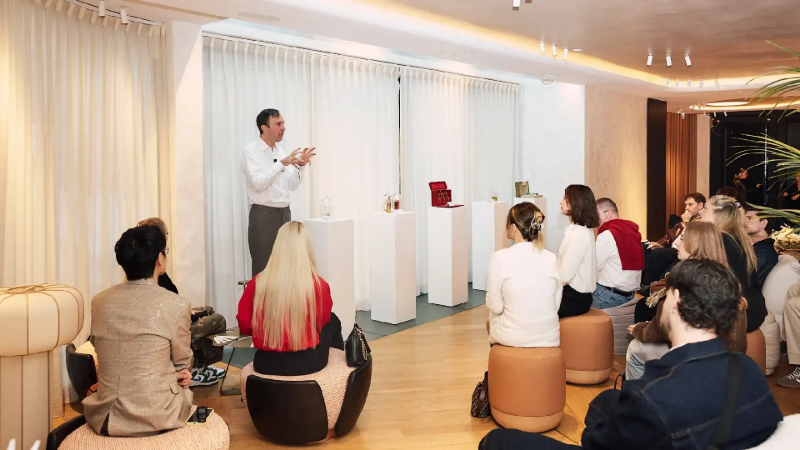
The Fragrance Club is a community of fragrance experts, educators, creators and community leaders, brought together with Coty’s own fragrance teams through discussions, workshops, immersive experiences and what the company calls co-creation. It started in Paris with members from Europe, the UK, the US and China, who spent time with perfumers including Nathalie Lorson, Amandine Clerc-Marie, Meabh McCurtin, Julie Massé, Fabrice Pellegrin and Delphine Lebeau. After the launch, the idea is for it to continue as a global community that meets regularly.
The reasoning is laid out with unusual candour. Coty notes that TikTok has become the leading influence on fragrance purchases among Gen Z, and also that people still value real expertise and personal experience. In other words, the shelf-talker at the counter lost some of its power, the reviewer with a camera gained it, and a century-old company would like to be on speaking terms with that reviewer.
What does a member get? Mostly proximity: time with the people who actually make the perfumes, and early conversations about where scent is heading. What does Coty get? A listening post, a pool of credible voices, and some goodwill from communities that are not famously fond of corporate perfume. That is a fair trade, though “club” is a rather grand word for what has so far been one gathering. The test will be whether the follow-ups happen and whether members feel free to say something uncomfortable.
The dashboard
The Brandlight deal is about a different kind of newcomer to the conversation: the AI assistant. The press release explains that shoppers increasingly begin with a need or a question rather than a brand name, and ask an AI for suggestions. Coty wants its brands to be part of the answer, and the work involves tuning product pages, creator assets, digital PR and launch kits so that language models understand and surface them. Early pilots, the company says, improved visibility even for searches that never mention a brand. Strobel’s ambition, in his words, is to make the brands “impossible to overlook.”
Coty is not alone, and not first. L’Oréal announced a partnership with OpenAI in June, including a pilot to feed verified product information for Lancôme and Kérastase into ChatGPT. Estée Lauder Companies signed up Profound in September to monitor and optimise how its whole portfolio appears in AI answers, which it described as a first in prestige beauty. Sephora launched an app inside ChatGPT in March. Coty is joining a race already underway, and its approach, a community for human taste-makers plus a tool for machine taste-makers, is at least a coherent pairing.
The Map to Modern Luxury
THE CURATED CALENDAR
Discover the world’s most prestigious gatherings & exhibitionsI could not find a direct rival with an equivalent branded fragrance club. Industry bodies such as The Fragrance Foundation run awards and mentoring programmes for emerging talent, but that is an association, not a company inviting outsiders into its studio.
What it means if you actually wear perfume
If you are the kind of person who owns a dozen bottles and has opinions about oud, there are two things to notice. First, you may soon be getting more of your recommendations from an assistant than from a counter, and the assistant’s answers will be shaped by whoever has done the most careful homework on feeding it. That is not sinister, but it is not neutral either. An AI summarising “the best woody fragrances” tends to favour brands with the best-organised information, which is not the same thing as the best-smelling ones. Niche houses without a data team should worry a little. Or take it as an opportunity to be found by word of mouth, which is how niche perfume always began.
Second, the more answers become automatic, the more valuable a human nose becomes. Time with a perfumer, a workshop, a conversation about why a base note behaves the way it does: that is exactly the sort of access luxury tends to ration. We saw the same instinct in LVMH opening its workshops for a weekend and in Porsche Design planning clubhouses for collectors. Everyone, it seems, is building a clubhouse, because a community is the one thing a chatbot cannot supply on a brand’s behalf.
There is a modest irony in a company doing both at once. It wants to be the host of the best dinner party in town and the first name the waiter recommends. Whether those two ambitions sit comfortably together will depend on whether the club is allowed to say that some recommendations are rubbish.
For now, a sensible approach for the curious: ask the assistant, enjoy its list, and then go and smell things on actual skin. Machines are getting good at describing perfume. They remain hopeless at wearing it.