How the world’s most recognizable check went from royal lining to fashion emergency — and lived to tell the tale.
The secret hiding in the lining
Picture this: it’s 1920s Britain. The Burberry check — that unmistakable beige, black, red, and white tartan — exists only as a hidden whisper inside coat linings. A quiet inside joke between tailors and those who knew.
Then, in 1967, a Paris store manager has a moment of chaos-agent energy and decides to hem the coats so the lining shows. Customers? Absolutely feral for it. Within years, the check migrated from inside to outside — scarves, umbrellas, bags, the works. By the 1980s, it was the official uniform of the British upper class.

“In luxury, the best details are the ones only the right people notice.”
The $50 mistake that looked great on paper
Late 1990s. A new MBA-approved strategy lands at Burberry HQ: accessibility. Enter the £30 baseball cap. Sales? Through the roof. Revenue charts? Beautiful. But in luxury fashion, there’s an unwritten law — the moment everyone is invited to the party, the VIPs start heading for the exit.
Selfridges — Selfridges — quietly stopped stocking Burberry. The brand that once dressed royalty was now being described in tabloids with a word no luxury house ever wants near its name.
The photos that broke the brand
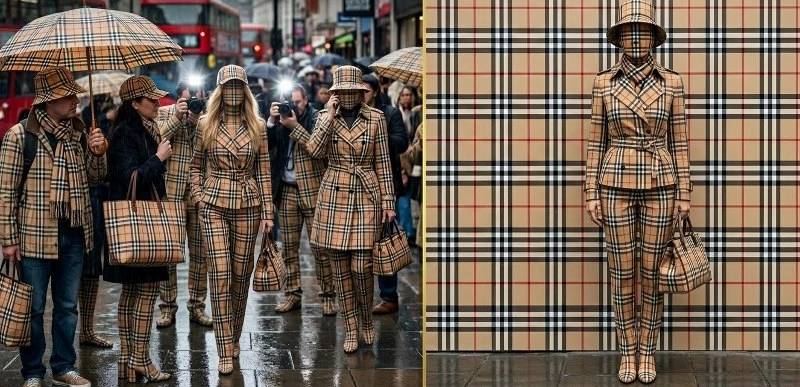
The images of celebrities go viral before “going viral” was even a thing. In it, absolutely everything — the outfit, the accessories, — is head-to-toe Burberry check. Not a hint of restraint. Not a single breath of contrast.
The British press had a field day. And in that one photograph, something irreversible happened: the pattern stopped reading as wealth and started reading as costume. Decades of carefully built heritage, undone by overexposure in a single frame.
The Map to Modern Luxury
THE CURATED CALENDAR
Discover the world’s most prestigious gatherings & exhibitionsIt sounds almost absurdly specific — one photo, one family, one very loud stroller. But that’s how luxury works. Perception is everything, and perception had just taken a very public left turn.
The great disappearing act
Designer Christopher Bailey’s rescue plan was radical in its simplicity: make the check rare again. The check was slashed from 20% of all products down to just 5%. Overnight scarcity, by design.
Cheap accessories? Quietly discontinued. The £30 caps were metaphorically (and perhaps literally) set on fire.
Price points climbed. Distribution tightened. The brand voluntarily walked away from easy money to protect its long-term identity.
By 2011, the cool kids were back. Sales jumped 27%. The check was desirable again.
The Luxury Lesson
The Burberry saga is a masterclass in what makes luxury actually work. It’s not the quality of the fabric (though that matters). It’s not the heritage (though that helps). It’s scarcity — real or engineered.
The moment a luxury symbol becomes a commodity, it stops being luxury. Burberry had to sacrifice millions in “easy money” to save billions in brand equity. They chose the harder, longer road — and it worked.
The best flex? The one not everyone can have. Sometimes, the most powerful move is to pull back, go quiet, and let desire do the work.