The Iran war has doubled jet fuel costs, halved airline profits and pushed fares up 22%. The industry’s answer? Better beds, more suites — and a private jet market where used aircraft now cost more than new ones.
If you want a single number to explain the state of aviation in late 2026, try this one: US Gulf Coast jet fuel went from $2.43 a gallon before February to $4.63 in October — a rise of roughly 91%. The war in Iran disrupted oil supplies and refining capacity, the IATA fuel monitor briefly showed jet fuel above $200 a barrel in April, and the industry’s collective fuel bill for 2026 will come in some $100 billion higher than last year, in IATA director general Willie Walsh’s estimate.
The consequences at the back of the plane are arithmetic. IATA now expects industry net profit to halve, from $45 billion in 2025 to $23 billion this year, with margins collapsing from 4.2% to 2.0% (IATA). Profit per passenger — the industry’s most quietly humiliating statistic — is forecast at $4.50 this year against $9.10 last, and revised again toward $3.50 by the autumn. That is roughly the price of a flat white at Geneva airport, without the croissant. US fares, meanwhile, were 22.4% higher in September than a year earlier, and the big carriers are openly trading fuller planes for fatter ones — American Airlines says it now prioritizes revenue per passenger over load factor, and third-quarter traffic across the five largest US airlines grew less than 1%.
Now look at what the front of the plane is doing. Because this is where the story stops being arithmetic and becomes strategy.
The answer to a fuel crisis: better beds
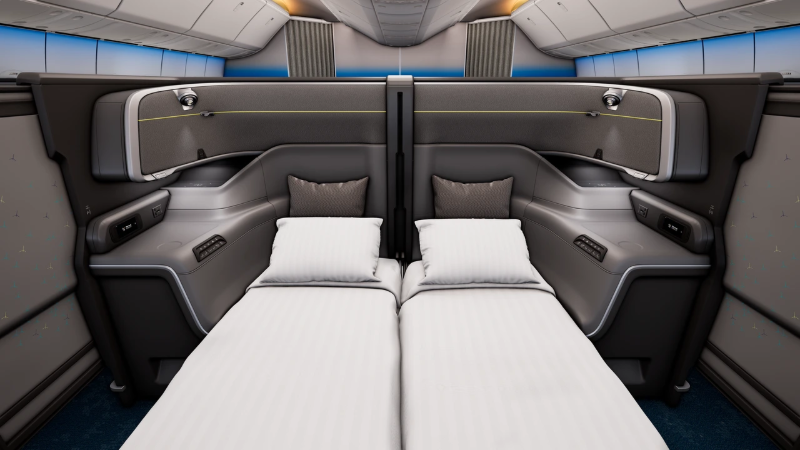
In early November, Singapore Airlines — tired of other airlines winning “world’s best” — unveiled its biggest cabin overhaul in almost a decade: a S$2 billion ($1.56 billion) programme that will bring new first- and business-class products to 41 retrofitted Airbus A350-900s and its incoming Boeing 777-9s from mid-2027. The new first class converts into what SIA calls the largest double bed in commercial aviation, with a sofa where the second seat used to be, 32-inch 4K screens and Bang & Olufsen headphones; business class gets 79-inch full-flat beds that can be joined into companion beds for couples. The design brief, apparently, was that premium travellers want to sit closer together — a sentence that would have caused a scheduling crisis at any focus group circa 2019.
SIA is not alone. JetBlue unveiled its first-ever domestic first class in November, retrofitting the entire fleet; Frontier — an ultra-low-cost carrier — has opened bookings for first-class seats debuting next spring, with Allegiant following; and a wave of new business-class suites is rolling out from United, Qantas, Riyadh Air, Air Canada and ANA. An ultra-low-cost carrier selling first class is one of those sentences that reads like a typo until you check the maths. Fuel is, in effect, a per-seat tax — it burns whether the seat is sold or not — and the rational response to a per-seat tax is to make each seat earn more. Premiumization is not a mood; it is the industry’s fuel hedge.
The private jet market, where used costs more than new
If the airlines are adapting, business aviation is quietly thriving — and the reason is a new kind of customer. Venture capitalists, early SpaceX employees and the founders of AI companies, along with the bankers shepherding the anticipated IPOs, are channelling fresh wealth into private aviation, often before they can legally call themselves wealthy. The result is a supply-side curiosity: with manufacturer lead times stretching 18 to 26 months and order backlogs up 23% year-on-year to nearly $63 billion, used jets now trade at prices above new ones — the only consumer market where “pre-owned” is the premium option, because a used jet exists. Waiting lists for new aircraft run to four years — longer than the average AI startup’s lifespan, which is awkward given who is buying.
The Map to Modern Luxury
THE CURATED CALENDAR
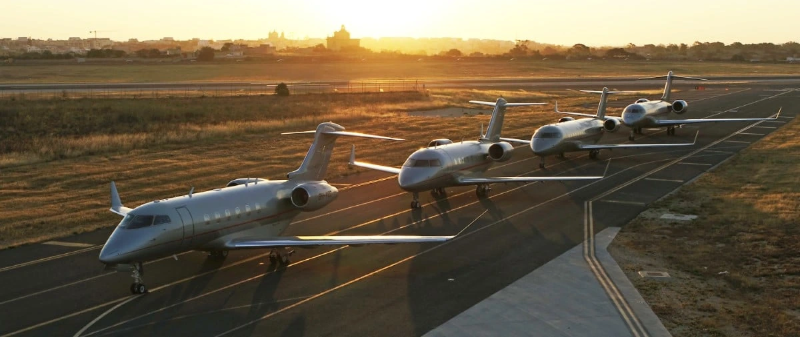
Discover the world’s most prestigious gatherings & exhibitionsThe operators are racing to meet them. NetJets has opened its eleventh exclusive-use lounge, in Las Vegas — 250,000 square feet of ramp, 24-hour maintenance and marble countertops sourced domestically, we are told, to avoid the impression of extravagant spending — with six more facilities planned, including a $35 million Dallas terminal; Flexjet countered with a $34 million London terminal at Farnborough. Note what the two rivals are actually fighting over: not the sky, which they already have, but the ground. Vista, meanwhile, is standardizing its long-range fleet around Bombardier’s Global 8000 to sell non-stop intercontinental travel. The battle for the wealthy customer has moved to the terminal, the lounge and the mattress — precisely where the airlines are also investing. Same war, different runways.

The noise and the signal
Not every number is rosy. Global business jet activity fell 6% year-on-year in the first week of November — blamed, gloriously, on the US midterms — and North American business flying posted its first monthly decline in 19 months in October. The rich, it turns out, take a week off to vote. But the structural picture points the other way: fractional flying — private aviation’s entry product — rose 5% in that same October, Bombardier just raised its 2026 cash flow forecast on record aftermarket sales, and Global Jet Capital’s latest brief shows departures up 2.7% year-to-date with aircraft values appreciating 6.6%.
The decade-long view is more striking still. Honeywell’s 35th annual outlook, published in October, projects 9,950 new business jets (plus 4,200 turboprops) delivered over 2026–2035, the global fleet growing from 39,400 to nearly 51,000 aircraft, and flight hours up 34% — with midsize jets, the sensible ones, growing fastest of all. Nine out of ten operators expect to fly the same or more hours next year.
What it all means
The decode is the same one running through every corner of luxury right now: polarization. Fuel at $152 a barrel is a tax on the middle of the market — the mid-tier airline, the mid-priced seat, the marginal route. At the top, it barely registers, because the client’s currency is time, not fuel, and the industry’s response to a 90% cost spike has been to raise the revenue per seat: suites, double beds, first class at Frontier. The airline industry will earn $3.50 per passenger this year and still find the capital to install the largest double bed in commercial aviation. Somewhere in that sentence is the entire business model of luxury in 2026.
So is the industry shifting because of fuel prices? Yes — but only below the waterline. The back of the plane gets higher fares and emptier seats; the front gets S$2 billion of beds; and above it all, a four-year queue of newly minted AI money waits for a jet that costs more second-hand than new. The fuel crisis, it turns out, did not change what luxury travellers want. It just made everyone else pay for it.
