
While the luxury watch world argues about tariffs and job cuts, a Zurich-based crystal house has been quietly executing one of luxury’s most complete brand-stretch plays: a thirteen-room hotel, crystal light switches, and an edelweiss for your Christmas tree. None of it is random.
Luxury news has a hierarchy of glamour, and this month’s releases from Lalique occupy three rungs of it that normally never meet: a boutique hotel, an electrical fitting, and a Christmas tree ornament. Read together — as one should, because the house clearly intends them that way — they sketch one of the more coherent empire-building exercises the luxury industry has produced in years. It is a strategy you can hold in your hand, hang on a tree, and now, as of this August, sleep inside.
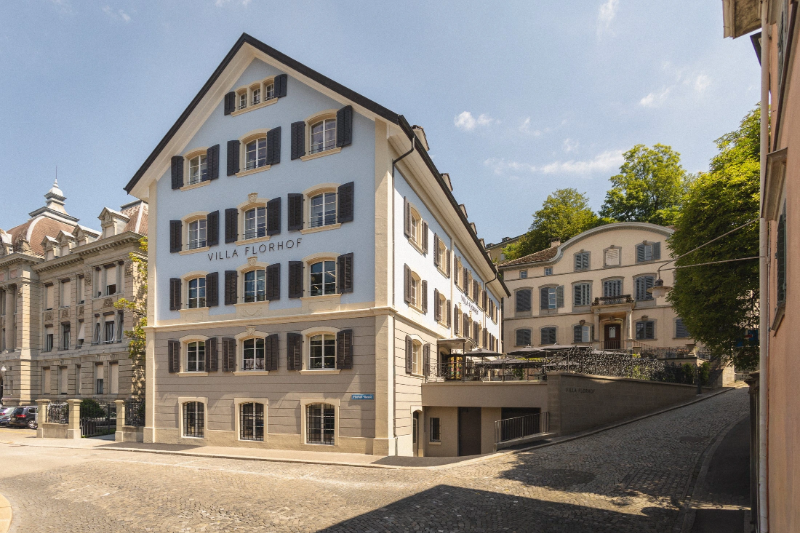
Thirteen keys, and not one more
On 1 August 2026, Lalique opened Villa Florhof, its first boutique hotel in Zurich — thirteen rooms and suites inside a 15th-century residence on Florhofgasse, between the Old Town and the university quarter, a building listed since 1973 and entangled, since the 1500s, with Zurich’s silk trade. The interiors are by Green & Mingarelli, the bar and brasserie opened on day one under chef John Schiffmann (formerly of the Dolder Grand), a signature restaurant follows this autumn, and the cellars include a vaulted wine cellar and a cigar lounge.
The number thirteen is the tell. When Silvio Denz — Lalique’s chairman, owner and chief strategist — and his co-investor Peter Spuhler acquired the property in 2022, the plans mentioned fifteen rooms; rumours spoke of thirty-five; the hotel opened with thirteen. In an industry that measures success in keys and square metres, a room count that falls twice before opening is practically a manifesto. Thirteen keys is not a hotel that scales; it is a private home that happens to take bookings — and, as the hotel trade press notes, it is precisely the format that makes white-glove, know-every-guest-by-name service economically viable without industrial resources.
It is also, quietly, a homecoming with a flag planted: Lalique Group is headquartered in Zurich, and Villa Florhof is its first hotel in Switzerland and its first in any international metropolis.
And about Peter Spuhler: he is the billionaire who took Stadler Rail from eighteen employees to one of Europe’s great trainmakers, which makes this a partnership between the man who sells crystal to the world and the man who builds much of the rolling stock that brings the world to Switzerland. If the hotel ever runs late, at least the excuse infrastructure is world-class.
The showroom you can sleep in
Villa Florhof is the fifth address in the Lalique Hospitality collection, after the Villa René Lalique and Château Hochberg in Alsace, Château Lafaurie-Peyraguey in Sauternes and The Glenturret in Scotland. Notice the pattern: no two properties are alike, and each is welded to a territory — crystal in Alsace, wine in Sauternes, whisky in Perthshire, silk in Zurich. Rather than rolling out a standardized chain, Lalique is assembling, in its own words, a collection of rare places.
The decode is older than the hotel. Denz said it himself years ago: a Lalique hotel “will act as a gigantic showroom” for the brand’s savoir-faire. The hospitality playbook — perfected by Armani and Bulgari — turns marketing from an expense into a revenue line: the guest sleeps in the brand, eats off the brand, and checks out having paid for the privilege of the advertisement. There is also a distinctly 2026 logic to it. Unlike Swiss watches, hotel nights cannot be stockpiled in New Jersey warehouses ahead of a tariff announcement. Experiences are the one luxury good that cannot be front-run.
The last unconquered surface
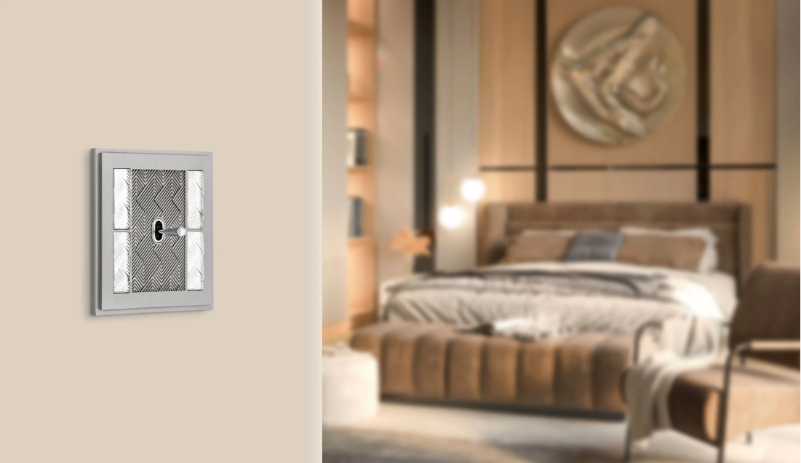
Which brings us to the light switch. In December 2025, Meljac — France’s leading maker of luxury electrical fittings — and Lalique unveiled a collection of switches in which panes of Lalique crystal, sculpted with the Art Deco “Vibration” motif, are set into solid brass plates available in twenty-nine finishes. The companies call the result “an exquisite jewel adorning the wall,” which is one way to describe the object you flick with a wet finger on your way to bed.
The Map to Modern Luxury
THE CURATED CALENDAR
Discover the world’s most prestigious gatherings & exhibitionsThe humour almost writes itself, but the strategy is dead serious. The home has been the last unbranded territory in luxury — the fashion houses got your wardrobe, the jewellers got your wrists, the hotels got your holidays, and yet the wall switch, humble and plastic, escaped. No longer. This is brand immersion in its final, literal form: not a logo on a vase but the house itself, wired into the architecture. Twenty-nine brass finishes, meanwhile, is a decision matrix that has delayed more renovations than a planning committee. One suspects a Meljac x Lalique specification is how you know a client is serious.
And the loop closes neatly: Meljac’s fittings live in high-end hotels and residences, and Lalique now operates five showcases of its own. The hotel sells the switch; the switch sells the hotel.
An edelweiss for the tree
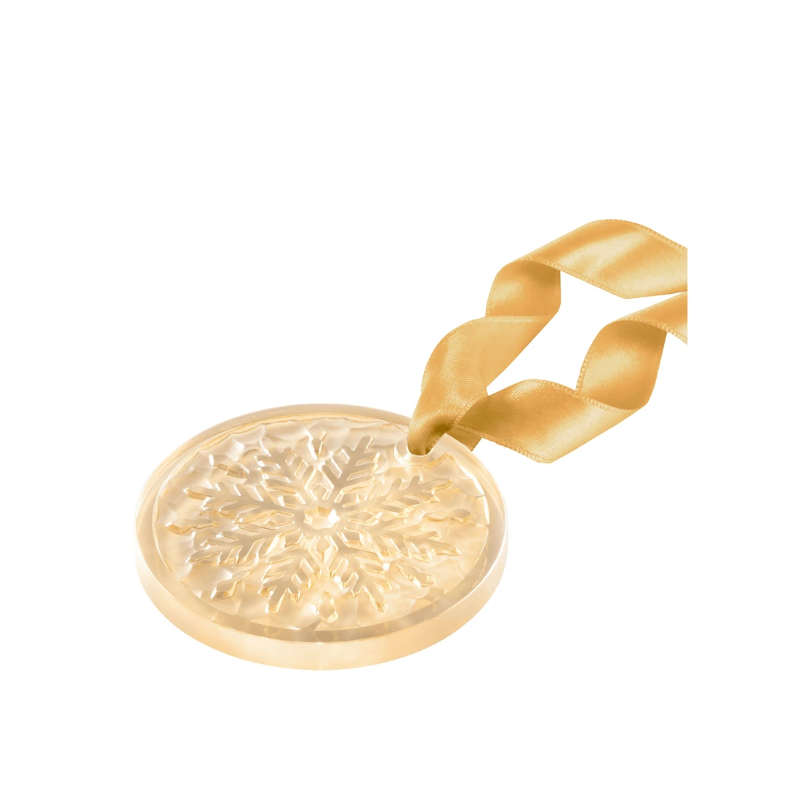
For the festive season, Lalique’s selection leans on its naturalist vocabulary — Anémones, Ombelles, Champs-Élysées, Papillons, Plumes, Pivoines — across vases, candleholders, tableware and tree ornaments, with gold-lustre finishes and a reissued Butterfly flacon. The headline piece is the 2026 annual Christmas ornament: an edelweiss in clear crystal or gold lustre, €150 and €170 respectively, handcrafted in France — the “immortal of the Alps,” a flower that thrives in extreme conditions, which feels like a reasonably on-the-nose mascot for the luxury market this year.
The ornament is the entry ticket — the cheapest signed object the maison sells, and one of the cleverest: an annual ritual (2023’s Plumes, 2024’s Lierre, 2025’s snowflake, 2026’s edelweiss) that converts customers into collectors at €150 a year . The Christmas gift collection then runs the whole ladder upward, 47 products deep, from a pendant at just over €100 to a Shivers Owl sculpture at €6,900. Ornament, owl, suite: the same brand at three price points, each one a gateway drug to the next.

The man behind the vitrine
None of this is accidental. Denz bought Lalique in 2008, when the house turned over some €67 million, with an explicit six-pillar plan — decorative objects, interior architecture, jewellery, perfume, art, hotels and restaurants — to build a lifestyle brand “around synergies between crystal, wine, gastronomy and hospitality”. By 2018 the group’s revenue had reached €136.4 million; in 2024, Denz took the company private, delisting it from the Swiss exchange after his tender offer left him with 57% — a move that removed quarterly scrutiny from a strategy built on patient, capital-intensive hotels.
The latest chapter adds a poignant footnote: in a recent statement, having turned 70, Denz said he considers it “natural” to address succession for each business while in good health, confirmed the group regularly receives expressions of interest from investors, and stressed that no decision has been taken — while noting, pointedly, that Lalique is still made in Wingen-sur-Moder, where it has been made since 1922. Empires built on one man’s wallet and taste eventually face one man’s calendar. The flywheel, meanwhile, keeps turning: the Paris flagship at 11 Rue Royale reopened for its 90th anniversary, a first directly operated boutique opened in Osaka in April, and a collaboration landed at the Maya hotel in Courchevel.
So: the vase on the table, the wine in the glass, the bed upstairs, the switch on the wall, the flower on the tree. Lalique has quietly assembled the complete luxury habitat — and at Villa Florhof, you can now fall asleep inside the brand. Thanks to Meljac, you can also turn the lights off on it. Twenty-nine finishes available.
