Decoding Seoul’s newest ultra-luxury redevelopment — and what “a living work of art” actually means when it’s zoned for 1,000 apartments
Every architect eventually says their building is “a living work of art.” Usually this means a lobby with a slightly unusual ceiling. Studio Libeskind‘s new project in Seoul’s Gangnam district is testing whether that phrase can survive contact with six actual 49-storey towers and nearly a thousand apartments.
The decoding: what’s actually being built
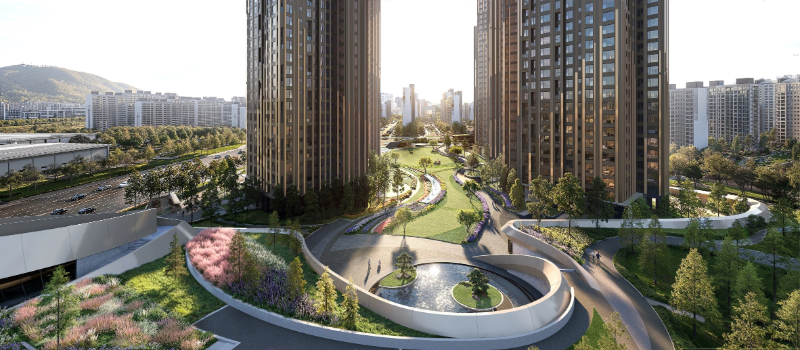
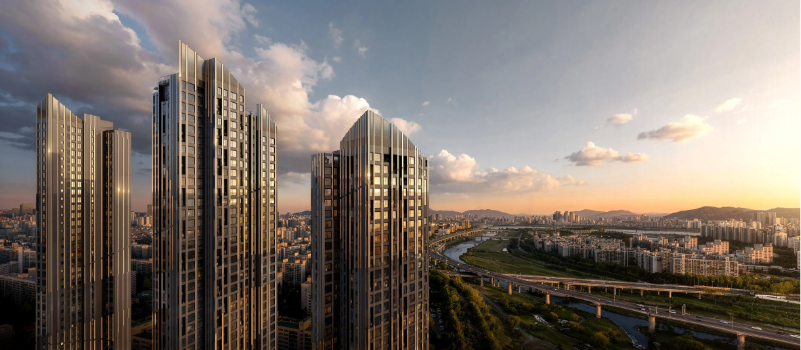
The project, called Daechi Ssangyong, will rise in Gangnam’s Daechi-dong neighbourhood, developed by Samsung Engineering and Construction Group in partnership with local firms Samoo and HJ Design Partners. It replaces five existing buildings currently holding 630 housing units — itself a telling data point about how aggressively Seoul’s most prestigious district is being re-densified. In their place: six towers reaching 49 storeys, containing close to 1,000 residences, wrapped in light-toned vertical facade elements designed to form curving bands across the exterior. The effect, as the design team describes it, is meant to shift with the sun and with the viewer’s movement — less a fixed facade than a slowly animated one.
Studio Libeskind has described the ambition in almost architectural-manifesto terms: a place meant to connect residents to the sky, the surrounding landscape, and to each other — treating six separate towers less as isolated real estate products and more as a single choreographed composition. Whether that reads as poetry or marketing copy probably depends on how much you’re paying per square metre, but it’s worth noting this isn’t Libeskind’s only recent swing at reframing high-density residential living as sculpture: the firm has also unveiled a geometric housing complex in Prague and a plant-clad angular building in Paris within the same stretch of months.
Why this matters beyond one Gangnam postcode
The Map to Modern Luxury
THE CURATED CALENDAR
Discover the world’s most prestigious gatherings & exhibitionsGangnam is not a neighbourhood that needs help attracting attention or capital — it’s already one of the most expensive, status-coded addresses in Asia. What’s notable here is the choice of architect and the specific language being used to sell the project. A decade ago, ultra-luxury residential towers in this bracket sold themselves primarily on address, floor plan and finishes. Increasingly, they’re selling themselves on the credibility of a single, internationally recognizable design name attached to the entire massing of the building — not just the interiors. That’s a meaningful shift in how the very top of the residential market signals value: the architect’s signature has become as much a status marker as the marble in the lobby.
It also reflects a broader trend across Asian megacities, where “starchitect” residential clusters — rather than single towers — are becoming the preferred format for the highest end of the market. A single striking building reads as a landmark; six coordinated ones, moving in visual rhythm with each other, read as a district unto itself, with all the exclusivity and self-contained prestige that implies. Expect more of this pattern globally as developers realize that in the current environment, “designed by” carries more weight in a listing than square footage alone.
For now, Daechi Ssangyong exists only as renderings and ambition. But if it delivers on the choreography Libeskind is promising, it will be one of the clearest examples yet of luxury residential real estate borrowing its playbook directly from the art world: not one masterpiece, but a curated set.