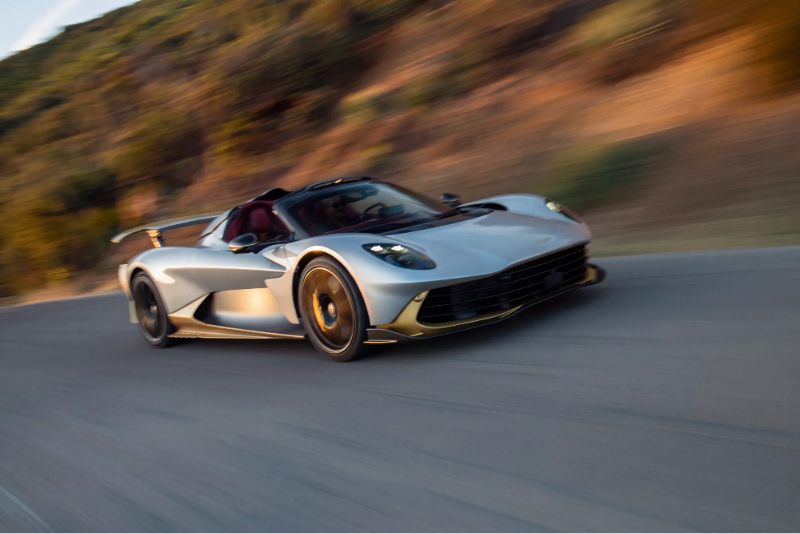
Aston Martin, the British marque founded in 1913 and headquartered in Gaydon, has taken the roof off its newest supercar. The Valhalla Spider is the open-cockpit version of the Valhalla, the mid-engined plug-in hybrid that arrived earlier this year and, by Aston Martin’s own count, broke a lot of new ground: its first mid-engined production supercar, first plug-in hybrid, first bespoke flat-plane-crank V8 and first eight-speed dual-clutch gearbox. The Spider made its global debut at the Concours at Wynn in Las Vegas this weekend, with customer deliveries due in the third quarter of 2027.
A surprising piece of arithmetic
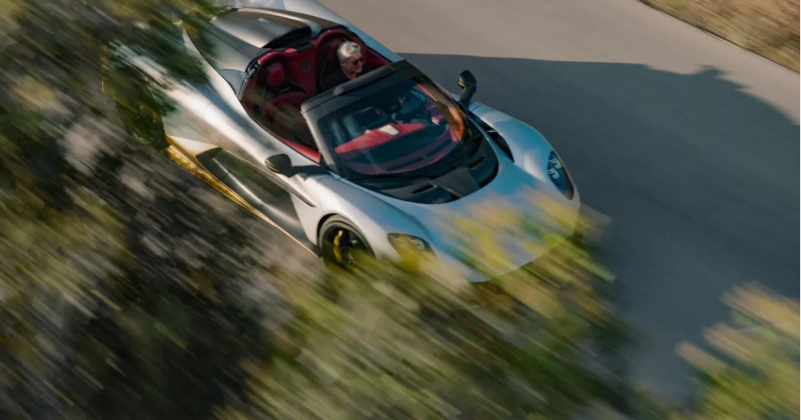
The most delightful detail in the technical notes is the speed rule. Fit the standard black fabric roof and the Valhalla Spider tops out at 124 mph (200 km/h). Take the roof off and, with a bespoke wind deflector clipped into place, the car can still reach its electronically limited 217 mph (350 km/h). An optional carbon hard top allows the full speed with the roof on. In other words, the roof is the slow option. It is a charming example of engineering logic from a company whose customers presumably spend most of their time not testing it.
Everything else is the coupe, with deliberate tweaks. Aston Martin Valhalla Spider’s powertrain is a 4.0-litre twin-turbo V8 producing 828 PS, aided by three electric motors for a combined 1,079 PS (about 1,064 hp) and 1,100 Nm of torque. Two motors drive the front axle with torque vectoring, and a third sits beside the eight-speed gearbox, with no mechanical link between front and rear. The carbon-fibre structure was developed with Aston Martin Performance Technologies, the consulting arm of the Aston Martin Aramco Formula 1 team, which also helped with aerodynamics and materials. Active aerodynamics are recalibrated for roof-on and roof-off driving, with downforce above 600 kg. The snorkel above the cockpit sits 35 mm taller, the carbon doors are now frameless, there is a new 15-litre storage space in each sill for the folded wind deflector, and a new Touring Seat is standard, with the coupe’s more supportive seat available at no cost.
Price, numbers and a bit of smoke
Aston Martin has not announced a price. British commentary expects it to start around £1.2 million (roughly $1.6 million), against about £850,000 for the coupe before options, and quotes ranging from £935,000 to £1.3 million. The coupe’s run was 999 cars, all sold. For the Spider, reports disagree: Forbes says production is limited to 249 cars, a figure that matches a share of about a quarter of the 999, while another British outlet says there is no official limit. The honest answer is that the company hasn’t confirmed a number in what it has published. Most coverage agrees that the order book is open and that private viewings were held before the public reveal.
Why Las Vegas?
Look at where the car was launched. A decade ago a British supercar would debut in Geneva, Goodwood or Pebble Beach. This one went to a concours at a casino resort. It makes commercial sense: the United States is a major market for this price bracket, and Las Vegas is a place where a lot of owners already come to gather. The Wynn event has drawn large groups of Bugattis in recent years. It also says something about the modern luxury launch, which has shifted from trade shows to curated owner gatherings, closer to a private view than a press conference.
The Map to Modern Luxury
THE CURATED CALENDAR
Discover the world’s most prestigious gatherings & exhibitions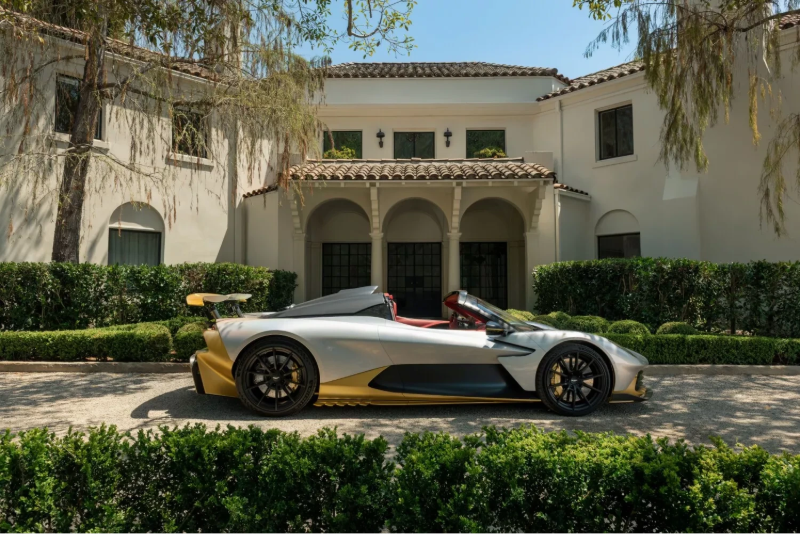
Soul with a battery
It fits neatly with the thesis we sketched in March, in our piece on the “pragmatic pivot” in luxury cars: after a rush toward fully electric models, the supercar market has settled on hybrids with voices. Aston Martin Valhalla keeps a screaming V8 and adds electric motors for torque and efficiency, which gives engineers speed and buyers a story they can live with. The Spider adds a further reason to buy: the pleasure of hearing it.
There are limits to the glamour. A removable roof is not a folding one; you stop, unlatch and stow it, which, as one reviewer wryly noted, is a lot of effort at this price. And a car that will mostly be admired in photographs, because so few will be built and most are already spoken for, is a different kind of luxury from one you can drive on a wet Tuesday. But that is the point of the segment: it sells the idea of the thing as much as the thing.
