Seventy-three years of family stewardship have ended in a single transaction. Now, with institutional capital in control and a new creative voice at the helm, the question isn’t whether Missoni can survive — it’s whether it can truly live again.

After the Zigzag: Missoni Without the Family
The house of Missoni was built on a single, audacious idea: that knitwear could be art. Ottavio and Rosita Missoni proved it from their tiny Lombardy workshop in 1953, wrapping the world in kaleidoscopic zigzags that became as recognisable as any brushstroke in any gallery. But last week, in the language of term sheets and equity transfers, the family quietly handed those brushstrokes to someone else.
The Missoni era at Missoni is over.
Milan-based private equity firm Fondo Strategico Italiano (FSI) has acquired the Missoni family’s remaining stake, raising its shareholding to approximately 73 percent. Simultaneously, German holding company Katjes International — through its luxury arm, Katjes Quiet Luxury — enters as a 27 percent minority partner. The deal, announced on 3 March and expected to close in Q2 2026 pending regulatory clearance, draws a firm line between the brand’s handcrafted origins and its institutionalised future.
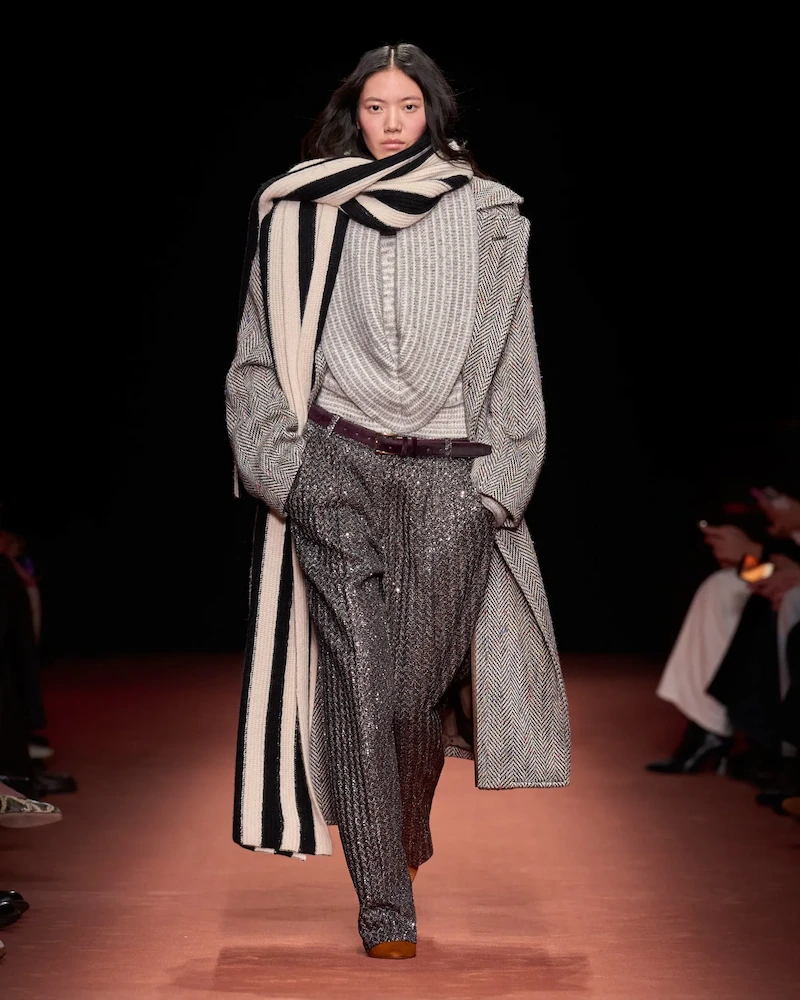
The news landed just days after creative director Alberto Caliri presented his third Missoni collection at Milan Fashion Week — a show that reportedly generated a 30 percent sales uplift across both spring and fall seasons. The timing was no accident. New owners, it seems, wanted proof of concept before signing.
The Missoni zigzag did not need reinventing. It needed re-releasing — into a world that had almost forgotten it was extraordinary.
ANALYSIS — THE NEW MISSONI PARADIGM. What the Numbers Actually Say
For a brand that spent years drifting near irrelevance, Missoni’s current financial position is quietly impressive. Revenue has roughly doubled to approximately €130 million, with adjusted EBITDA expected to reach €20 million this year. CEO Livio Proli — poached from Giorgio Armani’s orbit in 2020 — has already engineered a meaningful turnaround. The new ownership structure is not a rescue operation. It is a bet on acceleration.
Proli’s stated ambition is to push revenues beyond €200 million within five years, an increase of more than 50 percent. The roadmap is methodical: new flagship stores, expanded wholesale distribution, and a concerted push into lifestyle categories beyond fashion — most notably Missoni Home, which has long been the brand’s quiet secret weapon.
THE NEW MISSONI — KEY FACTS:
- FSI holds ~73% (up from 41.2% since 2018); Katjes Quiet Luxury holds 27%
- Revenue ~€130m; EBITDA target ~€20m in 2026
- CEO Livio Proli (ex-Armani) and Chairman Barnaba Ravanne (FSI) remain in post
- Alberto Caliri continues as creative director — his third season saw +30% sales uplift
- Katjes holds a call option on FSI shares, leaving a path to future majority control
- Missoni family retains cultural stewardship via Fondazione Ottavio e Rosita Missoni
- Production increasingly in-house, including signature zigzag knit fabrics
- Target: €200m revenue within five years via stores, wholesale, and lifestyle expansion.Alberto Caliri and the Creative Wager
Any serious analysis of Missoni’s prospects must centre on its creative direction, and here the picture is genuinely encouraging — if still unproven at scale. Alberto Caliri, who joined the house in 2024, represents something rare in contemporary luxury: a designer who appears to understand that his job is not to erase a brand’s DNA, but to restore it to its best self.
His early collections have leaned into the archive’s warmth and maximalism without tipping into nostalgic pastiche. In a fashion landscape where quiet luxury has dominated discourse for several years, Caliri’s Missoni — colourful, tactile, unapologetically Italian — reads almost as a counter-cultural statement. And it appears to be resonating: Missoni’s signature bright prints have found a new and unexpected audience on TikTok, introducing the house to a generation that had no memory of its 1970s peak.
Crucially, Caliri is backed by a team committed to in-house production. The house has been gradually bringing more manufacturing under its own roof — including the fabrics for its iconic knits — a move that both tightens quality control and builds a supply chain moat that fast-fashion imitators cannot easily replicate. This is not merely operational tidiness; it is a philosophical statement about what Missoni is.
Katjes is not buying a distressed legacy. It is buying an option on what happens when Italian craft meets German capital discipline — and leaving itself a path to drive the outcome.
ON KATJES QUIET LUXURY’S STRATEGIC POSITION
Who Is Katjes Quiet Luxury — and Why Does It Matter?
The arrival of Katjes International as a minority shareholder has prompted raised eyebrows in some quarters. The Fassin and Bachmüller families (the managing shareholders of Katjes International and its sister company, Katjes Deutschland.) built their fortune in confectionery — gummy bears and liquorice, not silk and knitwear. But Katjes Quiet Luxury is a deliberately separate vehicle, and its recent track record is instructive. The group recently took a majority stake in German ski-and-sport fashion brand Bogner, signalling a coherent thesis: acquire heritage European brands with undervalued identity, and provide the capital and operational patience to let that identity compound.
For the Missoni deal, Katjes raised its corporate bond by €15 million to a total of €200 million, listed on the Frankfurt Stock Exchange — demonstrating both access to capital and a willingness to use it. Perhaps more strategically significant is the call option Katjes has secured on FSI’s shares, meaning that at some future point, the German group could become Missoni’s controlling owner. This is not a passive minority stake. It is a foothold with ambitions.
Whether Katjes brings meaningful luxury expertise beyond financial backing remains an open question. The confectionery industry rewards consistency, patient brand-building, and distribution scale — qualities that transfer reasonably well to accessible luxury. What it does not necessarily cultivate is the aesthetic nerve required to take creative risks in fashion.
The Risks That No One Is Advertising
The optimistic reading of this deal is compelling. Doubled revenues, a resurgent creative director, institutional backing, Italian identity preserved, and a brand newly viral on social media. But history offers some sobering precedents for beloved Italian fashion houses that passed from family control into private equity structures.
The first danger is the resort boutique strategy. FSI has indicated a focus on resort mini-boutiques — a format that appeals to high-net-worth tourists but risks reducing a fashion house to a holiday souvenir. Missoni’s identity has always resided in its ability to dress women for real life, not merely for poolside photography. If the brand’s physical presence becomes synonymous with Capri and Mykonos, it may gain revenue while losing cultural relevance.
The second risk is succession at the creative level. Caliri’s early results are promising, but three seasons is not a body of work. The history of luxury is littered with creative directors who delivered an inspired first chapter only to falter when the initial energy dissipated. Whether the new ownership structure provides the creative latitude — and the timeline — necessary for a designer to build genuine artistic authority is untested.
Third, and perhaps most subtle, is the question of soul. The Missoni family’s exit is not merely a share transfer. Angela Missoni and her brother Luca were the living memory of the house’s founding spirit. The Fondazione Ottavio e Rosita Missoni will continue to steward the archive and heritage, but a foundation is a museum, not a nervous system. The irreplaceable thing that family-owned luxury houses possess — an owner who would rather die than betray the brand’s integrity — is now gone.
A Brand Reborn: Financially Sound and Creatively Awake
The brand is financially stable, creatively alive, and culturally visible in ways it has not been for years. The danger is institutional mediocrity — the slow homogenisation that tends to follow when private equity logic overrides instinct.
What could prevent that fate? A creative director given genuine authority and genuine time. A product strategy anchored in the knitwear and textiles that no one else in the world does as well. An expansion into Missoni Home that is treated as a lifestyle empire rather than a licensing afterthought. And a marketing approach that leans into the brand’s radical optimism — its insistence, across seven decades, that colour is a form of courage.
The zigzag is still one of the most powerful motifs in fashion. It belongs to no trend cycle, no single silhouette, no passing mood. It is simply, irreducibly Missoni. The new owners did not invent that. Their task — and their risk — is to prove they are worthy of it.
ASSESSMENT
Cause for optimism: Revenue trajectory is positive, creative direction is commercially resonant, ownership is Italian, and the brand has genuine global recognition. CEO Proli has already demonstrated operational credibility.
Cause for caution: PE-majority ownership has a mixed record in Italian fashion. Creative tenure is short. The resort boutique strategy risks positioning over identity. Katjes’s luxury credentials are unproven at this scale.
The wager: That institutional capital and patient German backing can do for Missoni what the family, ultimately, could not — provide the runway to become the global luxury brand the zigzag always deserved to be.