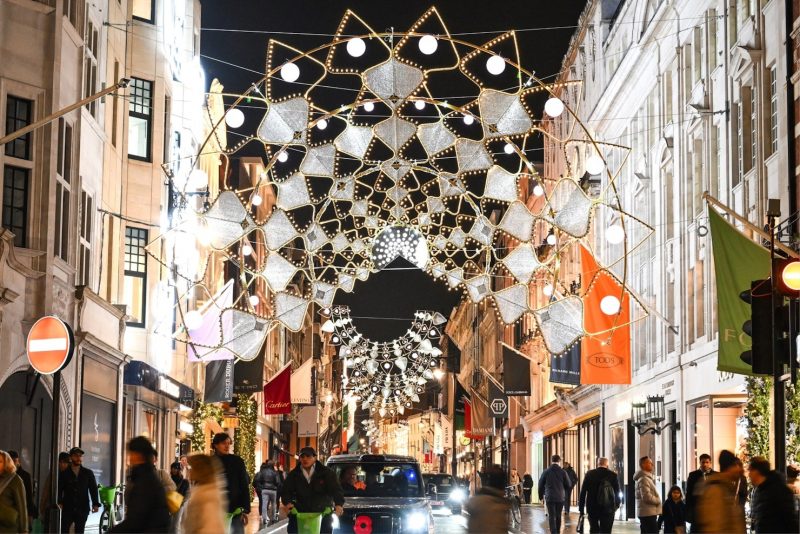
The perennial battle for supremacy among the world’s most rarefied shopping avenues has delivered its most dramatic result in a decade. According to the latest 2025 edition of Cushman & Wakefield’s authoritative Main Streets Across the World report, the global luxury crown now sits firmly upon London’s New Bond Street.
The move is less a seismic economic event and more a perfect alignment of geopolitical currents and aggressive brand strategy. For the first time, London’s iconic West End thoroughfare has surged past its continental rival, Milan’s Via Montenapoleone. New Bond Street’s Zone A rents have spiked to an astonishing £2,750 per square foot/year, translating to €20,482 per square metre/year, narrowly edging out Milan’s stable, yet static, €20,000 per square metre/year. This ascent was fueled by a convergence of sustained, high-intensity demand from the world’s most elite luxury houses—all vying for scarce flagship spaces—and, critically, a significant appreciation of the British pound against the US dollar, which buoyed its valuation in the global (USD) ranking.
The New European Hegemony
The significance of this result cannot be overstated: the top two most expensive destinations globally are now European, a notable departure from the decades when New York’s Upper Fifth Avenue reigned supreme. While Fifth Avenue remains a powerhouse at Global #3 ($2,000 psf/yr), its rents held flat this cycle, underscoring the fierce transactional dynamism witnessed across the Atlantic.
Europe, as a region, has proven remarkably resilient, posting an average prime retail rental growth of 4.0% year-on-year. This vitality extends beyond the absolute top tier. For instance, while Paris’s Avenue des Champs Élysées held steady at Global #5, the continent as a whole is confirming its role as the stable bedrock of high-end consumption, defying broader global economic uncertainties.
This stability contrasts sharply with parts of Asia-Pacific. While the region boasts major trophy assets like Hong Kong’s Tsim Sha Tsui (Global #4), which recorded a 6% decline in rents, driven by macroeconomic headwinds, other Asian power centers are showing renewed vigour. Tokyo’s Ginza district, for example, reported a remarkable 10% rental surge, confirming Japan’s continued strength as a domestic luxury market and prime destination for high-net-worth tourism. The luxury map is thus becoming fragmented: stability in Western Europe, dynamism in Tokyo, and caution in historically dominant hubs like Hong Kong.
The Flight to Flagships
The Cushman & Wakefield analysis provides a crucial insight into contemporary luxury retailer behavior: the profound polarization of performance between prime and secondary retail locations.
This is a global strategy of triage. Rather than pursuing wide geographic expansion, brands are focusing on fewer, stronger, and more experiential flagship stores. These locations are not merely points of sale; they are temples of brand identity, designed to capture customer imagination and integrate digital and physical experiences.
This strategic “flight to quality” is perfectly illustrated in the stability of the Belgian market, which, despite a less frantic pace than London, remains critical to the regional ecosystem. Antwerp’s Meir holds firm at Global #29. Locally, while Brussels’ Rue Neuve slipped one place to 43rd in the European ranking, overtaken by the 4% rental growth of Lisbon’s Chiado, the core lesson remains: premium retail streets in both Brussels and Antwerp continue to see demand exceed supply.
As Nicolas Diercxsens, Partner in the Retail Agency department of Cushman & Wakefield Belgium, noted, this confirms the “solid performance of retail in today’s commercial letting market.” The focus is less on volume and more on visibility, cementing the prime address as the most valuable asset in the luxury portfolio. The gap between the world’s most expensive streets and the rest is not just a gap in price, but a gap in strategic priority.
This shift confirms that the luxury retail landscape is no longer defined solely by historical prestige, but by relentless strategic investment, limited supply, and the ability of a street to act as a global beacon for high-net-worth consumers.