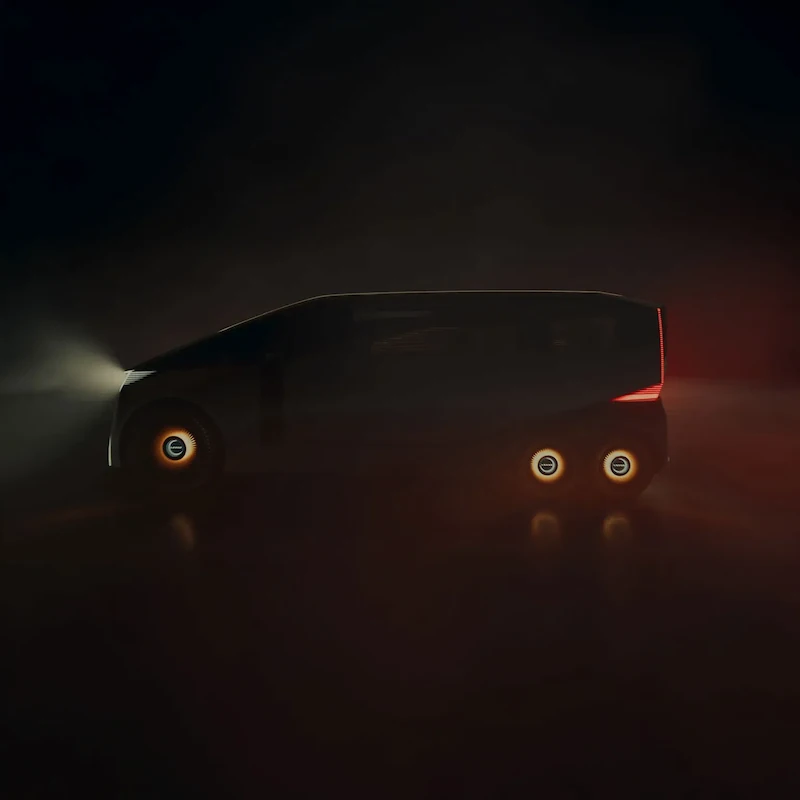
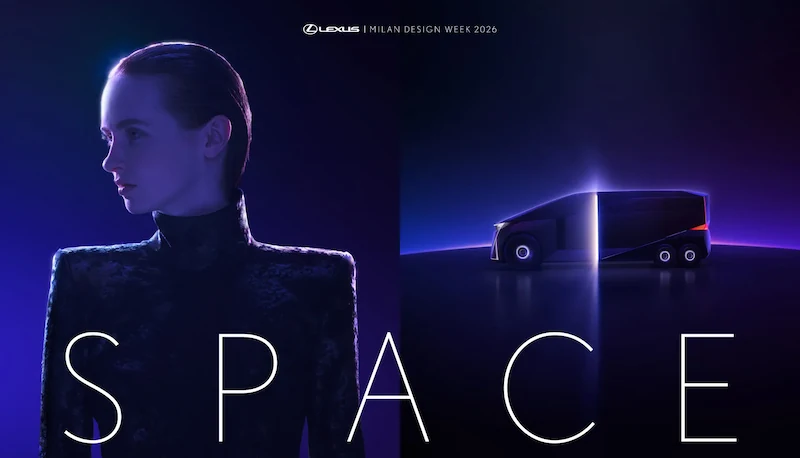
When the design world descends upon Milan this April for the Salone del Mobile, the air usually hums with the frantic energy of “the new.” Yet, in the heart of the Tortona district, Lexus is planning to offer the exact opposite: the world premiere of “SPACE,” an immersive installation that challenges the very industry it leads.
Based at the Superstudio Più from April 21–26, Lexus is pivoting from “transportation” to “transcendence.” While the automotive world has spent a century obsessing over the engine under the hood, Lexus is now obsessing over the human inside the cabin.
The New Motif: The LS Concept as a Sanctuary
At the center of this year’s showcase is the Lexus LS Concept, a next-generation chauffeur car that debuted at the Japan Mobility Show. But at Milan Design Week, the car isn’t just a vehicle; it’s a motif.
Under the theme “Discover Your Space,” Lexus is exploring the “raison d’être” of the modern flagship. In an era where our professional and personal lives are blurred by constant connectivity, the “space” within a car is the last true frontier of privacy. It is no longer about getting from A to B; it is about what happens to your state of mind during the interval.
How “Discover Together” Changes the Narrative
This year marks the evolution of the Lexus Design Award into “Discover Together.” This isn’t just a name change; it’s a strategic shift from a competition to a high-level creative laboratory. Lexus has paired its in-house masters with a global vanguard of creators to dissect the concept of luxury volume.
The 2026 Collaborators:
Kyotaro Hayashi & Yumi Kurotani (Japan): The “Poets of Light.” They are transforming the LS Concept’s essence into a narrative of light and shadow that speaks to human memory rather than just aesthetics.
Guardini Ciuffreda Studio (Italy): The “Eco-Architects.” Expect organic forms that dissolve the boundary between a car’s interior and a living ecosystem.
Random Studio (Netherlands/France): The “Tech-Alchemists.” They specialize in interactive environments that react to the observer, turning “space” into a conversation.
Lexus In-House Artisans: A dream team of Kumiko woodworkers, Tendo Mokko plywood masters, and stone craftsmen. This is where 21st-century mobility meets 100-year-old Japanese soul.
The Map to Modern Luxury
THE CURATED CALENDAR
Discover the world’s most prestigious gatherings & exhibitionsThe Radical Departure: Why This Isn’t Just “Another Car Display”
Most automotive exhibits at Milan Design Week are exercises in branding—shiny cars under bright lights. Lexus is doing something significantly more “niched” and cerebral:
Deconstructing the Machine: Instead of showing you a car, they are showing you the feeling of being inside one. They are selling the “void”—the luxury of having nothing demanding your attention.
The Artisan-Engineer Fusion: By putting a WorldSkills Olympics champion wood-modeler in the same room as a stone craftsman from Inagaki Sekizai-ten, Lexus is asserting that the future of tech is actually tactile.
The Chauffeur Logic: The LS Concept focuses on the “rear seat” experience. In the luxury tier, power is defined by the ability to be moved, not just to move. This project explores the dignity of the passenger.
The Industry Ripple Effect
What does this mean for the industry? It’s a signal that the “Horsepower Wars” are officially dead, replaced by the “Serenity Wars.” Lexus is betting that as cars become autonomous and electric, the only way to differentiate a luxury brand will be through its “spatial philosophy.” If a car is just a box on wheels, Lexus wants their box to feel like a cathedral, a gallery, or a meditation garden.
For the design scene, this move validates “Mobility Design” as a legitimate branch of Fine Art. It suggests that the most important “space” we inhabit in the future won’t be our homes or offices, but the fluid, private bubbles that carry us between them.
The Verdict: If you are in Milan this April, don’t go to Superstudio Più to see a car. Go to see if you can still find a moment of peace in a world that never stops moving.