Twenty Years, One Napkin Sketch, and a Museum the Size of a Small Airport
Some restaurants make you wait forty-five minutes for a table. The Guggenheim Abu Dhabi made the entire art world wait twenty years for a building. On December 11, 2026, it finally opens — and the wait, by every account, appears to have been the point rather than the problem.
The decoding: why did this take so long?
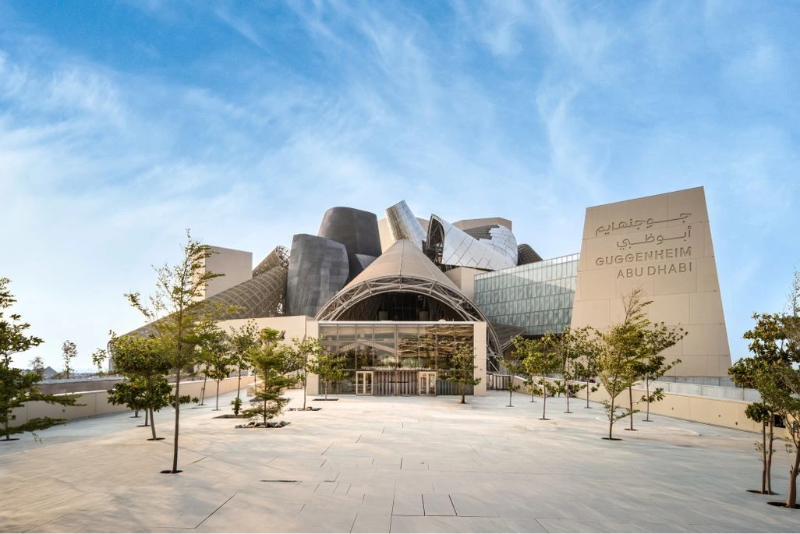
First announced in 2006, the project spent its first decade as a rumor with a rendering attached. Construction actually began in 2011, was suspended for years amid economic pressure and contract renegotiations, resumed in 2019, missed a proposed 2025 completion date, and has now landed — for real this time — on a firm December opening. Frank Gehry, who died in 2026, will not see the doors open on the building he called one of his most thrilling projects. That alone gives this launch a different emotional register than most museum openings: this is as much a posthumous tribute as a ribbon-cutting.
What visitors will actually walk into is staggering by any museum’s standards. At roughly 80,000 square metres, it becomes the largest museum Gehry ever designed and the biggest of the four Guggenheim outposts worldwide, overtaking even Bilbao. Ten sculptural cones — nine wrapped in stainless steel mesh, one finished in onyx and glass — rise as high as 88 metres, forming an irregular skyline over a central atrium. Thirty galleries of varying shapes and heights surround it, alongside a technology and art centre, a conservation lab, archives and a library. The mesh cladding isn’t just an aesthetic signature; it’s Gehry’s answer to the Gulf’s punishing light and heat, filtering sun across the structural frame rather than fighting it with brute-force glass and air-conditioning.
Why the luxury and culture worlds should care
This isn’t an isolated museum opening — it’s the capstone of Saadiyat Island’s decade-long transformation from empty coastline into one of the most concentrated cultural districts on the planet. The Guggenheim now joins Jean Nouvel’s Louvre Abu Dhabi, Foster + Partners’ Zayed National Museum, and Mecanoo’s Natural History Museum Abu Dhabi as neighbors on a single island — a starchitect roll call that reads like an invitation list to a very exclusive dinner party. For luxury travel, that concentration matters enormously: Abu Dhabi has effectively engineered, from scratch, a cultural weekend destination that can compete with Paris or Bilbao on architectural pedigree alone, before a single artwork is hung.
The Map to Modern Luxury
THE CURATED CALENDAR
Discover the world’s most prestigious gatherings & exhibitions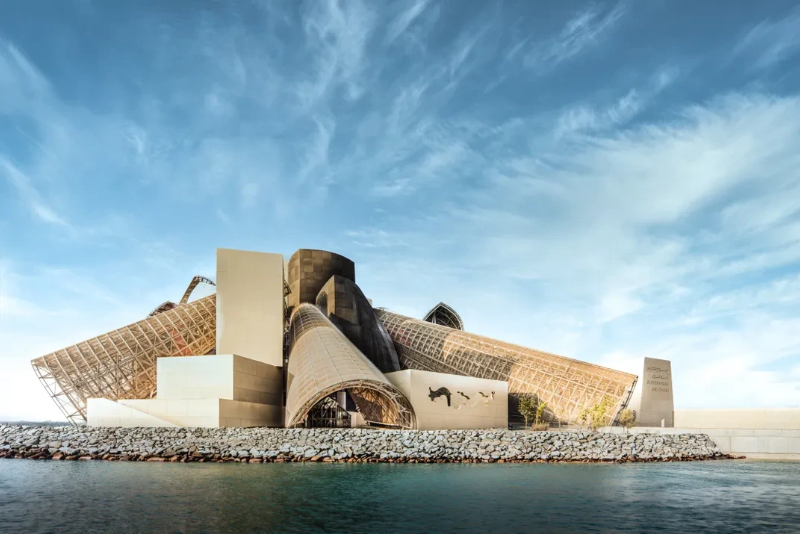
For the art world specifically, the more interesting signal is curatorial, not architectural. Guggenheim Foundation director Mariët Westermann has described the museum’s ambition as regionally rooted rather than simply another satellite of the New York flagship — a collection organized around themes like memory, land and storytelling rather than the traditional Western chronological march through art history. Read generously, that’s a genuine attempt to decentre the story of modern art away from its usual American and European axis. Read cynically, it’s also smart positioning: a museum built in the Gulf, funded substantially by the Gulf, should probably not feel like a rerun of Fifth Avenue.
Either way, the practical takeaway for anyone planning a cultural itinerary is simple: Saadiyat Island just became a legitimate, multi-day art pilgrimage rather than a one-museum stopover. December 11th is the date to circle — and possibly the moment Abu Dhabi stops being described as an “emerging” art destination and starts being treated as an arrived one.