Poaching Steals From Us All: : Wildlife Protection Award 2019 goes to Award-winning actress Lupita Nyong’o


Award-winning actress Lupita Nyong’o is this year’s Wildlife Champion.
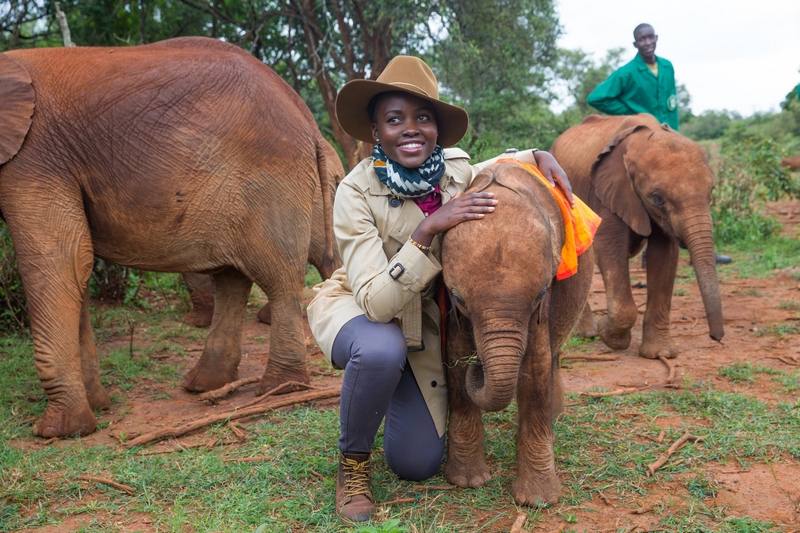
Lupita Nyong'o to Receive Wildlife Protection Award
Lupita Nyong’o to Receive Wildlife Protection Awa; @WildAid

WildAid, the global conservation organization leading the fight to end the illegal wildlife trade, announced today it will honor Academy Award-winning actress, Lupita Nyong’o, as this year’s Wildlife Champion at its annual fundraising gala on November 9 at the Beverly Wilshire, A Four Seasons Hotel.

Nyong’o has been a prominent advocate for elephant conservation, traveling to Kenya with WildAid in 2015 to publicize the threat of poaching and most recently partnering with WildAid on Discovery’s best-rated series, Serengeti, which follows the lives of Tanzania’s majestic animals.

“Elephants are part of my heritage and a personal love for me,” Nyong’o said. “They play an important part of African economies through tourism and it’s unthinkable that we could let them become extinct just to trade their ivory.”

To celebrate Africa’s wildlife heritage, WildAid’s gala will rally support for the continent’s national parks and anti-poaching efforts with the simple message, “Poaching Steals From Us All.”

Nyong’o was named WildAid’s Global Elephant Ambassador in 2015, joining the international conservation organization on a trip to Kenya to visit Amboseli National Park with the Amboseli Trust for Elephants and The David Sheldrick Wildlife Trust’s Nairobi elephant orphanage. The Kenyan-Mexican actress was featured in WildAid’s PSAs with the poignant message, “Poaching Steals From Us All.”

Although Kenya banned the ivory trade more than 25 years ago, growing affluence in Asia has produced a new class of ivory consumers who have reignited demand and stimulated the illegal ivory trade, resulting in continued poaching. Across Africa, up to 25,000 elephants have been killed annually for their ivory, with militant groups and international criminal syndicates profiting from the trade.

WildAid and Yao Ming were instrumental in 2017 in supporting China’s historic ban on domestic ivory sales, the greatest single step in safeguarding the future of African elephants as well as reducing prices for ivory down by two-thirds. The organization continues to produce high-impact communications campaigns to reduce demand for ivory in China, Thailand and Vietnam, as well as in Japan, the largest remaining legal ivory market.

This year’s gala sponsors include Elegance Brands Inc., Chantecaille, Moon Hollow Estate, and Kelleher International, all of whom support WildAid in its mission of wildlife conservation.

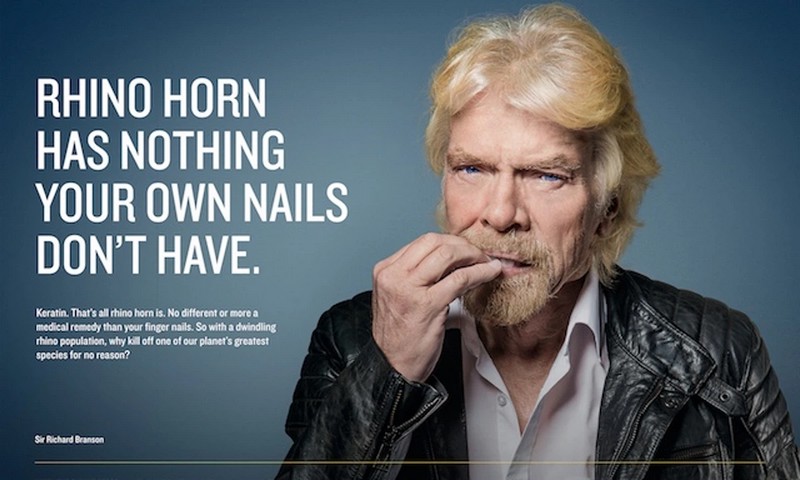
Richard Branson fronts nail-biting campaign against rhino poaching

richard branson rhino horn


Powered by Guardian.co.ukThis article titled “Richard Branson fronts nail-biting campaign against rhino poaching” was written by Jessica Aldred, for theguardian.com on Wednesday 13th January 2016 11.20 UTC

Sir Richard Branson is leading a new campaign against the sale of rhino horn that features the Virgin founder, along with Chinese celebrities and global wildlife ambassadors, chewing their nails.

The campaign, a series of English and Chinese-language billboards and videos from conservation groups WildAid and the African Wildlife Foundation, aims to highlight how rhino horn is made primarily of keratin, the same protein that makes up human fingernails and hair, which has no medical benefits.

In one advert, Sir Richard is shown biting his nails next to the words: “Keratin. That’s all it is. No different or more a medical remedy than your fingernails. So with a dwindling rhino population, why kill off one of our planet’s greatest species for no reason?”

Rhino horn is considered a status symbol in Vietnam and China, where the growth of the middle class has led to an explosion in demand for the horn, which is ground down and used as a traditional medicinal cure and recreational drug. International criminal syndicates are known to charge £60,000 a kilo for an illegal substance that is worth more than gold but is actually no different from human fingernails.

“Rhino horn’s luxury cache among a privileged few is the root cause of the poaching crisis raging in Africa,” said WildAid chief executive, Peter Knights. “This campaign seeks to deflate rhino horn’s allure and expose it for what it is: fraud.”

The most recent official figures show that 749 rhinos had been poached by 27 August last year in South Africa, where most of the animals are concentrated. The rate had further intensified after a record total of 1,215 rhinos were killed in 2014.

The adverts will be displayed on billboards in Beijing airport, Chonqing’s Central Square and around Shanghai, Guangzhou and Shenzhen. Videos will be broadcasted on several national TV networks and onboard bullet trains, and heavily promoted on Chinese social media networks.

Also featuring in the “nail biters” campaign is Vietnamese-American actress and WildAid wildlife champion of the year Maggie Q, Chinese actor Li Bingbing and Chinese celebrities such as actor and singer Jing Boran, fashion photographer Chen Man and actor Chen Kun.

A Vietnamese version of the “nail biters” campaign is also underway, as part of a drive to educate consumers in the world’s largest rhino horn market and persuade them not to buy, gift or consume rhino horn.

“Rhino horn won’t cure cancer or a headache, but the rhino poaching epidemic in Africa does have a cure, and it involves people not buying rhino horn,” said Dr Patrick Bergin, African Wildlife Foundation chief executive. “Sir Richard and other campaign celebrities are delivering the message, and now we need citizens in China and Vietnam to be part of the solution.”

Earlier this week England cricketers Stuart Broad and Steven Finn followed in the footsteps of Prince Harry by learning about the plight of rhinos at the Shamwari wildlife rehabilitation centre ahead of the third test against South Africa in Johannesburg.

guardian.co.uk © Guardian News & Media Limited 2010

Published via the Guardian News Feed plugin for WordPress.

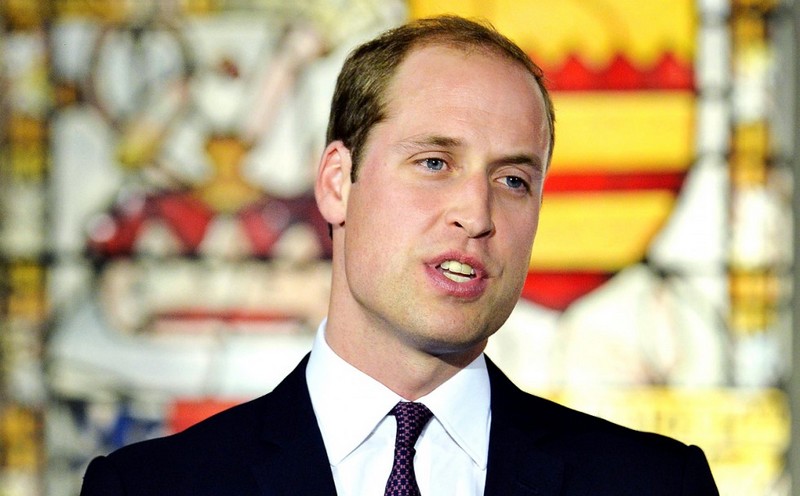
Prince William urges Chinese to stop buying ivory and rhino horn

WildAid | Be Ivory Free

prince william against ivory trade


Powered by Guardian.co.ukThis article titled “Prince William urges Chinese to stop buying ivory and rhino horn” was written by Adam Vaughan, for The Guardian on Monday 19th October 2015 16.49 UTC

Prince William has told Chinese citizens to stop buying illegally traded wildlife products such as ivory and horn to save Africa’s rhino and elephants, hours before a state visit to the UK by China’s president.

He said: “We have to accept the truth: that consumers are driving the demand for animal body parts, for art, for trinkets, or for medicine. Only we as consumers can put the wildlife traffickers out of business.”

The Duke of Cambridge made the comment in a speech to a small audience at King’s College London that included the broadcasters Sir David Attenborough and Bear Grylls. It will later be shown to millions on Chinese television station CCTV1.

“It is time to talk about the growing human demand for illegal wildlife products that drives the trade and makes it profitable,” he continued.

He said the rate of killing – three rhino and more than 50 elephants a day in South Africa – meant that children born this year, such as his daughter Charlotte, would see the last elephants and rhino die before their 25th birthday.

“The good news is that we are far from powerless in this struggle. We can turn the tide of extinction,” he said, adding that the “killing fields” of poachers and their supply chains were already known.

He praised the Chinese president, Xi Jinping, for saying recently that he would take steps to stop the country’s domestic ivory trade. Conservationists say the trade enables the laundering of illegally imported ivory.

The prince visited an elephant sanctuary in Yunnan province during a royal visit to China in March, where he praised the country’s contribution to protecting wildlife in Africa. But without singling out China, he said more could done to reduce demand, which comes largely from south-east Asian countries.

“Demand provides traffickers with their incentive. It fuels their greed and generates their vast profits,” he said.

Before the visit, China banned ivory carving imports for a year and Attenborough, along with MPs and conservationists, wrote to Xi to urge him to end the country’s domestic ivory trade.

William has been campaigning for years against the illegal wildlife trade and in December last year he used a speech to point out the wholesale price of ivory had jumped from $5 to $2,100 per kilogram (about £3 to £1,350) in 25 years, driving poaching.

Along with his father, the Prince of Wales, William was a key figure at a London summit on the wildlife trade in February 2014. “We are here with a single shared purpose, to use our collective influence to put a stop to the illegal killing and trafficking of some of our world’s most iconic and endangered species,” he told the 46 nations represented at the meeting, where they agreed an accord to tackle the problem.

guardian.co.uk © Guardian News & Media Limited 2010

Published via the Guardian News Feed plugin for WordPress.

Sales of shark fin in China drop by up to 70%

Traditionally a symbol of wealth and luxury, public attitidues towards shark fin are changing in China, according to a new report