Let’s start with an uncomfortable truth: a wheel is, at its most fundamental, a round thing that helps another thing not drag along the ground. Humanity has been making round things for about 5,500 years. We have had a lot of practice.
And yet, somehow, in 2025–2026, the wheel has become the most technically complex, ludicrously expensive, and spiritually significant component you can bolt onto a motor car. We have gone from carved wood to carbon fiber lattices grown atom by atom in electron beam furnaces. We have gone from wagon wheel to artwork. And somewhere along the way, a set of four of them started costing more than a family saloon.
Welcome, then, to the golden age of the automotive wheel. Strap in. Or rather, torque to spec — typically 120 Nm, since you’re clearly the type who asks.
What Are These Things Even Made Of?
For most of automotive history, wheels were made of steel, and then aluminum, and that was considered quite exciting enough. Steel was heavy. Aluminum was lighter. Everyone was very pleased.
Then someone asked: but what if we made it from the same materials used on spacecraft? And instead of being shown the door, they were handed a large budget. The results, it must be said, are spectacular.
The Carbon Revolution: Not Just a Band Name
Carbon Revolution — which is both a real company name and something that sounds like it should be a 2009 prog-rock album — has quietly become one of the most consequential wheel manufacturers on the planet. Their full carbon fiber monoblock wheels are approximately 40–50% lighter than aluminum equivalents, a figure that sounds modest until you consider what it means at each corner of a moving vehicle.
The company has supplied wheels to Ford (Shelby GT350R, GT500), Ferrari, and GM on flagship performance models. Carbon Revolution claims their wheels contribute approximately 1.5 seconds of lap time improvement per 2-minute circuit — a documented, publicly stated figure, not something conjured for dramatic effect. In the world of performance driving, 1.5 seconds is the difference between a podium and a polite consolation trophy.
“Reducing unsprung weight transforms how a car communicates with the road. It is, in engineering terms, the closest thing to giving the suspension a brain transplant.”
The science is straightforward: the less mass your suspension has to control at each wheel, the faster and more accurately it can react to road inputs. Steering sharpens. Braking shortens. The car stops feeling like it’s being negotiated with and starts feeling like it’s being commanded. All because you removed some weight from the very edges of the vehicle.
The Titanium Lattice: Beauty from a Beam of Electrons
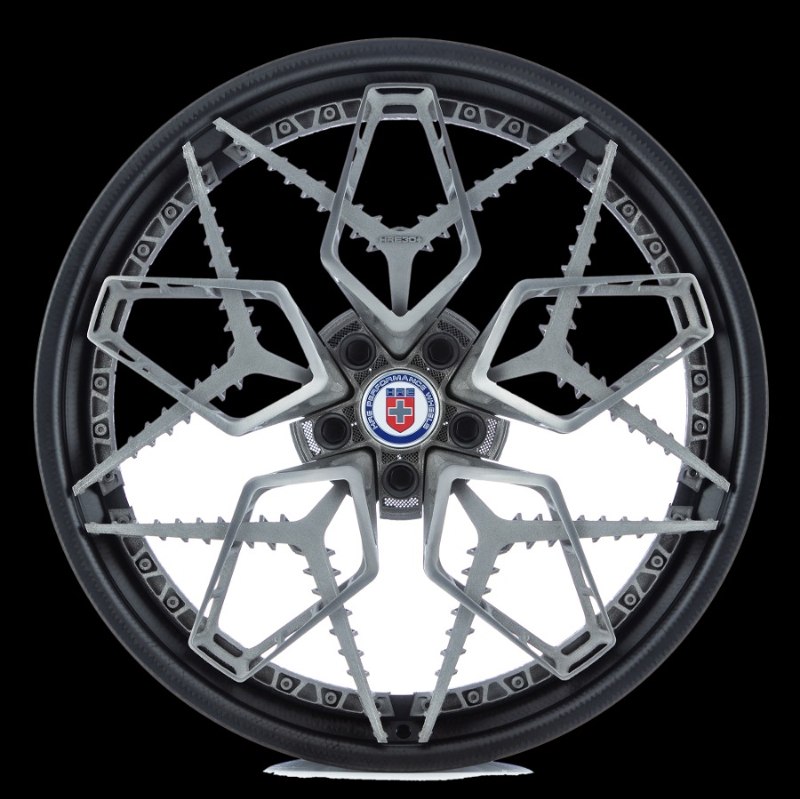
In 2018, HRE Wheels — a California manufacturer whose name is pronounced with the reverence usually reserved for Swiss watch houses — partnered with GE Additive to produce the HRE3D+. It is, genuinely, one of the most extraordinary objects in the automotive world.
Using a process called Electron Beam Melting, a computer-directed beam of electrons fuses titanium powder, layer by microscopic layer, into a wheel spoke structure that looks like it was designed by a particularly gifted spider. The resulting lattice is simultaneously lighter than a comparable forged spoke, stiffer where stiffness is needed, and visually arresting in a way that makes people stop mid-sentence.
There is one catch: HRE stated clearly at launch that the HRE3D+ was a proof-of-concept, not a product. It has never been sold. If you were planning to order a set, you are approximately seven years too late and also, technically, still too early.
This is not a criticism. Proving a concept at this level of engineering elegance is genuinely valuable. But any article claiming you can buy these wheels today is, politely put, writing cheques the supply chain cannot cash.
Magnesium-Carbon Hybrids: The High-Maintenance Marriage
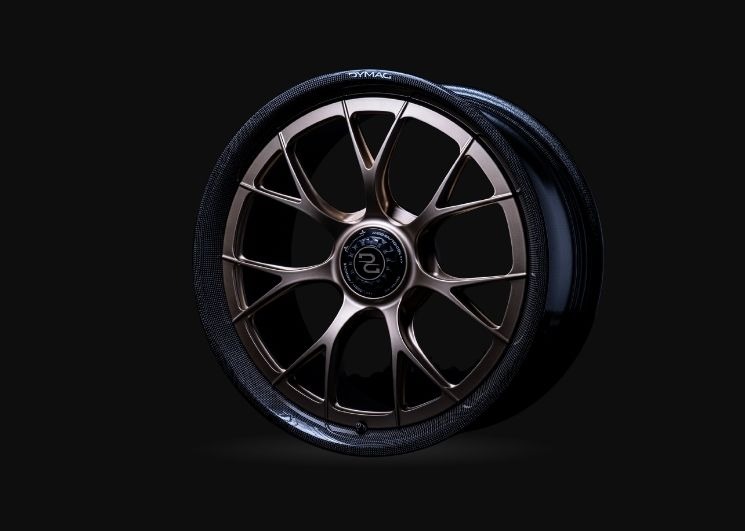
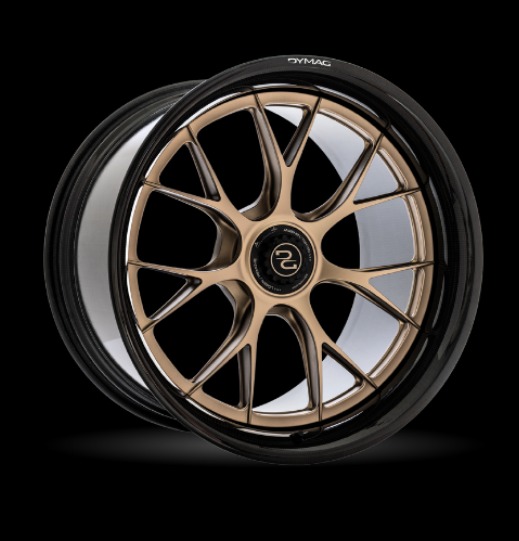
Dymag’s HALO-X is what happens when engineers decide that one exotic material is simply not enough. It pairs a magnesium center hub — magnesium being the lightest structural metal in mainstream automotive use — with a carbon fiber rim barrel. The result is among the lowest unsprung mass figures available for any road-legal wheel.
The price for a set fitted to a Porsche 911 GT3 RS sits at approximately £28,000 — or roughly $36,500 USD, which is, for context, more than the average new car sold in the United States. For that money, you receive wheels that are lighter, faster, and significantly more delicate than anything in a standard catalogue.
Magnesium, for all its remarkable lightness, requires attentive maintenance. Compromise the protective coating and corrosion moves in with the enthusiasm of a houseguest who never leaves. These are wheels for the committed, the careful, and the mechanically sympathetic.
THE WEIGHT COMPARISON IN PLAIN ENGLISH
A standard forged aluminum wheel: 25–30 lbs. A full-carbon wheel: 15–18 lbs. A magnesium-carbon hybrid: marginally less than that. Multiply the savings across four wheels and you’ve removed the equivalent of a medium-sized Labrador from your car’s rotating mass. The Labrador, however, provided no performance benefit and was considerably harder to balance.
Technology — Separating the Real from the Remarkable
Enthusiasm for high-end wheels has, on occasion, outpaced the actual engineering. The internet is full of articles about wheel-integrated sensor systems that read road friction, predict potholes, and—one suspects, in some drafts—brew coffee. The truth is more grounded, but no less interesting.
What Is Actually In Your Wheel Right Now
The Tire Pressure Monitoring System (TPMS) is the quiet hero of wheel-integrated technology: mandatory in most markets, largely ignored until the light comes on, and genuinely useful when it does. Modern iterations have evolved considerably beyond a simple pressure gauge; advanced systems now incorporate multi-axis sensors that detect lateral load distribution, feeding data into active suspension calibration systems on high-end vehicles.
In motorsport, rim-integrated brake temperature sensors are well-established — allowing engineers to monitor thermal loading at each corner in real-time and adjust brake bias or cooling accordingly. Trickle-down to road cars is gradual but ongoing. Wheel-mounted accelerometers are now found on several production hypercars, contributing data points to active damping systems that adjust faster than any human reaction time.
This is genuinely impressive. It is also, compared to some claims in enthusiast media, rather more modest than “a data center on your axle.”
Aerodynamics: Static Ingenuity, Not Sci-Fi
Brixton Forged’s Aerotech series uses disc inserts and vented flange geometry to direct airflow through the wheel face — a real and measurable contribution to brake cooling and drag reduction at speed. It is elegant, it is engineered, and it exists.
What does not exist — regardless of what you may have read — is a self-actuating wheel blade that opens and closes like a gill depending on speed, vacuum-extracting heat from your ceramic brake rotors with cinematic precision. That technology is not available from any wheel manufacturer. If anyone quotes you a price for it, they are either from the future or from a different profession entirely.
A GENTLE NOTE ON WHEEL SENSORS
The term ‘Electro-Tiro-Gram (ETG) sensor’ does not exist in any engineering literature, product catalogue, or legitimate industry publication. It was, by all available evidence, invented. This is mentioned not to shame anyone, but because the real sensor technology — advanced TPMS, load-sensing accelerometers, thermal monitoring — is genuinely remarkable without embellishment. The truth needs no fiction.
The Electric Revolution and the Wheel’s New Role
The rise of electric vehicles has, unexpectedly, made the high-performance wheel more relevant than ever. In a combustion car, saving 12 lbs of unsprung mass is a performance upgrade. In an electric vehicle, it is also a range upgrade.
Carbon Revolution has demonstrated that EV models equipped with their carbon wheels can achieve 5–10% improvements in range — because weight saved at the wheel can be reallocated to battery capacity, and because the reduced rotational inertia means the motor does less work per kilometre. For an EV buyer anxious about range, that is not a trivial figure.
The instantaneous torque delivery of electric motors also rewards low-inertia wheels more dramatically than combustion engines. When a motor can spin up to full torque in milliseconds, having less rotating mass at the wheels means the car responds with a directness that feels almost telepathic. The wheel, in this context, has become the interface between the digital and the physical.
Design: The Art of Expensive Restraint
The dominant aesthetic of 2025–2026 among serious collectors is what might be called Hidden Complexity: wheels that appear clean and almost austere from a distance, but reward close inspection with microscopic CNC detail, raw carbon fiber weave transitions, and spoke geometries that take an engineer to fully appreciate.
This is a deliberate and somewhat satisfying rejection of the chrome-everything excess of the early 2000s, when a wheel’s prestige was measured primarily in its ability to reflect sunlight into oncoming traffic. The current consensus, at least among those with significant wheel budgets, is that if you have to tell someone how much your wheels cost, you have probably bought the wrong wheels.
Bespoke one-of-one programs — where a single spoke pattern is designed and machined exclusively for one car — are real, practiced by HRE, ADV.1, and others, and priced accordingly. This is where the ‘yacht-costing’ comparison begins to feel less like hyperbole and more like arithmetic.
The Wheel of Tomorrow — Educated Predictions
We arrive now at the most entertaining part of any technology article: the predictions. These are based on genuine engineering trajectories, current research, and a reasonable assessment of where the industry’s money and talent are pointed. They are not guaranteed. But they are not invented, either.
1. Commercial 3D-Printed Metal Wheels
The HRE3D+ proved that electron beam-grown titanium wheels are structurally viable and aesthetically extraordinary. The barrier to commercialization has always been cost and production speed — EBM machines are expensive and slow. As additive manufacturing scales and material costs fall — which they are doing, consistently — the first commercially available 3D-printed titanium wheel is a plausible product within the decade. It will almost certainly cost more than your first car. It will almost certainly be worth it.
More likely to arrive sooner: 3D-printed aluminum alloy wheels for niche performance applications, where the lattice structures enabled by additive manufacturing offer structural advantages over milled monoblock designs. Several Tier 1 suppliers are already deep into this research.
2. Embedded Structural Health Monitoring
The next real frontier for smart wheel technology is not a sensor stuck to the rim — it is sensors built into the composite structure itself. Research into embedded fiber-optic strain sensors within carbon fiber layups is active and well-funded. A wheel that continuously monitors its own structural health — detecting micro-cracks before they become failures, measuring real-time stress distribution — is an engineering problem with a known solution path.
The first applications will almost certainly arrive in motorsport: endurance racing teams would pay significant sums to know the real-time structural state of a wheel rather than relying on scheduled replacement intervals. Road car trickle-down, as always, will follow.
3. Thermally Adaptive Materials
Shape-memory alloys — metals that return to a programmed shape when heated — have been studied in aerospace for decades. Their application to wheel aerodynamics is theoretically sound: spokes or rim inserts that subtly alter their geometry in response to thermal loading, optimizing airflow through the wheel face as brake temperatures change.
This is not the nonsensical ‘self-adjusting Aero-Blade’ of fictional product marketing. This is a real materials science trajectory that researchers are actively pursuing. It will not arrive on an aftermarket wheel next year. But in a decade’s time, on a Le Mans prototype or a flagship EV hypercar, it is genuinely plausible.
4. The Wireless Wheel: A Rolling Network Node
Current wheel sensors communicate wirelessly already — TPMS has done this for years. The logical extension is a wheel that forms a proper node in the vehicle’s sensor network: transmitting road surface data, vibration signatures, and load measurements in real-time to both the car’s active systems and, eventually, to cloud-based road condition mapping.
Autonomous vehicles need exactly this kind of granular, high-frequency road data. The wheel — the one component that is always in direct contact with the surface — is the obvious place to collect it. Expect this to arrive first in commercial trucking (where the safety and maintenance case is easier to monetize) before cascading into the performance car market.
5. The Price, Regrettably, Will Not Come Down
The honest prediction is this: advanced wheel technology will become more capable, more beautiful, and more precisely engineered. It will not become affordable in any meaningful sense for the mass market. The materials involved — carbon fiber, magnesium, titanium — are expensive to source and expensive to work. The manufacturing processes are slow. The demand from HNWIs is price-inelastic.
What will happen is that the technology will mature and filter downward into the upper-mid segment: the enthusiast driver spending £2,000–4,000 on a set of upgraded wheels will, in ten years, be buying something that would have been considered exotic today. The very top of the market will simply have moved further ahead, as it always does.
The Round Thing That Changed Everything
There is something philosophically pleasing about the wheel being the component that the automotive industry has chosen, in 2025–2026, to treat as the pinnacle of its craft. The wheel was the beginning. It is, in a sense, still the beginning — the place where all the engineering, all the power, all the technology meets the road.
For the discerning collector, the wheel is not a purchase — it is a position. It is the clearest possible statement that one understands where performance is truly made and lost. Not in the headline horsepower figure, not in the brochure’s claimed top speed, but here: at the four small contact patches where every engineering decision either justifies itself or does not.
The wheel has always been where the engineering conversation ends and the road begins. In 2025–2026, it has simply become the most eloquent sentence in that conversation — and for those who appreciate such things, that is precisely the point.