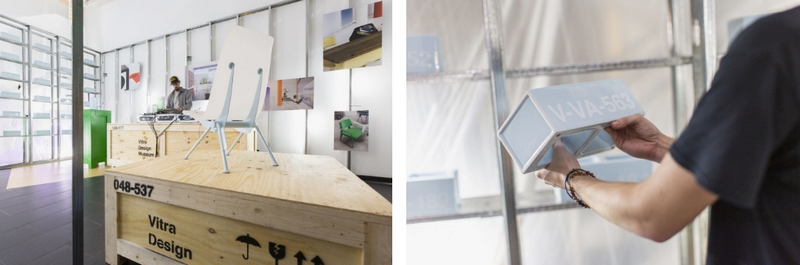
In 2019, Vitra and Virgil Abloh presented the installation TWENTYTHIRTYFIVE, his vision of a future home, in the
Fire Station on the Vitra Campus. Three products developed by the American architect, artist and designer were
launched in a limited edition as spin-offs of the exhibition. Vitra and Virgil Abloh are now presenting an edition of
limited pieces available to consumers globally through the online marketplace Basic.Space. The collection was
unveiled during Design Miami as part of an installation hosted by Basic.Space.
Virgil Abloh is known for pushing boundaries and using creativity to communicate socio-political messages, while
Vitra has a long history of undertaking experimental projects with designers, architects and artists that test the
limitations of design’s predicted norms. The Virgil Abloh c/o Vitra collaboration invites people of all generations
and backgrounds to have conversations about both social issues and design topics.
‘I feel that it’s urgent, as designers, to make sure that design doesn’t leave out the 17-year-old boy who has no clue
about art ordesign history,’ explains Virgil Abloh. ‘My hope for this collaboration is to further strengthen this bond
with the new generation, providing them with further inspiration, as well as room for thought and a sense of
inclusion. This collaboration invites the new generation into the conversation – my work is meant to open doors for
them.’
‘What I find particularly inspiring about Virgil Abloh is that he comes to the table as an outsider, with a fresh look at
our collection and a different pace, free of constraints,’ says Nora Fehlbaum, Vitra CEO. ‘I’m interested in the way
that he structures knowledge and passes it on to a new generation in such a condensed manner. He manages to
shift the topic of design classics away from the discourse of an intellectual elite to make them accessible to a wider
public.’
The spin-off collection is related to an earlier collaboration that dropped during Art Basel in 2019 on the Vitra
Campus in Weil am Rhein, Germany, involving the futuristic exhibition TWENTYTHIRTYFIVE. The three pieces – a
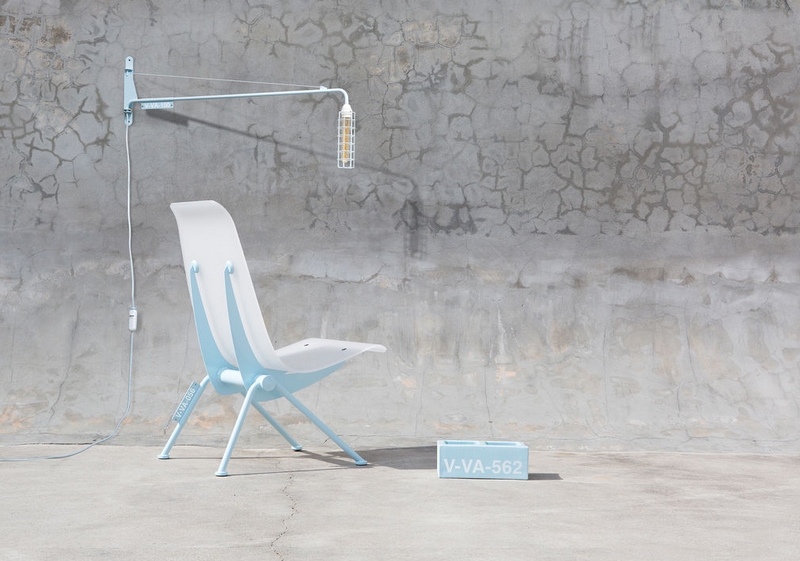
Ceramic Block, along with the Petite Potence lamp and Antony armchair originally designed by Jean Prouve´ – are
now reimagined in baby blue. The ‘hacked’ Prouve´ pieces demonstrate how the power ofdesign can evolve in
order to speak to a new generation.
Virgil Abloh’s artistic intervention focuses on the interaction between an adolescent and his home surroundings. On
one hand, it looks at how the evolution of technology and changes in society might affect our homes, touching on
such themes as sustainability by means of recycling, dematerialisation and overabundance – or as Abloh
suggests: ‘It’s arguable whether we will even have a need for furniture by 2035.’ On the other hand, it addresses the
degree to which our environment influences our life path, our tastes and the decisions we make over time. ‘My
studio has an ambition that the world can be a better place. Aesthetics will be impacted by the events of 2020, and
in my mind, things will have to mean and represent something, and the meaning of the world is now getting
recalibrated,’ says Abloh.
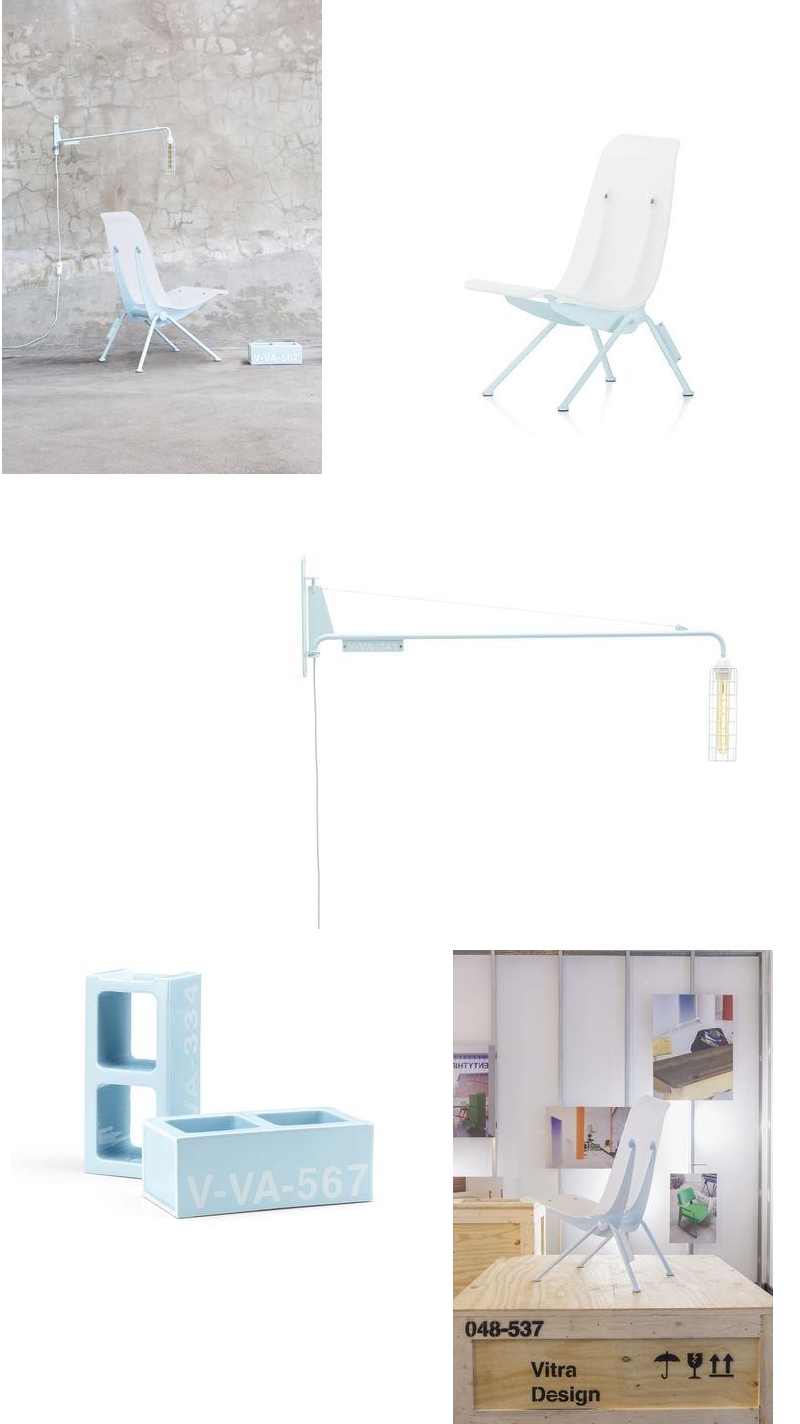
2035 US Edition Virgil Abloh c/o Vitra. The products:
Ceramic Block
In the installation ‘2035: US Edition Virgil Abloh c/o Vitra, the visitor’s gaze is directed to the future with a wall of
consecutively numbered bricks: the Ceramic Blocks. These glazed ceramic objects are not just a structural
element but also take on a life of their own as storage objects in Virgil Abloh’s exhibition concept. The limited
edition comprises 999 Ceramic Blocks, in baby blue, each with a noticeable numeral that makes it unique. They
can either be purchased directly from the Basic.Space ‘gallery’, modifying the installation with every block that is
acquired, or ordered from the curated online marketplace Basic.Space.
Petite Potence
Jean Prouve´ created the Potence wall lamp for his home in Nancy in 1942, and the design was soon produced in
a range of sizes. Virgil Abloh is fascinated by the industrial clarity of this concept and integrates the smaller Petite
Potence in his installation. He has accentuated the industrial DNA of the design with a baby blue lacquer finish that
gives it a new visibility, while a striking LED bulb in an oblong cage further enhances the appearance. Virgil
Abloh’s version of Petite Potence is available in a limited and numbered edition of 150 pieces.
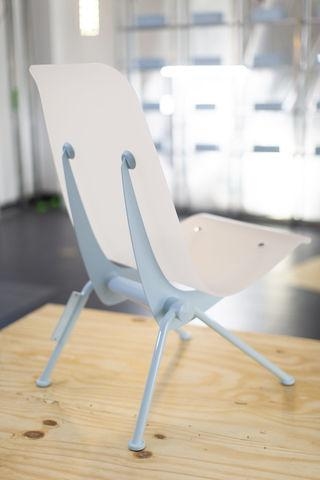
Antony
The armchair Antony was developed by Jean Prouve´ in the early 1950s for the university halls of residence in
Antony near Paris. With its dynamically curved wooden shell and characteristic metal base, this small armchair
was one of the French designer’s last furniture creations. Virgil Abloh pays tribute to the iconic design with an
updated version in his installation. He has transformed the armchair by giving it a frosted plexiglass shell, which is
further accentuated by a baby blue lacquer finish. This version is available in a numbered edition limited to 150
pieces.